A merchant account is the financial backbone that lets your business accept debit cards, credit cards, and many forms of digital payments. Without a properly set up merchant account, you’re limited to cash, checks, or peer-to-peer apps that aren’t designed for serious business use, especially as your volume grows.
In a world where card and digital payments make up the majority of in-person and online transactions, a modern merchant account is no longer a “nice to have” but a fundamental piece of your revenue engine.
Unlike a standard business bank account, a merchant account is a specialized account that temporarily holds card payments while your processor runs authorization checks, screens for fraud, and moves money across card networks.
Once the payment is cleared, funds are transferred from the payment processing account into your main business bank account, usually within one to three business days. This separation helps manage risk for banks and payment processors while giving you a streamlined way to accept customer payments in-store, online, or on mobile devices.
A merchant account is part of a larger payments ecosystem that also includes payment gateways, card networks like Visa and Mastercard, issuing banks, acquiring banks, and sometimes payment facilitators or aggregators like PayPal or Stripe.
Your merchant account acts as the bridge between your business and this ecosystem. When it’s properly configured, your payment processing account can help you lower costs, reduce chargebacks, increase approval rates, and give customers a faster, smoother checkout experience.
As digital wallets, contactless payments, and real-time rails become more common, the role of the payment processing account is evolving. Providers are bundling merchant accounts with POS systems, eCommerce tools, analytics, and risk management in one platform.
Understanding what a merchant account is and how to choose the right one puts you in a strong position not only for today’s payment landscape, but also for emerging trends like instant payouts, AI-driven fraud detection, and open banking.
Understanding the Basics of a Merchant Account
A merchant account is a type of business bank account that allows your company to accept card and electronic payments and route them safely into your regular business bank account. When a customer pays with a card or digital wallet, the money does not go directly into your business bank account.
Instead, the transaction first passes through your payment processing account, where it is held while card networks and banks complete authorization, settlement, and risk checks.
One way to think of a merchant account is as a secure staging area for your incoming revenue. The merchant account sits between your customer’s bank and your business bank, managed either by your acquiring bank or a payment processor that sponsors your business.
This structure makes it possible to handle refunds, chargebacks, and disputes while keeping your main bank account separate from the day-to-day flow of card authorizations and reversals. The payment processing account structure also enables different pricing models, including interchange-plus, tiered, and flat-rate pricing.
A modern merchant account usually comes bundled with merchant services such as a payment gateway, virtual terminal, card terminals, mobile readers, and sometimes full POS systems. Many providers also include tools for recurring billing, invoicing, and subscription payments, making your payment processing account a central hub for all your payment channels.
When comparing providers, it’s important to look not just at the merchant account itself, but the entire ecosystem of hardware, software, and support that surrounds it.
Because a merchant account exposes banks and processors to risk, providers perform underwriting and ongoing monitoring. They look at your industry, chargeback history, processing volume, and business practices.
Some industries, such as travel, gambling, or high-ticket online sales, may be classified as high-risk and require a specialized high-risk merchant account with different pricing and reserve requirements. Knowing how your business is categorized helps you choose a realistic and sustainable merchant account setup.
What Exactly Is a Merchant Account?
At its core, a payment processing account is a contractual relationship between your business, an acquiring bank, and often a payment processor, allowing you to accept card payments under the rules of the major card networks.
Legally, it’s more than just a bank account; it’s an agreement that you will follow card association rules, maintain security standards like PCI DSS, and manage chargebacks within defined thresholds.
In exchange, your acquiring bank and processor commit to routing funds from approved card transactions into your merchant account and then into your main business bank account.
Technically, when you run a transaction, your customer’s issuing bank doesn’t send money straight to your business. The issuing bank sends funds to your acquiring bank through the card network after authorization and clearing.
Your acquiring bank or processor uses your payment processing account to receive those funds. Then, after fees and interchange costs are deducted, the net amount is settled into your business bank account. This behind-the-scenes process is why a merchant account is often described as a “holding” or “settlement” account for card payments.
A merchant account can be structured as a dedicated account for your business or provided under an aggregator model where your payments are pooled under a master merchant account.
In both cases, the core purpose of the payment processing account is the same: to make card and digital payments possible while protecting the financial system from fraud, excessive chargebacks, and non-compliant merchants.
From your perspective, the merchant account is your gateway to getting paid reliably across in-person, online, and recurring billing environments. Because a payment processing account sits at the intersection of banking, card network rules, and technology, the details can feel complex.
However, if you remember that a merchant account is the controlled environment where card transactions are received, checked, and passed through to your bank, the concept becomes much easier to manage.
Once you understand that, you can focus on negotiating better pricing, reducing risk, and picking the right provider to support your growth.
Key Players Involved in a Merchant Account
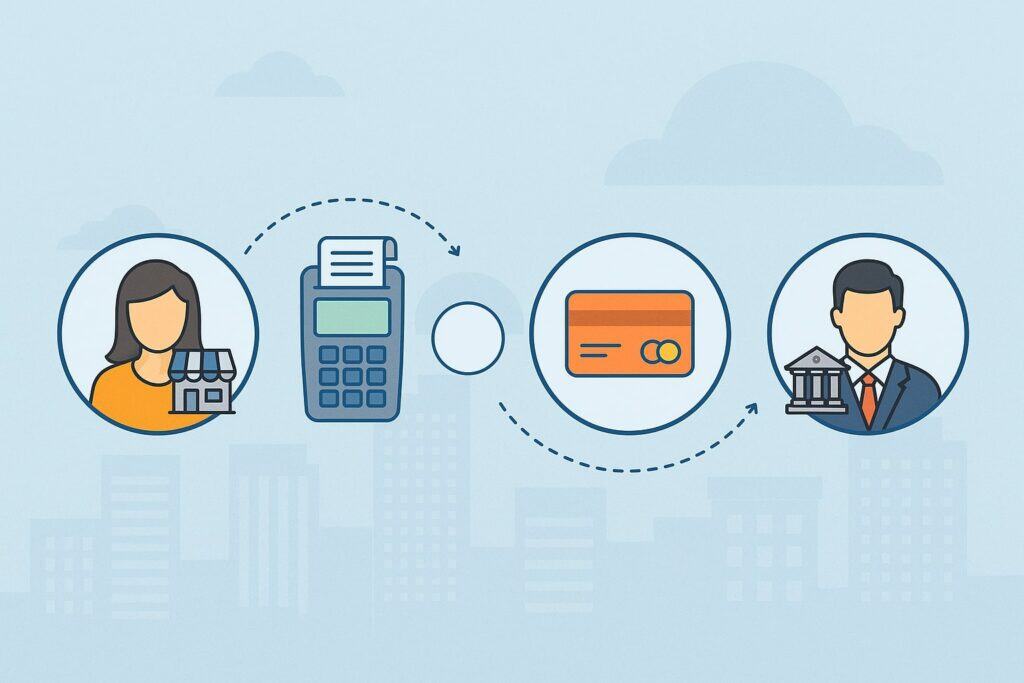
Every payment processing account operates within a network of players that each have a specific role. First is the merchant—your business—which accepts the payment. Then there is the acquiring bank, which provides and manages your merchant account.
The acquiring bank is responsible for settling transactions on your behalf and is ultimately liable to the card networks for your activity. Because your acquiring bank carries this risk, it underwrites your payment processing account and sets rules around fees, reserves, and acceptable chargeback levels.
Next, you have the payment processor or merchant service provider. Sometimes this is the acquiring bank itself; other times it is a separate company working as an ISO/MSP (independent sales organization/member service provider) registered with the card networks.
The processor connects your payment processing account to payment gateways, terminals, and card networks, routing transactions, applying fraud filters, and generating the batch files that ultimately move money into your merchant account. Increasingly, processors bundle merchant accounts, gateways, and POS systems into one integrated platform.
On the customer side sits the issuing bank—the bank that issued your customer’s card. When you run a transaction through your payment processing account, the issuing bank is asked to approve or decline based on cardholder balance, credit limit, fraud rules, and card network rules.
The card networks themselves (such as Visa, Mastercard, American Express, and Discover) provide the rails that connect issuers and acquirers, define interchange rates, and enforce operating regulations that your merchant account must follow.
Finally, there are technology partners such as payment gateways, fraud detection tools, 3-D Secure providers, and POS software vendors. These systems integrate directly with your payment processing account and processor so you can accept payments in multiple environments—retail, eCommerce, mobile, and subscription billing.
Knowing who these players are and how they interact through your merchant account makes you a more informed buyer when you choose providers, negotiate contracts, or troubleshoot payment issues.
How a Merchant Account Works from Swipe to Settlement
From the moment a customer taps a card or enters details on your website, your merchant account orchestrates a multi-step process to move money securely. This journey has three main phases: authorization, clearing, and settlement.
While these might sound technical, the entire process typically happens in seconds for the customer and in one to three business days for the funds to reach your bank account. Understanding these steps helps you see why merchant accounts require underwriting, charge fees, and enforce security rules.
First, your POS terminal or payment gateway captures card data and sends an authorization request through your processor to the card network, which routes it to the issuing bank.
The issuing bank checks the card’s status, available funds, and risk signals and then approves or declines the transaction. Your customer sees “approved” or “declined,” but behind the scenes, your payment processing account is being used to log the transaction for later settlement.
Next, approved transactions are grouped into a batch. When you “close the batch” or your system auto-settles, those transactions move into the clearing and settlement phase. The card networks calculate interchange fees and route funds from issuing banks to your acquiring bank.
Your acquiring bank deposits the net amount—after interchange, assessment fees, and your processor’s markup—into your merchant account. Finally, your processor sends the funds from your merchant account into your regular business bank account.
As faster payment rails like instant funding and real-time payments become more common, many providers now offer same-day or even near-real-time settlement options.
These features still depend on the structure of your payment processing account, but they shorten the time between authorization and availability of funds, which can improve cash flow for businesses with tight operating margins.
Expect the typical settlement window for merchant accounts to continue shrinking over the next few years as competition and new technology push providers toward faster payouts.
Authorization, Authentication, and Risk Checks
During the authorization stage, your merchant account is responsible for initiating the request that determines whether a transaction is allowed to proceed. When a customer pays, your POS terminal or gateway encrypts the card data and sends an authorization message through your processor to the card network and then to the issuing bank.
The issuing bank evaluates the transaction in real time based on card status, spending patterns, available credit, and internal fraud models. The response—approved, declined, or referred—is returned through the same path to your merchant account.
Modern merchant account setups also leverage additional authentication layers such as EMV chip technology, tokenization, and 3-D Secure for eCommerce. These technologies help confirm that the card is genuine and the customer is legitimate.
For example, EMV chips make it harder to clone cards in card-present environments, while 3-D Secure can require step-up authentication like one-time passwords for risky online transactions. If your merchant account is configured correctly, these tools can reduce chargebacks and qualify more transactions for lower interchange categories, saving you money.
Risk checks don’t stop after the initial authorization. Many processors that power your merchant account continuously monitor transactions for patterns that suggest fraud or abuse. They may flag unusually large purchases, spikes in refunds, or a sudden increase in card-not-present transactions.
As AI-driven fraud tools advance, your merchant account is increasingly becoming a dynamic risk-management system, not just a passive settlement account. Over the next few years, expect to see more customizable risk profiles and real-time risk scoring built into merchant account dashboards.
For you as the merchant, understanding authorization and authentication helps explain why some banks decline transactions that look perfectly valid to you, or why some cross-border and card-not-present transactions attract higher fees.
When you know how your merchant account handles risk, you can work with your provider to adjust fraud settings, add tools like address verification and CVV checking, and reduce false declines without opening the door to actual fraud.
Clearing, Settlement, and Funding Timelines
Once a transaction is authorized, your merchant account enters the clearing and settlement phase. Clearing is the process by which the details of approved transactions are sent to the card networks and then to issuing banks for final posting to cardholder accounts.
This usually happens after you submit a batch, either manually at the end of the day or automatically at a scheduled time. Your processor assembles all authorized transactions linked to your merchant account into settlement files that card networks can process.
During settlement, the card networks calculate interchange fees and assessments and net those amounts from the funds routed from the issuing banks to your acquiring bank. Your acquiring bank then posts the net proceeds to your merchant account.
Depending on your agreement, funds from your merchant account are swept into your business bank account within a specified funding window, often next-day or two-day funding. High-risk industries or new merchants may have longer funding cycles or rolling reserves, where a portion of funds stays in the merchant account as a buffer against chargebacks.
Funding timelines are becoming a competitive differentiator. Many providers now advertise instant or same-day payouts, which rely on a combination of more sophisticated risk modeling and new payment rails.
In practice, these accelerated funding services are still anchored to your merchant account structure, but they shorten the time your money sits in transit. They can be especially valuable for small businesses with tight cash cycles, gig-economy merchants, or seasonal sellers who need faster access to funds.
From a practical standpoint, understanding settlement helps you reconcile your statements. Your merchant account statements will show gross sales, refunds, chargebacks, interchange, processor markup, and net deposits.
When you know how clearing and settlement work, you can match these reports to the deposits you see in your business bank account, spot discrepancies early, and evaluate whether your current merchant account setup is cost-effective and aligned with your cash-flow needs.
Types of Merchant Accounts and Service Models
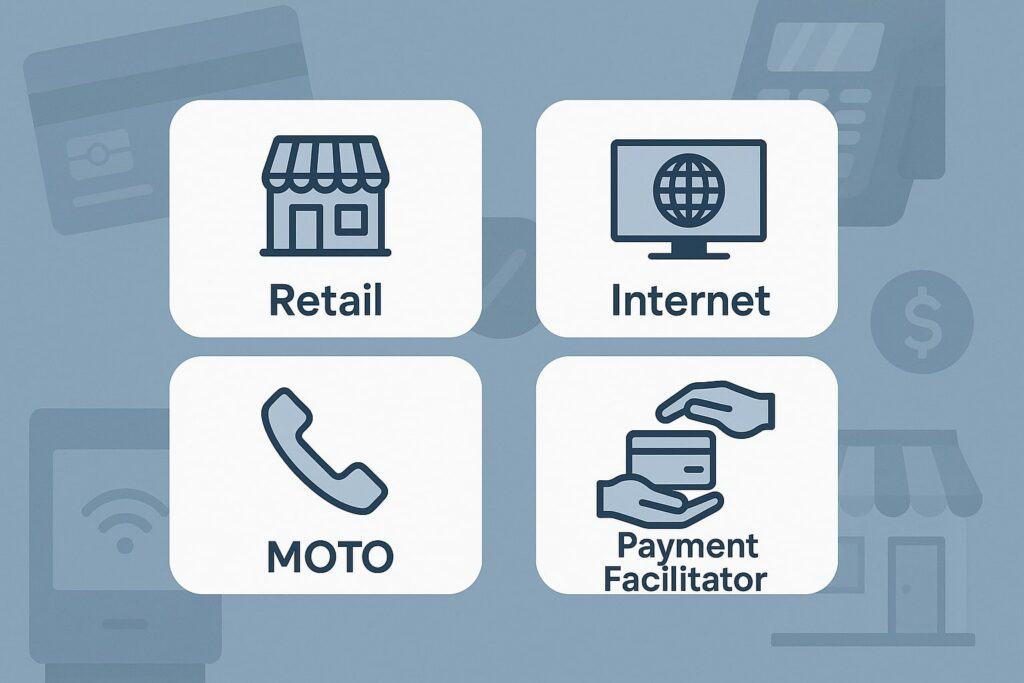
Not all merchant accounts are built the same. The way your merchant account is structured has a direct impact on your costs, risk profile, funding speed, and flexibility across payment channels. At a high level, you can divide merchant account setups into dedicated merchant accounts and aggregated models.
On top of that, you’ll find specialized high-risk merchant accounts for industries with higher chargeback rates or regulatory complexity. Knowing which category fits your business helps you choose providers that match your risk profile and growth plans.
A dedicated merchant account is issued specifically for your business by an acquiring bank, usually through a processor or ISO. This gives you more control over pricing, chargeback thresholds, and funding timelines, but it also requires deeper underwriting.
Aggregated models, on the other hand, place your transactions under a master merchant account owned by a large payment facilitator. These models are popular for very small or new merchants because they offer fast onboarding and simple flat-rate pricing, though they may come with higher fees and less control.
In addition, some industries are labeled high-risk by acquiring banks due to higher rates of fraud, chargebacks, or regulatory complexity. These businesses often need specialized high-risk merchant accounts that include stricter monitoring, higher fees, and sometimes reserves.
While these accounts can be more expensive, they still provide a vital lifeline for businesses that would otherwise be shut out of mainstream payment processing.
Service models are also evolving quickly. Many modern providers now bundle merchant accounts with omnichannel POS systems, invoicing tools, subscription billing, and online store platforms.
In the coming years, expect merchant accounts to be even more integrated with inventory management, loyalty systems, and analytics dashboards, giving merchants a unified view of sales and customer behavior across channels.
Traditional Dedicated Merchant Accounts
Traditional dedicated merchant accounts are customized accounts set up specifically for your business with an acquiring bank. This model has been the standard for decades. It involves a more detailed application and underwriting process, where the bank reviews your credit, business history, industry type, and estimated processing volume.
In exchange for this scrutiny, you gain a direct relationship with an acquirer and processor, which can lead to better pricing and more flexible terms as your volume grows.
Because dedicated merchant accounts are tailored to your risk profile, they can offer advantages in interchange-plus pricing and negotiation. You can often work with your provider to optimize your setup for specific transaction types—such as card-present retail, eCommerce, B2B Level II/III processing, or recurring billing.
Dedicated merchant accounts also make it easier to integrate advanced tools like tokenization, account updater services, and custom risk scoring. For higher-volume merchants, the ability to fine-tune these details can translate into significant savings.
The trade-off is that dedicated merchant accounts can take longer to approve and may be more complex to manage. You’ll need to complete detailed paperwork, provide financial statements, and sometimes accept reserve requirements if your industry is considered higher risk.
However, once your dedicated merchant account is in place, you have a scalable infrastructure that can grow with your business, support multiple MID structures, and handle more sophisticated reporting and reconciliation needs.
In the future, dedicated merchant accounts are likely to remain the preferred option for larger or more established businesses that care about pricing transparency, control, and specialized features.
As APIs and cloud-based processors mature, dedicated merchant accounts will become easier to integrate with custom software, ERPs, and data warehouses, giving finance and operations teams deeper insight into payment performance and customer behavior.
Payment Aggregators and All-in-One Solutions
Payment aggregators, also called payment facilitators (PayFacs), offer merchant account services by placing many small merchants under a single master merchant account. When you sign up for services like PayPal, Square, or Stripe in their simplest form, you are usually operating as a sub-merchant under their aggregated structure.
This model lets you start accepting cards almost immediately with minimal underwriting, simple flat-rate pricing, and pre-built integrations for online checkouts, invoicing, and mobile payments.
For startups, freelancers, and very small businesses, aggregator-based merchant accounts can be attractive because they remove friction. You don’t have to negotiate complex pricing tables or understand interchange categories.
The aggregator takes on the heavy lifting of risk, compliance, and PCI obligations, passing costs back to you through higher, but predictable, transaction fees.
Many of these platforms bundle additional features like POS software, inventory management, appointment booking, and online store templates, making the merchant account part of a broader business toolkit.
However, aggregators also have trade-offs. Because you are sharing a master merchant account, funds may be held more frequently if the platform detects unusual activity.
Chargeback disputes can feel less flexible, and you may have limited control over how disputes are handled. As your volume grows, you may find flat-rate pricing expensive compared to a dedicated merchant account with interchange-plus pricing. Many businesses start with an aggregator-based merchant account and later graduate to a dedicated account as they scale.
Looking ahead, expect aggregators to continue innovating with embedded finance features, such as built-in lending, instant payouts, and advanced analytics.
Even if you eventually move to a dedicated merchant account, understanding how PayFacs structure their services will help you compare options and choose the merchant account model that best fits your growth stage and risk tolerance.
High-Risk and Specialized Merchant Accounts
Some businesses operate in industries that banks classify as high-risk, meaning they are more likely to experience fraud, chargebacks, or regulatory scrutiny.
Examples include travel, subscription boxes, adult content, certain financial services, nutraceuticals, and gambling, among others. These businesses often require specialized high-risk merchant accounts, which are still merchant accounts but with stricter underwriting, higher pricing, and extra risk controls.
A high-risk merchant account may include measures such as rolling reserves, where a percentage of your daily card volume is held back for a period to cover potential chargebacks. Funding timelines may be longer, and chargeback fees can be higher.
On the positive side, these specialized merchant accounts make it possible for high-risk businesses to operate legitimately within the card network ecosystem instead of relying on unstable or non-compliant alternatives.
Choosing an experienced high-risk provider is crucial, since they understand your industry’s patterns and can help you keep chargebacks within network limits.
Specialized merchant account programs are also growing for B2B and government payments, where Level II and Level III data can significantly reduce interchange costs. These setups require passing enhanced data—like tax amounts, purchase order numbers, and line-item details—through your gateway.
When properly configured, a B2B-optimized merchant account can unlock lower interchange tiers and produce substantial savings on large invoices, making them attractive to manufacturers, wholesalers, and service providers.
As regulatory expectations rise and industries evolve, expect more niche merchant account offerings tailored to subscription businesses, marketplaces, platforms, and cross-border eCommerce.
These will blend specialized risk models, dynamic currency conversion, marketplace split payouts, and compliance tooling into unified merchant account solutions designed for complex, digital-first business models.
Why Your Business Needs a Merchant Account
A merchant account isn’t just a technical requirement; it’s a key driver of revenue, customer trust, and operational efficiency. Today’s customers expect to pay with credit cards, debit cards, and digital wallets, whether they’re standing at your checkout counter, ordering on their phones, or paying an invoice online.
If you only accept cash or checks, you’re creating friction that can send customers to competitors. Studies consistently show that card usage now represents a majority of retail transactions, making a robust merchant account central to meeting customer expectations.
Beyond convenience, a merchant account can increase average ticket size. Customers tend to spend more when using cards compared with cash, and a smooth checkout experience reduces cart abandonment online.
Your merchant account enables recurring billing and subscriptions that provide predictable revenue, from membership plans to software subscriptions and service retainers. With the right configuration, your merchant account can support upsells, cross-sells, and loyalty programs that further boost revenue.
Operationally, a merchant account creates clearer audit trails and better reporting. All card transactions are logged with timestamps, authorization codes, and settlement details.
When integrated with your POS or accounting system, your merchant account data becomes a powerful source of insight into sales performance, customer behavior, and cash-flow trends. Instead of deciphering manual deposits, you get structured data that supports smarter planning and decision-making.
Security and compliance are another major reason you need a merchant account. Card networks and regulators impose strict requirements on how payment data is handled.
A reputable merchant account provider helps you meet PCI DSS obligations, implement encryption and tokenization, and manage chargeback risk. In an environment of rising cyber threats and fraud attempts, a well-managed merchant account is essential for protecting customer data and your brand reputation.
Customer Experience, Trust, and Revenue Growth
From your customer’s perspective, a merchant account is invisible—but the experience it enables is not. When your checkout process is smooth, fast, and supports multiple payment methods, it creates trust.
Customers associate the ability to pay with major cards and digital wallets with legitimacy and professionalism. If your business only takes cash or asks customers to send money through consumer peer-to-peer apps, some will hesitate, especially for higher-value purchases or online orders.
A well-configured merchant account lets you accept payments in the ways customers prefer: tap-to-pay at the counter, card-on-file for subscriptions, click-to-pay links in invoices, and one-click checkout for returning eCommerce customers.
Each of these experiences reduces friction, which directly influences your conversion rate and average order value. Customers who can seamlessly pay through their preferred method are more likely to complete the purchase and return in the future.
Trust is also reinforced by security signals. Using a recognized gateway, showing secure checkout badges, and implementing 3-D Secure or tokenization all depend on your merchant account setup.
These signals reassure customers that you take data security seriously. Over the long term, consistent, secure payment experiences strengthen your brand and encourage loyalty, which is cheaper than constantly acquiring new customers.
As real-time payments, digital wallets, and embedded finance options expand, your merchant account will increasingly be the engine behind personalized payment experiences.
You can expect more context-aware checkout flows that adapt to device type, purchase history, and risk profile, further boosting conversion and customer satisfaction. A forward-looking merchant account strategy positions you to take advantage of these shifts instead of playing catch-up.
Better Cash Flow, Reporting, and Business Control
Cash flow is the lifeblood of any business, and your merchant account directly impacts how quickly you receive funds from card sales. Compared with waiting for paper checks to clear, card transactions settled through a merchant account can reach your bank within one to two business days, sometimes faster.
This predictability helps you manage payroll, inventory purchases, and operating expenses with more confidence. For businesses with high daily volume, even a one-day improvement in funding speed can make a noticeable difference.
Your merchant account also centralizes reporting. Instead of reconciling many different payment tools manually, you can pull consolidated reports showing total sales, refunds, chargebacks, and fees.
When integrated with your POS or eCommerce platform, this data flows into your accounting system, reducing manual entry and error.
Over time, the historical data in your merchant account helps you identify trends such as peak selling hours, popular SKUs, and seasonal demand patterns. That insight drives better decisions about staffing, marketing, and inventory.
Control is another major benefit. With your own merchant account, you can choose risk settings, chargeback management tools, and gateway configurations that suit your business model.
You can route different transaction types through multiple MIDs, negotiate bespoke pricing as your volume increases, and switch gateways without losing your core acquiring relationship.
This flexibility is harder to achieve if you rely solely on consumer-grade payment apps that don’t give you deep access to payment settings or robust reporting.
As providers roll out more advanced dashboards, your merchant account will increasingly function as a control center for your revenue operations. Expect predictive cash-flow analytics, automated reconciliation, and machine-learning-based forecasting to become common features, helping you anticipate needs and optimize working capital.
Security, Compliance, and Chargeback Management
Security is one of the most important reasons to use a formal merchant account instead of improvised payment methods. Merchant account providers are required to follow PCI DSS standards and implement strong encryption, tokenization, and secure network practices to protect cardholder data.
By using their infrastructure, you reduce your own scope and risk, especially if you never store raw card data on your systems.
Chargebacks—when customers dispute transactions through their card issuer—are another major concern. Your merchant account includes defined procedures and timelines for responding to chargebacks, submitting evidence, and tracking outcomes.
Providers monitor your chargeback ratio, and card networks typically require merchants to keep chargebacks below 1% of monthly volume to avoid penalties or termination programs.
A good merchant account provider will offer tools and guidance to help you fight friendly fraud, improve descriptor clarity, and reduce disputes through better communication and policies.
Compliance also extends to anti-money laundering (AML), Know Your Customer (KYC) rules, and industry-specific regulations. Your merchant account provider performs KYC checks during onboarding and may periodically request updated information.
While these steps can feel tedious, they are essential for maintaining access to the card networks and protecting your business from being associated with unlawful activity.
Looking ahead, expect your merchant account to integrate more advanced fraud and compliance tools by default. AI models that analyze transaction behavior, device fingerprints, and geolocation will help flag suspicious activity earlier.
At the same time, authentication tools like 3-D Secure 2.0 and tokenized wallets will become even more important for reducing fraud while keeping checkout experiences smooth. Working closely with your merchant account provider keeps you ahead of these trends and reduces your exposure to evolving threats.
Costs, Fees, and Pricing Structures
Every merchant account comes with costs, and understanding them is crucial to protecting your margins. Fees fall into three broad categories: interchange fees set by the card networks, assessments and scheme fees, and the processor’s markup. Interchange varies based on card type, transaction method, and data quality.
For example, card-present EMV transactions often qualify for lower rates than keyed or eCommerce transactions, and B2B payments with Level II/III data can qualify for specialized pricing. Your merchant account provider passes these interchange costs through to you in different ways depending on the pricing model.
On top of interchange, many merchant accounts have periodic fees such as monthly statement fees, PCI compliance fees, monthly minimums, and annual fees. There may also be per-item authorization fees, batch fees, chargeback fees, and retrieval fees.
Some providers package many of these into a simple flat-rate structure, while others itemize each cost. Neither approach is inherently good or bad; the best merchant account pricing structure for you depends on your average ticket, monthly volume, and transaction mix.
Because fees can be complex, merchants sometimes focus only on the headline rate, such as “2.9% + $0.30.” That can be a mistake if your business is large enough to benefit from interchange-plus or if your transaction mix leans toward lower-cost debit cards.
A careful review of your merchant account statements and pricing model can reveal opportunities to renegotiate or optimize how transactions are submitted, potentially saving thousands per year.
In the future, as real-time payments and alternative rails grow, expect more dynamic pricing options in merchant accounts. Providers may offer blended plans that include cards, account-to-account payments, and digital wallets under a unified pricing structure.
Merchants who understand their merchant account costs today will be better positioned to compare these emerging options and design a payment strategy that balances acceptance, conversion, and profitability.
Common Merchant Account Fees Explained
A typical merchant account includes several recurring and transactional fees. The most basic is the discount rate, which covers interchange, assessments, and processor markup.
Discount rates can be expressed as a single blended percentage or broken out under interchange-plus pricing. On top of that, there is usually a per-transaction authorization fee, which applies every time you send a transaction for approval, whether it is ultimately accepted or not.
Many providers charge a monthly statement or account fee to cover the cost of reporting and customer support. There may also be a monthly minimum, meaning if your combined fees for the month don’t reach a certain threshold, you pay the difference.
Annual fees are less common than they once were but still appear, sometimes bundled with PCI compliance programs or security tools. Batch fees may apply each time you settle a batch of transactions from your terminal or gateway.
Chargeback fees are another important line item. Whenever a customer disputes a transaction, your merchant account provider charges a fee to cover investigation and processing, regardless of the outcome.
Excessive chargebacks can also lead to penalty fees or higher pricing. Other possible fees include gateway fees for online processing, terminal rental fees, non-compliance fees if you fail to complete PCI validation, and early termination fees if you break a contract before its end date.
To avoid surprises, it’s essential to request a full fee schedule when setting up your merchant account and review your first few months of statements carefully. Over time, your goal should be to minimize “junk” fees, keep chargebacks under control, and focus your attention on the main drivers of cost: transaction fees and discount rates.
Once you understand where your money is going, you can negotiate better terms or adjust your payment flows to take advantage of more favorable interchange categories.
Pricing Models: Tiered, Interchange-Plus, and Flat-Rate
Merchant account providers typically use one of three pricing models: tiered, interchange-plus, or flat-rate. Under tiered pricing, your merchant account transactions are bucketed into “qualified,” “mid-qualified,” and “non-qualified” tiers, each with its own rate.
While this model is easy to quote, it can be opaque. Different providers define tiers differently, and many transactions may fall into higher tiers without you understanding why.
Interchange-plus pricing is more transparent. Your merchant account statements show the actual interchange cost for each transaction plus a fixed markup (for example, interchange + 0.20% + $0.10).
This model can be advantageous for businesses with higher volume or a favorable transaction mix, such as many regulated debit transactions or B2B payments with enhanced data. Interchange-plus makes it easier to see whether your provider’s markup is competitive and to compare different merchant account offers.
Flat-rate pricing, popular with aggregators and all-in-one platforms, charges a single rate (such as 2.9% + $0.30) for most transactions. This simplifies budgeting and is attractive for small or seasonal merchants.
However, as your volume grows or your transaction mix shifts toward lower-cost debit cards, flat-rate pricing can become more expensive than a well-negotiated interchange-plus merchant account. Some providers offer hybrid models, blending flat-rate for certain channels with interchange-plus for others.
Over the next few years, expect more flexible pricing options as providers compete on transparency and value. Dynamic merchant account pricing that adapts based on volume tiers, payment method mix, and risk scores is likely to become more common.
Merchants who understand the strengths and weaknesses of each pricing model today will be best positioned to take advantage of these new structures.
Practical Ways to Reduce Your Merchant Account Costs
Reducing the cost of your merchant account starts with understanding your data. Pull a few months of statements and analyze your effective rate by dividing total fees by total processed volume.
Then look at your transaction mix: card-present vs. card-not-present, debit vs. credit, rewards vs. basic cards, and average ticket size. This snapshot shows how your current pricing model interacts with your actual processing behavior.
One of the easiest ways to lower costs is to optimize how transactions are submitted. For card-present sales, always use chip or contactless instead of manual keying whenever possible, as these typically qualify for better interchange.
For online transactions, enable tools like AVS (address verification) and CVV checking, and ensure you send all required data fields. For B2B payments, work with your provider to implement Level II/III data through your gateway so your merchant account can qualify for lower corporate and purchasing card interchange categories.
Negotiation is another key lever. Once you understand your volume, chargeback history, and risk profile, you can ask your provider for better interchange-plus markups or reduced flat-rate pricing.
If your current merchant account is locked into an unfavorable tiered model, you can request a switch or compare offers from other providers. Be sure to factor in non-rate items such as contract terms, early termination fees, and support quality when evaluating alternatives.
Finally, keep an eye on chargebacks and fraud. High dispute levels can lead to penalty programs and higher pricing. Use your merchant account tools—fraud filters, clear descriptors, refund policies, and chargeback alerts—to keep disputes within acceptable limits.
Over time, a clean chargeback record combined with strong processing volume gives you leverage to negotiate better terms and keep your merchant account costs as low as possible.
How to Get a Merchant Account
Applying for a merchant account is similar to applying for other financial services: you provide information about your business, the provider evaluates your risk, and if approved, you receive credentials to start processing.
The process can be as quick as a few minutes with aggregator-style providers or a few days to a couple of weeks with dedicated acquiring banks, especially for higher-risk industries.
Understanding what underwriters look for and how to prepare your documentation can significantly improve your chances of fast approval with strong terms.
The first step is to clarify your needs. Decide whether you require in-person terminals, an online gateway, mobile readers, recurring billing, or marketplace payout capabilities. These requirements help you choose between simple aggregator solutions and more customizable dedicated merchant accounts.
It’s also useful to estimate your monthly processing volume, average ticket size, and the types of cards you expect to accept. Providers use this information to design a merchant account profile and set initial risk parameters.
Next, you complete an application that includes business information, ownership details, bank account information, and sometimes financial statements or tax returns. Underwriters use this data to perform KYC checks, evaluate creditworthiness, and determine whether your business fits their risk appetite.
Once approved, you’ll receive a merchant identification number (MID), gateway credentials, and instructions for setting up terminals or integrating with your website. From that point, your merchant account is live and ready to process.
Over time, your merchant account provider may re-evaluate your account based on actual processing patterns. If your volume grows significantly or your chargeback levels rise, they may adjust pricing, request additional documentation, or update risk controls.
Maintaining open communication and strong operational practices helps ensure your merchant account remains in good standing and can support your business as it evolves.
Eligibility, Risk, and Underwriting
Merchant account underwriting is primarily about risk. Providers want to know whether your merchant account will generate excessive chargebacks, fraud, or regulatory exposure.
They examine your industry, product types, refund policies, marketing practices, and prior processing history. High-ticket items, future-delivery products (like travel or custom goods), and subscription models are often scrutinized more closely because they are more likely to produce disputes.
Underwriters also look at personal and business credit, especially for small or new businesses. A strong credit history signals financial responsibility and lowers perceived risk. If your credit is limited or challenged, you may still get a merchant account but with tighter limits, rolling reserves, or higher fees.
Some providers specialize in working with newer merchants or those rebuilding credit, offering merchant accounts that can be upgraded as your risk profile improves.
Operational practices matter too. Clear terms and conditions, transparent pricing, realistic marketing claims, and accessible customer support reduce the likelihood of disputes.
Underwriters may review your website or storefront to ensure that your policies are visible and that your products comply with legal and card-network rules. A well-documented business with professional materials can make your merchant account application more attractive.
In the future, underwriting for merchant accounts will likely become more data-driven, using alternative data sources, payment history from other platforms, and real-time risk scoring.
This could make it easier for newer businesses to qualify quickly while still giving providers robust tools to manage risk. Being transparent and organized during the application remains the best way to ensure your merchant account is approved on favorable terms.
Step-by-Step Application Process and Documents Needed
To apply for a merchant account, you typically follow a structured process. First, you research providers and compare offerings based on pricing, contract terms, technology features, and support. Once you choose a provider, you complete an online or paper application.
This form collects basic business details such as legal name, DBA, business address, contact information, tax ID, and ownership structure. You’ll also specify the types of payments you plan to accept and the estimated monthly processing volume.
Next, you provide supporting documents. These often include a voided business check or bank letter to verify your deposit account, identification for owners (such as driver’s licenses or passports), and sometimes business formation documents like articles of incorporation or partnership agreements.
For more established businesses, underwriters may request financial statements, prior processing statements, or tax returns to assess stability. If your business is online, you’ll need a functioning website with clear product descriptions, terms, refund policies, and contact details.
Once the application and documents are submitted, underwriting begins. For low-risk industries and aggregator models, this may be largely automated and completed quickly. For traditional dedicated merchant accounts, human underwriters review your file, validate information, and possibly request clarifications.
If approved, you’ll receive a merchant identification number and any gateway or terminal credentials. You then integrate your POS or website, run test transactions if needed, and start processing live payments through your new merchant account.
It’s wise to carefully review your merchant account approval documents, including fee schedules, contract length, early termination clauses, and any reserve requirements. Clarify how and when you’ll receive funding and who to contact for support.
Taking an extra hour at this stage can prevent misunderstandings later and ensure your merchant account relationship starts on a clear, confident footing.
What to Watch Out for in Contracts and Terms
Merchant account contracts can be dense, but they are crucial. One of the first things to watch is contract terms and early termination fees. Some merchant account agreements have multi-year terms with automatic renewals and substantial penalties for early cancellation.
Others operate on month-to-month terms with no cancellation fee. Knowing your obligations upfront helps you avoid being locked into unfavorable arrangements.
Carefully review the fee schedule beyond the advertised discount rate. Look for monthly minimums, PCI fees, statement fees, batch fees, chargeback fees, and non-compliance penalties. Check whether rates are fixed or subject to change and under what conditions.
Pay attention to any clauses that allow the provider to impose reserves or hold funds in your merchant account if they perceive increased risk. These details affect your actual cost of accepting payments and your access to cash.
Another key area is chargeback and risk policies. Your merchant account agreement will outline how disputes are handled, the timelines for responding, and the thresholds that trigger additional scrutiny or account review.
Make sure you understand your responsibilities for providing evidence and the consequences if your chargeback ratio exceeds card-network limits. Strong internal policies and documentation can help you comply with these terms and avoid merchant monitoring programs.
Over time, expect merchant account contracts to become somewhat more transparent as competition and regulation push providers toward clearer disclosures. Even so, it’s always wise to read the fine print, ask questions, and compare at least two or three offers.
Treat your merchant account like any other critical vendor relationship: one that deserves careful due diligence and periodic review as your business grows.
Future of Merchant Accounts and Digital Payments
Merchant accounts are evolving rapidly as payment technology, consumer behavior, and regulation change. Instead of simply being a settlement mechanism, a merchant account is becoming a full-stack financial platform.
Providers are integrating real-time payments, digital wallets, buy-now-pay-later (BNPL), and account-to-account transfers alongside traditional card rails, all under a unified reporting and reconciliation framework. This means your future merchant account will likely support more payment methods with a single integration.
Real-time payments and instant funding are a major trend. As new payment rails mature, more providers will offer same-day and near-instant settlement options as standard features, not paid add-ons.
For merchants, this shortens the cash-conversion cycle and opens new possibilities for dynamic payouts, such as daily or even transaction-level deposits. Ensuring that your merchant account provider is investing in these capabilities can give you a long-term advantage.
Another trend is the rise of embedded finance and platform-based merchant accounts. Marketplaces, software platforms, and vertical SaaS providers are increasingly embedding merchant services directly into their offerings.
In these models, the platform itself may become a PayFac, offering its users sub-merchant accounts under a master structure. If your business runs on such a platform, your day-to-day interaction with the merchant account may be through that software rather than directly with a bank or processor.
Finally, AI and data analytics will reshape how merchant accounts handle risk, pricing, and customer insights. Expect more dynamic risk scoring, personalized offers, and predictive analytics built into your merchant account dashboard.
Over the next few years, the businesses that treat their merchant account not just as a payment utility, but as a strategic data asset, will be better equipped to optimize pricing, reduce fraud, and drive growth.
Frequently Asked Questions
Q.1: Do I Really Need a Merchant Account If I Use Payment Apps?
Answer: It can be tempting to rely solely on consumer-focused peer-to-peer payment apps, but a dedicated merchant account is still the right long-term solution for most businesses.
Peer-to-peer apps are designed primarily for personal transfers, and using them at scale for business can violate terms of service, limit your chargeback protections, and create messy bookkeeping. They also typically lack formal dispute workflows, detailed statements, and integrations with accounting or POS systems.
A merchant account, by contrast, is built for business needs. It gives you structured reporting, defined dispute processes, and predictable funding. It supports multiple channels: in-person, online, mobile, and recurring billing.
Importantly, a merchant account enables you to accept all major cards and digital wallets under a compliant framework that aligns with card-network rules and regulatory expectations. That means you can scale confidently without worrying that your payment method will suddenly be restricted.
From a customer-experience standpoint, a merchant account also delivers a more professional checkout. Customers expect to see card terminals, branded checkout pages, secure gateways, and familiar payment logos.
While peer-to-peer apps can be useful as supplementary options, especially in informal settings, they rarely replace the robustness and legitimacy of a merchant account. Over time, relying solely on consumer apps may cost you more in lost trust, manual work, and compliance risk than a properly configured merchant account ever would.
Q.2: How Long Does It Take to Get Approved for a Merchant Account?
Answer: Approval times for a merchant account vary based on provider type and your risk profile. Aggregator-style platforms can often approve basic accounts in minutes by using automated identity checks and risk scoring.
This speed is ideal for very small businesses, side hustles, or early-stage experiments. However, these quick approvals typically come with more generic pricing and less flexibility.
Traditional dedicated merchant accounts usually take longer because underwriters perform more detailed evaluations. For low-risk industries with straightforward business models, you might receive approval within one to three business days after submitting your documents.
For higher-risk industries or more complex setups—such as marketplaces, cross-border merchants, or high-ticket sellers—the process can take a week or more as the bank requests additional information and clarifications. Providing complete, accurate documentation from the start is the best way to speed things up.
The time between approval and actually processing live transactions also depends on how quickly you can configure terminals or integrate gateways. Some providers offer pre-configured hardware that ships ready to use, while others require more custom setup.
For online merchants, integration time depends on your platform and technical resources. In many cases, you can go from approved merchant account to first live transaction within a few days, especially if you’re using popular eCommerce platforms or turnkey POS solutions.
Q.3: Is a Merchant Account Safe, and How Do I Reduce Fraud?
Answer: A modern merchant account is designed with security in mind, but safety depends on both your provider’s infrastructure and your own practices.
Reputable providers operate under PCI DSS standards, use strong encryption, and offer tools like tokenization to protect stored card details. Many also provide built-in fraud filters, velocity checks, and risk scoring to help you block suspicious transactions before they settle.
To reduce fraud, start by enabling basic security features: AVS and CVV checks for card-not-present transactions, EMV chip acceptance for in-person sales, and secure, SSL-protected checkout pages online.
Consider using 3-D Secure for eCommerce to add an extra layer of authentication for risky orders. Monitor your merchant account reports regularly for unusual patterns, such as many small test transactions, spikes in refunds, or high-ticket orders from unfamiliar locations.
Operational policies matter just as much as technology. Make sure your refund and shipping policies are clear and prominently displayed, respond quickly to customer inquiries, and keep detailed records of orders, delivery confirmations, and communications.
These records are critical when you need to respond to chargebacks. Work closely with your merchant account provider to fine-tune fraud rules and dispute strategies.
Over time, combining strong internal processes with the security tools built into your merchant account will significantly reduce fraud risk while preserving a smooth experience for legitimate customers.
Conclusion
A merchant account is much more than a technical necessity for taking card payments. It is a strategic asset that touches revenue, customer experience, security, and cash flow.
When you treat your merchant account as a core part of your business infrastructure, you make more informed decisions about pricing, providers, and payment methods. That mindset can unlock higher conversion rates, better margins, and more predictable cash flow.
By understanding how a merchant account works—from authorization and settlement to pricing models and risk management—you gain leverage in negotiations and clarity in operations.
You can choose between dedicated and aggregated setups, optimize transaction data for better interchange, and implement tools that reduce chargebacks and fraud. Instead of accepting fees and declines as a black box, you can actively shape how your merchant account performs.
Looking ahead, merchant accounts will continue to evolve alongside digital payments. Real-time funding, AI-driven risk tools, embedded finance, and expanded support for digital wallets and account-to-account payments will all flow through your merchant account relationship.
Businesses that stay informed and choose providers committed to innovation will be best positioned to benefit from these trends.
If you’re serious about growth, now is the time to evaluate your current merchant account or set one up for the first time. Focus on clarity in fees, flexibility in features, and strength in security. With the right merchant account strategy, you turn payments from a back-office headache into a powerful engine for sustainable, scalable growth.
Leave a Reply