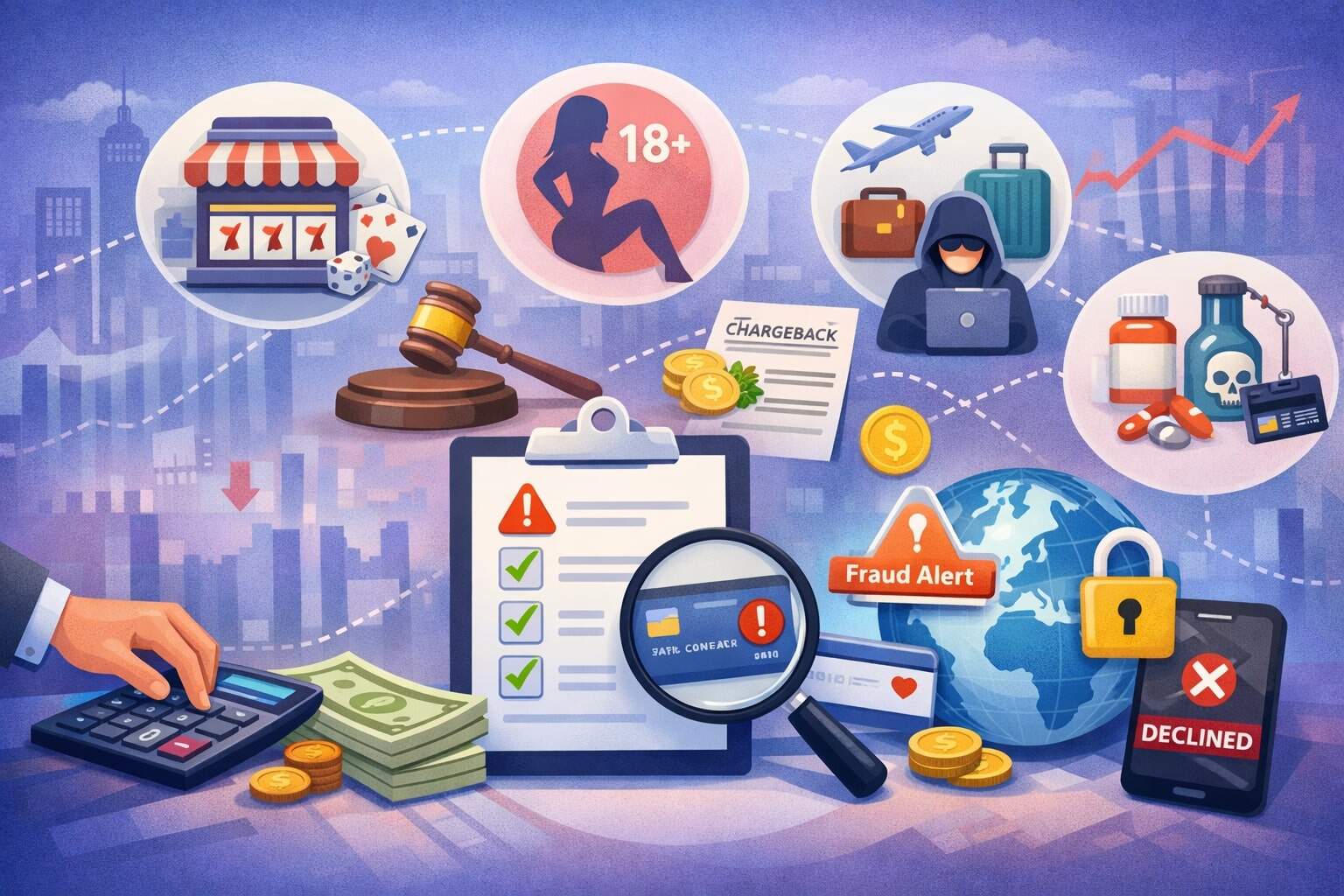
A high-risk merchant is a business that payment providers (acquirers, processors, sponsoring banks, and card networks) believe has a higher-than-average chance of creating losses, disputes, regulatory issues, or reputational damage in the payments ecosystem.
That “risk” can come from your industry, your business model, your billing practices, your chargeback and fraud rates, or even your operational maturity.
In practical terms, being labeled a high-risk merchant usually means tighter underwriting, more documentation, higher processing costs, rolling reserves, lower initial limits, and more monitoring.
This classification is not a moral judgment. It’s a pricing and control decision based on patterns: some verticals see more refund pressure, some products trigger “buyer’s remorse,” some marketing methods cause misunderstanding, and some delivery models make it easier for customers to dispute a transaction.
Card networks also run formal monitoring programs that push banks and processors to reduce excessive fraud and disputes—so risk controls aren’t optional for providers.
For example, Visa has been consolidating and updating its monitoring approach under the Visa Acquirer Monitoring Program (VAMP), including revised thresholds and a broader “payment integrity” view that combines disputes and fraud signals.
If you’re a high-risk merchant, the smartest path isn’t to “argue the label.” It’s to understand the risk categories, build a compliance-forward operation, reduce disputes, and document everything so underwriters can confidently support your growth.
This guide breaks down why high-risk merchant classifications happen, how risk categories work, and how to get approved and stay approved—with realistic future predictions based on where fraud, disputes, and security standards are headed.
How Payment Providers Decide You’re a High-Risk Merchant

Most people assume “high-risk merchant” only means “high chargebacks.” In reality, payment risk is multi-dimensional. Underwriting teams evaluate whether your transactions could result in losses for the provider due to disputes, fraud, fines, regulatory action, or sudden business failure.
Even if you’ve never processed before, your risk profile can be “high” because the provider is predicting what could happen once you scale.
A common underwriting lens is: Can this business deliver what it promises, at the quality promised, within the promised timeframe—while staying compliant—and can it survive refunds? If any part looks uncertain, you may be classified as a high-risk merchant.
Business model matters: subscription billing, trial-to-paid flows, continuity offers, and digital delivery often create higher dispute rates because the customer experience is easier to misunderstand and harder to “prove” later.
Marketing also matters. Aggressive claims, unclear pricing, or confusing checkout language can spike “friendly fraud” and buyer confusion, raising your high-risk merchant profile.
Providers also look at external pressure from the card networks. Network monitoring programs and compliance frameworks effectively force acquirers and processors to intervene early when disputes and fraud rise.
Visa’s updated VAMP approach reflects that the industry is moving toward combined metrics and ecosystem accountability, not just classic chargeback ratios.
Finally, security and data protection can affect risk classification. If your checkout, storage, or integrations increase the odds of card data compromise, providers see more exposure.
PCI Security Standards Council publications show ongoing updates to the PCI DSS framework (including v4.0.1 and supporting guidance), reinforcing that “security maturity” is now part of payments survivability—not a nice-to-have.
High-Risk Merchant vs. Low-Risk Merchant: The Practical Differences

The difference between a high-risk merchant and a low-risk merchant is mostly visible in cost, controls, and tolerance. A low-risk merchant usually gets fast approvals, stable pricing, minimal reserves, and higher initial limits.
A high-risk merchant typically gets deeper underwriting, higher fees, and more rules—because the provider is building cushions against uncertainty.
Cost differences you can feel immediately
A high-risk merchant is more likely to see higher discount rates, extra per-transaction fees, and additional monthly costs tied to monitoring, reporting, fraud tools, or chargeback mitigation.
Many providers also require a reserve, meaning they hold back a percentage of settlements for a period (or maintain a fixed reserve) to cover future refunds and chargebacks. Reserves are common in high-risk merchant accounts because disputes can arrive weeks after a sale, and subscription disputes can arrive months later.
Control differences that shape operations
High-risk merchant processing tends to include:
- Lower starting daily/monthly volume caps
- More frequent reviews (sometimes monthly)
- Stricter refund and cancellation rules
- More required descriptors, receipts, and customer service standards
- Monitoring tied to network programs and dispute ratios
Network and scheme pressures make “controls” increasingly standardized. Mastercard, for example, maintains merchant rules and compliance programs, and also publishes detailed chargeback and dispute process documentation that merchants are expected to align with operationally.
Tolerance differences when something goes wrong
A low-risk merchant might survive a short spike in disputes. A high-risk merchant is often on a shorter leash: if disputes, fraud, or refunds rise sharply, the provider may reduce volume, increase reserve, or terminate.
That’s why high-risk merchant success is less about getting approved and more about staying stable through seasonality, promotions, and growth.
The Core Risk Categories That Make a High-Risk Merchant
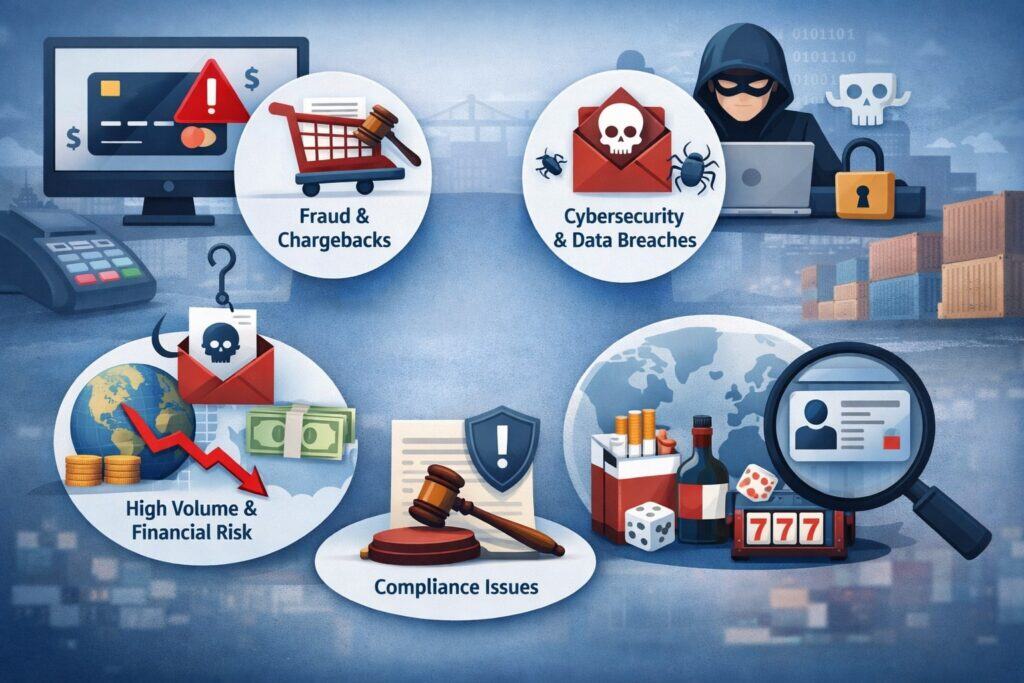
High-risk merchant classification usually comes from one (or more) of these categories. Underwriters often score each category, then decide overall risk tier and pricing.
Industry risk category
Some industries historically generate higher disputes, higher fraud, or heavier regulatory scrutiny. Providers price that exposure. Even within one industry, your exact product and claims matter. Two companies can share a category but get different decisions based on fulfillment and customer experience.
Business model risk category
Subscriptions, continuity, pre-orders, backorders, and high-ticket items can increase the likelihood of disputes. Digital services can also be riskier because “proof of delivery” is harder than shipping with tracking. If your model increases ambiguity, you may be treated as a high-risk merchant even if your vertical is not traditionally risky.
Transaction profile risk category
High average ticket size, high monthly volume, rapid scaling, international card usage, and card-not-present (ecommerce) patterns may increase risk. Card-not-present environments tend to have higher fraud exposure than in-person chip transactions, so underwriting is tighter and fraud tools matter more.
Compliance and reputational risk category
If your marketing, claims, or supply chain creates a chance of legal complaints, regulator attention, or brand damage, providers often classify you as a high-risk merchant to protect themselves. Providers must consider not only chargebacks, but also the risk of fines, monitoring program enrollment, and ecosystem harm.
Security risk category
Weak security practices increase the chance of account takeover, card testing, and data compromise. PCI guidance and ongoing revisions to standards emphasize that payment security expectations continue to rise.
High-Risk Merchant Industries: Why Some Verticals Get Flagged

It’s normal for merchants to ask, “Which industries are high-risk?” The better question is: Which behaviors and customer outcomes create more disputes, fraud, and regulatory exposure?
Many verticals get labeled high-risk merchants because they combine a few patterns: intangible value, emotional buying decisions, recurring billing, delayed fulfillment, higher refund rates, or marketing claims that customers later contest.
High-risk merchant industries often include:
- Subscription-heavy consumer products (especially trial-to-paid and continuity)
- Digital goods/services where delivery proof is limited
- High-ticket ecommerce with cross-border orders
- Businesses with complex fulfillment timelines
- Sectors with heavier licensing or compliance requirements
But classification is not fixed. A well-run business in a traditionally risky vertical can often get better terms than a poorly-run business in a “normal” vertical. What underwriters want is evidence: clear fulfillment, transparent policies, responsive support, low disputes, and consistent processing behavior.
Also, industry classification interacts with network monitoring pressure. If a vertical tends to produce more disputes or fraud signals, the entire chain—merchant, processor, and bank—faces more scrutiny. Visa’s evolving VAMP structure highlights how network programs are pushing risk accountability upstream and downstream.
So if you operate in a high-risk merchant vertical, success depends on building systems that remove ambiguity: better checkout disclosures, better post-purchase communication, better refund handling, and stronger fraud controls.
Business Model Risk: Subscriptions, Preorders, and Continuity Billing
Business model risk is one of the most misunderstood reasons a company becomes a high-risk merchant. You can sell a perfectly legitimate product and still be considered high-risk if your billing structure increases confusion or disputes.
Subscription and recurring billing risk
Recurring billing increases disputes for predictable reasons:
- Customers forget they subscribed
- Customers can’t find cancellation options quickly
- Customers mistake a brand descriptor on the statement
- Customers contact their bank before contacting you
These are preventable, but only if your subscription experience is designed for clarity. Clear “what happens after the trial” language, visible renewal dates, confirmation emails, and easy cancellation flows reduce “I didn’t authorize this” disputes.
Disputes and fraud signals are increasingly tracked in combined ways by networks, so subscription businesses must manage both classic chargebacks and early fraud indicators.
Preorders, backorders, and delayed fulfillment
If you charge today but deliver later, you create a time gap where customers can change their mind, forget the purchase, or become impatient. Delays are a leading cause of “item not received” disputes.
Underwriters treat long fulfillment times as high-risk merchant behavior unless you have documented fulfillment performance, tracking, proactive delay notifications, and a generous refund policy.
Free trial to paid / continuity offers
These can work, but they’re scrutinized. If the customer doesn’t fully understand the pricing transition, or if upsells and add-ons aren’t clearly disclosed, disputes rise quickly. Providers may require stronger controls (disclosures, receipts, and cancellation terms) because these models historically correlate with higher dispute rates in many portfolios.
If your model has any of these characteristics, your job is to reduce misunderstanding. Make it impossible for a reasonable customer to be surprised by billing.
Chargebacks and Disputes: The #1 Signal Behind High-Risk Merchant Labels
Chargebacks are not just “refunds with paperwork.” They’re a formal dispute process that shifts liability, triggers fees, and affects the entire payments relationship. High dispute levels are one of the fastest paths into high-risk merchant territory because they create direct losses and attract network monitoring.
Visa has been actively updating and consolidating monitoring programs and metrics under VAMP, reflecting the industry trend of measuring disputes more holistically rather than using a single old-school ratio.
Mastercard also maintains detailed dispute and chargeback documentation and ecosystem compliance programs that influence how providers manage merchants.
Why disputes happen (and why they’re rising)
Disputes rise due to:
- Confusing descriptors and brand names
- Delivery delays and stock issues
- Poor support response times
- Aggressive marketing claims
- Friendly fraud (first-party misuse)
Industry research and reporting has highlighted that “friendly fraud” is a major component of chargeback volume and projected losses, especially as bank apps make disputes easier for consumers.
What underwriters look for
Even if you’re new, underwriters look for “dispute likelihood.” If you have processing history, they look at:
- Monthly dispute counts and ratios
- Refund rate vs dispute rate (refunds are better)
- Reason codes (fraud vs service vs non-receipt)
- Evidence quality and win rate
- Support responsiveness and customer satisfaction signals
A high-risk merchant reduces disputes by designing the business for clarity and fast resolution. Think of chargeback prevention as a product feature, not a compliance chore.
Fraud Risk: Card-Not-Present, Account Takeovers, and Card Testing
Fraud is a major driver of high-risk merchant classification, especially for ecommerce and any card-not-present environment. Fraud is costly on its own, but it also triggers downstream disputes, which is what networks monitor aggressively.
Common fraud patterns that trigger high-risk merchant attention
- Card testing/carding attacks: bursts of small authorizations to validate stolen cards
- Account takeover (ATO): compromised customer accounts used for purchases
- Synthetic identities: fake profiles that pass superficial checks
- Refund fraud: criminals exploit refund processes and support channels
- Triangulation: fraudsters resell goods using stolen cards
Providers take these seriously because fraud can explode overnight. If your store can be used as a “testing ground,” you may see sudden declines, issuer complaints, and monitoring enrollment—fast.
How fraud ties to network monitoring
Modern monitoring increasingly blends fraud signals and dispute outcomes. Visa’s VAMP changes illustrate a move toward combined metrics that incorporate both disputes and fraud reporting signals into ecosystem integrity measurement.
What high-risk merchant businesses should implement
Fraud controls don’t have to destroy conversion, but they must be intentional:
- Layered fraud screening (velocity rules + device + behavioral)
- Strong identity verification for risky orders
- Clear shipping rules and address validation
- 3DS strategy where appropriate
- Manual review playbooks for edge cases
A high-risk merchant that treats fraud like a living system—tuned monthly, not yearly—will stay bankable.
Compliance and Regulatory Risk: Licensing, Claims, and Consumer Protection
Compliance risk is another major reason a merchant becomes a high-risk merchant. Payment providers don’t want to process transactions tied to deceptive marketing, prohibited products, or licensing failures.
Even when a business is legitimate, if it operates in a regulated category, providers expect higher documentation and tighter controls.
The compliance patterns that raise red flags
- Unsubstantiated product claims (especially health or earnings claims)
- Missing required disclosures in checkout and ads
- Inadequate refund and cancellation policies
- Lack of licensing documentation where required
- High complaint volume (even without chargebacks)
The risk isn’t just legal. It’s reputational and operational. Providers can face consequences if their portfolio is full of merchants that generate consumer harm complaints or repeated disputes. That’s why high-risk merchant underwriting tends to request:
- Terms of service and refund policy
- Marketing materials and landing pages
- Supplier/funding documentation
- Proof of fulfillment methods
- Customer support and escalation procedures
Security compliance matters too
Data protection and payment security compliance expectations continue to evolve. The PCI Security Standards Council’s library reflects ongoing updates and supporting tools around PCI DSS v4.x, which affects how merchants and service providers should manage card data environments.
A high-risk merchant that invests in compliance early doesn’t just reduce risk—it expands the number of providers willing to board them and improves long-term processing stability.
Financial Risk: Refund Pressure, Reserves, and Cash-Flow Volatility
Financial risk is central to high-risk merchant decisions because processors and sponsoring banks are exposed when refunds and disputes exceed a merchant’s available cash.
The key underwriting fear is negative cash flow combined with delayed liabilities. You might have strong revenue today, but disputes and refunds can arrive later—after you’ve spent the funds.
Why reserves exist (and why high-risk merchant accounts see them)
Reserves are designed to protect the processor and bank if chargebacks spike or if the merchant shuts down. They are especially common when:
- You have subscription billing
- You have long fulfillment cycles
- You have high average tickets
- Your margins are thin
- Your business is young or scaling fast
Many industry guides describe reserves and held funds as standard risk tools in high-risk merchant pricing and account structure.
Refund rate vs dispute rate: a crucial relationship
Underwriters prefer merchants that resolve issues with refunds rather than allowing chargebacks. A high-risk merchant operation should make refunds easy and fast—because a refund costs less than a dispute, and it protects your long-term ability to process.
Cash flow planning for high-risk merchant stability
Practical steps:
- Maintain a separate “chargeback cushion” account
- Avoid spending same-day settlements immediately
- Forecast refunds and disputes during promotions
- Monitor fulfillment delays that can trigger dispute waves
- Keep customer support staffed during spikes
A high-risk merchant that survives isn’t the one with the highest revenue—it’s the one with predictable, controllable refund and dispute behavior.
Operational Risk: Fulfillment, Support, and Customer Experience
Operational maturity is a hidden driver of high-risk merchant classification. Two businesses can sell the same product, but the one with poor customer support and sloppy fulfillment will generate more disputes and be priced at higher risk.
Fulfillment and delivery proof
For physical goods, tracking, delivery confirmation, and consistent carrier performance are essential. For digital goods, you need strong proof: login logs, IP/device info, download timestamps, access history, and clear usage records.
Customer support responsiveness
Many disputes happen because customers can’t get help quickly. If your average response time is days, customers escalate to their bank. High-risk merchant businesses should:
- Offer multiple channels (email + chat + phone if feasible)
- Publish support hours clearly
- Use automated confirmations and status updates
- Create fast cancellation and refund workflows
Post-purchase communication reduces disputes
Simple messages reduce chargebacks:
- Receipt with clear descriptor and support contact
- Shipping confirmation and tracking links
- Renewal reminders for subscriptions
- Delay notifications with options (refund, swap, new date)
Operational excellence is a dispute-prevention strategy. It directly lowers the “high-risk merchant” burden because it turns confusion into clarity.
Technology and Security Risk: PCI DSS, Data Handling, and Platform Choices
Security is no longer separate from payment risk. A high-risk merchant is expected to demonstrate safe handling of payment data, clean integrations, and rapid response to threats like card testing and bot abuse.
PCI DSS and security expectations
PCI DSS v4.x is now the dominant framework for payment data security, with the PCI Security Standards Council publishing v4.0.1 and additional guidance and tools. Even if you never store card data directly, your environment still matters: plugins, scripts, hosted payment pages, and third-party apps can introduce risk.
Common security issues that increase high-risk merchant exposure
- Outdated ecommerce plugins and themes
- Excessive third-party scripts on checkout
- Weak admin authentication (no MFA)
- Poor logging and monitoring
- Lack of bot protection and rate limiting
Safer architecture choices
High-risk merchant businesses often benefit from:
- Hosted payment fields or redirect-based tokenization (to reduce PCI scope)
- Minimal scripts on checkout
- Strict admin access controls and MFA
- Automated vulnerability scanning and patching cycles
- Fraud tooling integrated with order management, not just checkout
Security maturity influences underwriting confidence. It can also reduce fraud and disputes—the two biggest drivers of high-risk merchant instability.
How to Get Approved as a High-Risk Merchant: Underwriting Checklist
Approval for a high-risk merchant account is about reducing uncertainty. Underwriters don’t want promises; they want proof. If you present a clean, well-documented business, you can often get approved faster and negotiate better terms.
Documents and evidence that help approvals
- Formation documents and ownership info
- Bank statements showing operational stability
- Supplier invoices or proof of inventory access
- Clear refund, shipping, and cancellation policies
- Marketing materials (ads, landing pages, email flows)
- Customer support procedures and contact details
- Processing history (if available) with dispute data
What underwriters want to see in your policies
- Transparent pricing and billing terms
- Clear timelines for shipping and delivery
- Straightforward return/refund windows
- Subscription cancellation that doesn’t require “jumping through hoops”
- Descriptor clarity (brand name matches what customers remember)
Operational signals that strengthen your file
- Low complaint volume and fast response times
- Proactive customer notifications
- Fraud screening and manual review processes
- Realistic sales projections (not inflated)
Many payment industry resources emphasize that underwriting decisions reflect chargeback, fraud, volume stability, and business credibility.
A high-risk merchant that approaches underwriting like an audit—organized, transparent, and evidence-based—gets better outcomes.
How to Lower High-Risk Merchant Processing Costs Without Cutting Corners
High-risk merchant pricing can feel frustrating, but there are legitimate ways to reduce costs over time. The key is to lower the provider’s expected loss and workload.
Reduce disputes and fraud first
This is the fastest lever. Disputes create fees, monitoring risk, and staffing burden. Fraud creates disputes and network pressure. Visa’s move toward consolidated payment integrity metrics under VAMP reinforces that reducing both disputes and fraud signals will matter even more going forward.
Improve refund performance
If you refund quickly when customers are unhappy, you prevent chargebacks. Aim to resolve most complaints within 24–48 hours. A high-risk merchant that treats refunds as a retention and risk tool (not a loss) tends to stabilize and eventually earn better terms.
Negotiate based on data
After 3–6 months of consistent performance, you can often request:
- Lower reserve percentage or shorter hold period
- Higher volume caps
- Better pricing tiers
- Reduced monitoring fees
Bring proof: dispute ratios, refund rates, fraud rates, shipping performance, and support metrics.
Choose the right operational stack
Security improvements and reduced PCI exposure can also influence your risk profile. PCI guidance is evolving and emphasizes stronger controls and maturity.
The goal is not to “escape” the high-risk merchant label overnight. The goal is to behave like a low-risk merchant consistently until the numbers—and the provider’s experience with you—support better treatment.
Future Predictions: Where High-Risk Merchant Underwriting Is Headed
High-risk merchant underwriting is becoming more data-driven, more automated, and more tied to ecosystem-wide monitoring metrics. Several trends are shaping the next few years.
Disputes will be measured more holistically
Visa’s consolidation and updates to monitoring under VAMP signal a direction: combined fraud-and-dispute views, additional signals like enumeration/card testing risk, and ecosystem accountability. Merchants should expect fewer “one-number” evaluations and more multi-signal scoring.
Friendly fraud pressure will keep rising
Reporting continues to highlight major projected losses from fraudulent chargebacks and growing volume over time, driven in part by the ease of disputing transactions. That means high-risk merchant businesses will need better post-purchase documentation, clearer descriptors, and faster support to prevent bank disputes.
Security expectations will continue to tighten
PCI DSS v4.x guidance and ongoing publications show that security compliance remains a moving target. Expect underwriting teams to ask more questions about your platform, scripts, admin access controls, and incident response plans—especially if you process online.
More “continuous underwriting”
Instead of one approval and then silence, many providers are moving toward continuous monitoring: weekly or monthly checks, automated risk alerts, and dynamic limits. High-risk merchant accounts will increasingly feel like a living relationship, not a static contract.
If you build your business assuming this future—measuring disputes weekly, tuning fraud rules monthly, and documenting everything—you’ll be positioned to thrive.
FAQs
Q.1: What does it mean if my business is labeled a high-risk merchant?
Answer: Being labeled a high-risk merchant means your payment partners believe your business has a higher chance of creating losses or compliance issues compared with typical merchants.
That higher risk can come from your industry, your billing model, your fulfillment timeframes, your fraud exposure, or your history of chargebacks and refunds. It doesn’t automatically mean you did something wrong; it means the provider is pricing and controlling risk based on patterns seen across many merchant portfolios.
As a high-risk merchant, you’ll usually see deeper underwriting and ongoing monitoring. You may be asked for extra documents, marketing examples, supplier proof, and detailed policies. You may also face higher fees and a reserve requirement to cover future disputes.
Network pressure is a real factor here: card networks maintain monitoring programs that influence how banks and processors manage merchants, and those programs are evolving. Visa’s updated VAMP approach, for example, reflects more consolidated tracking of disputes and fraud signals.
The best way to respond is operational, not emotional: improve clarity, reduce disputes, strengthen support, and document your delivery and billing practices. Over time, consistent performance can lead to better terms.
Q.2: Are high-risk merchant accounts legal and safe to use?
Answer: Yes—high-risk merchant accounts are legal and widely used. “High-risk” is a risk classification, not a legality classification. Many legitimate businesses operate successfully for years with high-risk merchant processing because their products, billing, or fulfillment naturally produce higher dispute exposure than average.
Safety depends on the provider and your own compliance discipline. A reputable provider will clearly disclose fees, reserves, settlement timing, and compliance expectations.
You should avoid any provider that promises “guaranteed approval with no documents” or pushes you to misrepresent your business model, because that can lead to sudden termination or fund holds later.
Also, safety involves security. Payment security standards continue to evolve under PCI DSS v4.x, and merchants should prioritize secure implementations to reduce fraud and data compromise risk.
For a high-risk merchant, the “safe” path is transparency: honest underwriting, clear policies, and strong fraud prevention.
Q.3: What is the fastest way to stop being treated like a high-risk merchant?
Answer: There isn’t a magic switch, but the fastest practical path is to reduce the provider’s risk signals—especially disputes and fraud—and then present clean evidence of improvement. Start by addressing the most common dispute drivers:
- Make billing terms unmistakable at checkout
- Improve your statement descriptor clarity and include support contact info in receipts
- Ship on time and communicate delays proactively
- Make refunds and cancellations easy and quick
- Upgrade fraud controls to stop card testing, ATO, and high-risk orders
Then track results weekly. Providers respond to numbers. If you show stable processing, low disputes, and strong customer support performance for several months, you can often renegotiate reserve and pricing.
Because network monitoring is evolving toward broader “payment integrity” metrics (as seen in Visa’s VAMP updates), it’s increasingly important to manage both fraud signals and disputes together, not separately.
The goal isn’t just reclassification—it’s stability that makes reclassification possible.
Q.4: Why do high-risk merchants pay more in fees and reserves?
Answer: High-risk merchant pricing reflects expected cost and potential loss. Providers face:
- Chargeback losses and chargeback handling costs
- Fraud losses and fraud tooling costs
- Network monitoring risk and potential assessments
- Compliance overhead (reviewing policies, marketing, and licensing)
- The risk of sudden closure or refund waves
Reserves exist because disputes can arrive long after the sale. If a merchant spends settlements immediately, then later gets hit with a dispute spike, the provider may be forced to cover losses.
Industry discussions of high-risk merchant pricing frequently highlight reserves as a standard tool to reduce exposure and stabilize the relationship.
The good news is that fees and reserves aren’t always permanent. A high-risk merchant that demonstrates consistent low disputes, low fraud, and strong operations can often earn better terms over time.
Q.5: Can a new business with no processing history be classified as a high-risk merchant?
Answer: Yes. A business can be classified as a high-risk merchant even without processing history if underwriting predicts higher risk based on industry and business model.
If you sell subscriptions, offer delayed fulfillment, operate online-only, run aggressive marketing, or have high average ticket size, the provider may classify you as high-risk from day one.
In that situation, you need to replace missing history with strong documentation. Provide:
- Clear, consumer-friendly policies
- Proof of fulfillment capability
- Transparent billing flows
- Support readiness
- Realistic projections and financial stability evidence
Many guides on high-risk merchant approval emphasize that underwriting is a forward-looking risk decision based on business credibility, expected dispute risk, and operational readiness—not just past data.
New businesses can absolutely succeed as high-risk merchants if they build like grown-ups from the start.
Conclusion
A high-risk merchant is a business that payment providers believe carries higher exposure to disputes, fraud, compliance issues, or financial instability.
That classification is shaped by risk categories: industry risk, business model risk, transaction profile risk, compliance risk, and security risk. It shows up as deeper underwriting, higher pricing, reserves, and closer monitoring—because providers must protect themselves and meet network expectations.
The most important takeaway is this: high-risk merchant success is engineered. You engineer it by making billing and fulfillment crystal clear, reducing disputes through fast support and fair refunds, stopping fraud with layered controls, and strengthening your security posture in line with evolving standards like PCI DSS v4.x.
You also engineer it by understanding that dispute monitoring is evolving—Visa’s VAMP consolidation and updated approach are a strong signal that “payment integrity” will be measured more broadly going forward.
Leave a Reply