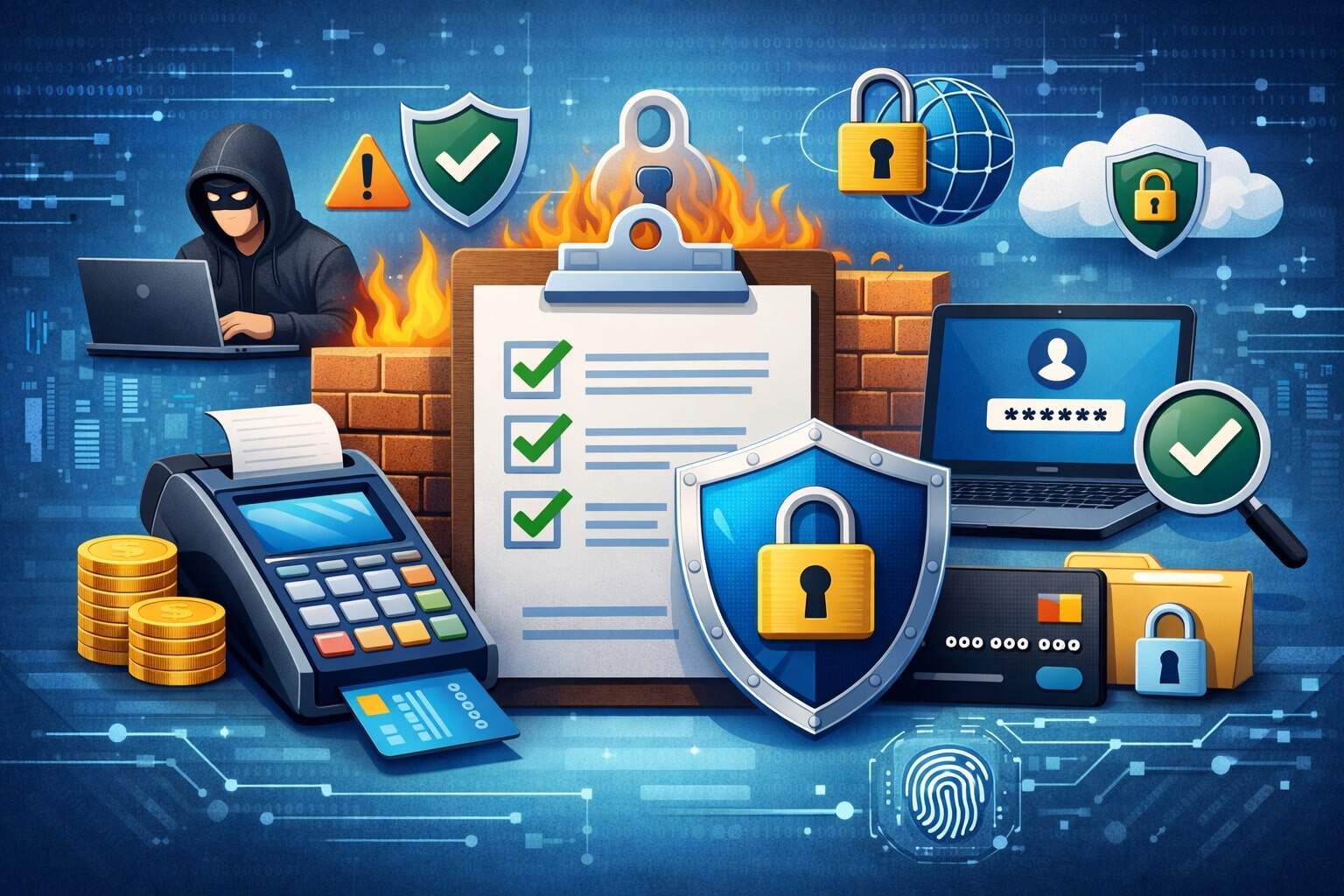
PCI compliance (short for Payment Card Industry compliance) is the ongoing process of meeting the PCI Data Security Standard (PCI DSS)—a set of security requirements designed to protect payment account data and reduce card fraud.
PCI compliance applies to any business that stores, processes, or transmits cardholder data, whether you run a single-location shop with a countertop terminal or a fast-growing online brand with subscriptions, recurring billing, and multiple payment channels.
PCI compliance is not a one-time “pass/fail” checkbox. It’s a security program that includes controls, evidence, monitoring, and annual validation.
What makes PCI DSS compliance so important is that payment data is a high-value target. Attackers don’t need to “steal everything” to profit—capturing payment card numbers, expiration dates, and security codes can be enough to create immediate losses, chargebacks, and reputational damage.
PCI compliance helps reduce those risks by focusing on practical security basics: strong access controls, encryption, vulnerability management, secure configurations, logging, and testing. The latest versions also emphasize modern threats like phishing-driven credential theft, third-party script attacks on checkout pages, and the need for continuous monitoring.
In today’s environment, PCI compliance also matters because it increasingly intersects with cyber insurance, vendor requirements, and incident response readiness. Many acquiring banks and card networks expect merchants to validate PCI DSS compliance annually and keep supporting evidence on hand.
Newer PCI DSS updates introduced more flexible implementation options (like a customized approach) while also raising the bar on authentication, e-commerce integrity, and risk analysis. PCI compliance is best understood as a business-critical safeguard: it protects customers, reduces breach likelihood, and supports stable payment processing relationships.
Understanding PCI DSS
PCI DSS is the core standard behind PCI DSS compliance. It’s a rulebook that tells you how to secure systems that touch payment card data.
PCI DSS was created and is maintained through the PCI Security Standards Council (PCI SSC), and it establishes a baseline of technical and operational requirements to protect payment account data.
PCI compliance means you’ve implemented the required controls and you can prove it (through scans, questionnaires, audit reports, policies, logs, and other evidence).
The standard is organized around high-level goals like building and maintaining secure networks, protecting stored data, encrypting transmissions, managing vulnerabilities, restricting access, monitoring activity, and maintaining an information security policy.
Even if you outsource most payment functions to a hosted checkout or a payment service provider, PCI compliance still matters because your website, employees, and processes can still impact payment security.
A practical way to think about PCI compliance is “scope and proof.” First, determine what systems are in scope (your cardholder data environment, or CDE). Then, implement controls that match your risk and payment flows.
Finally, validate PCI compliance annually and keep evidence current. PCI DSS v4.x also encourages continuous security, meaning you should design PCI DSS compliance so it’s maintained all year—not rebuilt in a panic right before an assessment.
PCI compliance vs. PCI DSS vs. PCI SSC
These terms get mixed up, and that confusion causes expensive mistakes. PCI DSS is the security standard (the requirements). PCI compliance is your organization’s state of meeting those requirements and validating it in the way your acquiring bank/card brands require. PCI SSC is the standards body that publishes and updates PCI DSS and related documentation.
Why does the difference matter? Because PCI DSS compliance is not just “following good practices.” It’s tied to specific validation methods (like completing a Self-Assessment Questionnaire or undergoing a QSA-led assessment), specific timelines, and specific deliverables (like an Attestation of Compliance).
A company can have strong security and still fail PCI compliance if it can’t produce required evidence or if it used the wrong validation method. Likewise, a company can “pass” a superficial checklist and still be insecure if the underlying controls aren’t implemented correctly.
PCI compliance is also not a product you buy. Vendors can help—like managed firewalls, endpoint protection, SIEM logging, file integrity monitoring, and vulnerability scanning—but PCI DSS compliance remains your responsibility.
Even if your processor says it’s PCI compliant, you still have PCI compliance obligations for your own environment, staff access, and payment flows.
Who needs PCI compliance and when it applies

PCI compliance applies to any organization that accepts card payments or supports card payment processing—even if card data never “touches” your servers in the way you imagine.
If your business accepts card payments in-person, online, via mobile, through invoices, or over the phone, PCI compliance is relevant. The key is whether your people, systems, or third parties handle cardholder data (CHD) or influence the security of the payment process.
PCI compliance also applies to service providers (companies that store, process, or transmit card data on behalf of others, or that could impact the security of the CDE).
Your obligations depend on your role, transaction volume, and acquiring bank requirements, but the baseline concept remains: reduce the attack surface, protect account data, and validate your PCI DSS compliance on schedule.
Timing matters too. PCI DSS versions change, older versions retire, and future-dated requirements become mandatory. For example, PCI DSS v3.2.1 was retired and v4.0 became the standard for assessments after March 31, 2024; additional “future-dated” requirements moved from best practice to mandatory by March 31, 2025.
That means PCI DSS compliance expectations for many merchants increased—especially around authentication, monitoring, and e-commerce security.
Common payment setups and what PCI compliance usually looks like
PCI compliance requirements can feel overwhelming until you map them to your payment setup:
If you use a fully hosted checkout page (where customers are redirected to a provider’s payment page), your PCI compliance scope can often be smaller.
If you embed payment fields via iFrames or hosted fields, your scope may still be limited, but your website security becomes more important because it can influence the payment experience.
If you collect card numbers directly on your servers (even temporarily), PCI DSS compliance becomes more intensive because your environment is directly handling CHD.
In-person payments vary too. If you use PCI-validated P2PE solutions, your scope can shrink dramatically. But if you use “semi-integrated” terminals connected to a POS network, your PCI compliance scope can expand depending on segmentation and how traffic flows.
In every case, PCI compliance starts with understanding the flow of data: where it enters, where it travels, where it might be logged, and who can access it.
The key PCI DSS concepts that determine your PCI compliance scope

PCI compliance becomes manageable when you master a few core concepts. The biggest one is scope—what systems, networks, and people are included in your PCI DSS assessment. The smaller and cleaner your scope, the easier PCI DSS compliance becomes. But scope isn’t something you can simply claim; you must justify it with architecture, segmentation, and evidence.
Your in-scope environment is typically called the Cardholder Data Environment (CDE). The CDE includes systems that store, process, or transmit cardholder data, plus any system that can impact the security of those systems.
That “impact” clause is where many businesses get surprised: if a workstation can administer a server that touches payment data, that workstation may be in scope. If a jump box can reach the CDE, it may be in scope.
If your e-commerce site loads third-party scripts that can change checkout behavior, your site security becomes part of PCI compliance expectations—especially under newer guidance.
PCI DSS v4.x also introduced more emphasis on targeted risk analysis and outcomes-based controls. This is good news if you have mature security practices, because you can better align PCI DSS compliance with real-world risk. But it also means your documentation must be tighter and your reasoning must be defensible.
Cardholder data vs. sensitive authentication data
PCI compliance requires that you understand what data is regulated. Cardholder data typically includes the Primary Account Number (PAN) and may include cardholder name, expiration date, and service code when stored together with PAN.
Sensitive authentication data includes things like full magnetic stripe data, CVV/CVC, and PIN blocks—data that must not be stored after authorization even if you’re otherwise PCI compliant.
This distinction is critical because many PCI DSS compliance failures come from accidental storage: debug logs capturing payment fields, call recordings with card numbers, screenshots, printed receipts, or chat transcripts.
PCI compliance is as much about operational discipline as it is about firewalls and encryption. A strong PCI compliance program includes data discovery, log reviews, and strict retention rules so that you don’t “grow” scope over time by accident.
The 12 PCI DSS requirements (and what they mean in practice)
PCI DSS is often summarized into 12 requirement families. They cover network security controls, secure configurations, data protection, encryption, malware defenses, secure development, access control, authentication, logging, testing, and governance. The point isn’t to memorize the list—it’s to implement controls that consistently protect payment data.
In practice, PCI compliance under these requirements looks like: documented configurations, hardened systems, restricted administrative access, strong passwords and MFA, encryption for data in transit, vulnerability scans, patching, secure coding practices, centralized logging, and periodic testing. The newer PCI DSS versions put more focus on continuous monitoring, stronger authentication, and better protection against modern web threats.
If you treat PCI DSS compliance as a yearly paperwork drill, you will struggle. The organizations that succeed build PCI compliance into everyday operations: onboarding/offboarding processes, change control, regular access reviews, automated patching where possible, and continuous vulnerability management.
PCI compliance becomes far less painful when the “evidence trail” is created naturally by your tools and workflows.
Why PCI DSS v4.0 and v4.0.1 changed how PCI compliance works
PCI DSS v4.0 was published in March 2022, and PCI DSS v4.0.1 later provided clarifications and minor corrections without adding or removing requirements.
The big operational shift was the transition timeline: v3.2.1 retired for assessments after March 31, 2024; future-dated v4.0 requirements became mandatory after March 31, 2025.
For PCI compliance teams, the practical implications include:
- More emphasis on multi-factor authentication and identity controls.
- Stronger expectations for logging, monitoring, and response.
- More structure around risk analysis (especially targeted risk analysis).
- More scrutiny on e-commerce integrity and third-party script risks (especially for merchants using SAQ A changes and related guidance).
If you’re trying to rank and win customer trust online, communicating these updates clearly matters. Many merchants search for “PCI compliance” guidance right when they receive a compliance notice or after a security scare. A current, v4.x-aligned PCI DSS compliance program becomes a competitive advantage.
PCI compliance validation: SAQ, ROC, AOC, ASV, and merchant levels
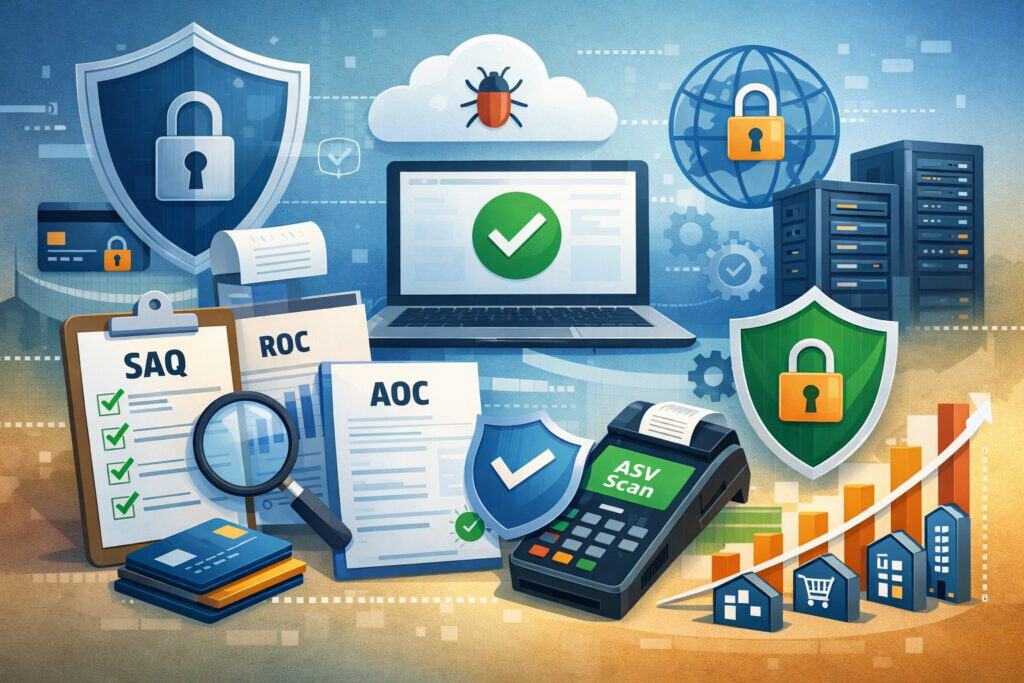
PCI compliance isn’t validated the same way for everyone. Validation depends on your transaction volume, risk profile, and payment channels.
Most smaller organizations validate PCI compliance via a Self-Assessment Questionnaire (SAQ), while larger or higher-risk organizations may require a QSA-led assessment resulting in a Report on Compliance (ROC).
You’ll also hear about:
- AOC (Attestation of Compliance): a signed confirmation of PCI compliance status.
- ASV (Approved Scanning Vendor) scans: external vulnerability scans required for many in-scope internet-facing systems.
- QSA (Qualified Security Assessor): a certified professional who performs formal PCI DSS assessments.
Card brands and acquirers often categorize merchants into “levels” based on annual transaction volume, with different validation expectations by level.
Visa, for example, ties merchant level to annual transaction volume and expects acquirers to ensure merchants validate at the appropriate level and submit required documentation. Mastercard also provides PCI program resources and validation expectations through its security programs.
The important takeaway: PCI compliance is not just “do the controls.” It’s also “validate correctly.” Using the wrong SAQ type is a common failure mode—especially in e-commerce where integrations can change scope quickly.
SAQ A updates and what they mean for e-commerce PCI compliance
If you run e-commerce and rely on SAQ A, pay attention. PCI SSC announced updates and clarifications for merchants validating to SAQ A, including FAQs to clarify eligibility criteria and modifications tied to e-commerce security requirements.
These changes are driven by real-world attacks where malicious scripts can skim card data at checkout. That means PCI compliance for e-commerce increasingly requires you to understand your scripts, third-party tags, and checkout integrity—even if you outsource payment processing.
A key point for ranking and readability: many merchants assume “hosted checkout = no PCI compliance.” That’s false. You may have reduced scope, but you still must maintain PCI DSS compliance for the parts you control. Staying PCI compliant in e-commerce now includes tighter third-party management and stronger website security hygiene.
Step-by-step PCI compliance roadmap for most businesses

A reliable PCI compliance program follows a sequence. Skipping steps usually leads to inflated scope, surprise remediation, or failed validation. Start with payment flow mapping: list every channel (in-store, online, phone, recurring), every vendor, and every system involved.
Then define scope: what is in the CDE, what is connected, and what is truly isolated. After that, choose the correct validation method (SAQ type vs ROC) and build controls around PCI DSS requirements.
Next, establish core technical controls: secure configurations, patching, endpoint protection, encryption, access control, and logging. Then add operational controls: change management, security awareness training, incident response playbooks, vendor management, and periodic access reviews.
Finally, implement testing and monitoring: ASV scans, internal scans, penetration testing as required, log review procedures, and alerting.
PCI DSS v4.x supports more flexibility through a customized approach, but most organizations still succeed faster by implementing the standard approach first.
Once you’re consistently PCI compliant, you can optimize—like shrinking scope through network segmentation, migrating to validated P2PE for in-person acceptance, or moving e-commerce payments to hosted solutions that reduce exposure.
The real secret to PCI compliance is repeatability. Build it like a monthly routine: patch cadence, access review cadence, scan cadence, log review cadence, and vendor review cadence. This reduces last-minute scramble and makes PCI compliance evidence easy to produce.
The PCI compliance checklist trap (and how to avoid it)
A lot of online “PCI compliance checklists” are oversimplified. They encourage box-ticking without real security outcomes, which leads to two problems: you still get breached, or you still fail assessment because you can’t prove implementation. Modern PCI compliance expects evidence, not intent.
Avoid the trap by keeping a “PCI compliance binder” (digital is fine) organized by requirement area: policies, diagrams, asset inventories, access lists, scan reports, change tickets, log samples, and vendor attestations.
Tie evidence to systems in scope. Document exceptions and compensating controls carefully. If you use cloud services, document shared responsibility boundaries. The best PCI compliance program is one where a new assessor can follow your story from payment flow to scope to controls to evidence without guessing.
Real-world consequences of not being PCI compliant
Failing PCI compliance can be expensive even without a breach. Many merchants face non-validation fees, increased scrutiny, or processing restrictions if they don’t submit required PCI compliance documentation. Some card brands publish data security requirements and may impose fees or additional obligations based on reporting status.
For example, American Express explains that merchants are required to comply with PCI DSS and report PCI compliance status, and notes that a non-validation fee may be charged for failing to report status on time.
If a breach happens and you’re not PCI compliant, consequences can escalate quickly: forensic investigations, incident response costs, card replacement costs, higher chargebacks, legal exposure, and brand damage.
Your acquiring bank may require a detailed remediation plan and additional assessments. Even if you are technically PCI compliant, poor logging or incomplete evidence can still create operational pain during an investigation.
PCI compliance also impacts growth. Enterprise clients, marketplaces, and strategic partners often require proof of PCI compliance from vendors. If your PCI compliance program is weak, you may lose deals or face longer security reviews.
From a business perspective, PCI compliance is a trust signal: it demonstrates that you handle payment data responsibly and can sustain long-term processing stability.
Why PCI compliance reduces breach risk (even if it can’t guarantee safety)
No standard can guarantee that a breach will never happen. But PCI compliance reduces risk by eliminating common failure points: default passwords, unpatched systems, weak access control, poor network segmentation, lack of monitoring, and insecure software development. PCI compliance forces you to do the unglamorous work that attackers exploit when it’s neglected.
PCI DSS v4.x’s stronger emphasis on continuous monitoring and risk analysis also pushes organizations toward better detection and response. That matters because modern breaches often involve compromised credentials, lateral movement, and delayed discovery.
Strong PCI compliance improves visibility and reduces dwell time—turning “silent compromise” into “detect and contain.”
Best practices to keep PCI compliance manageable all year
Sustainable PCI compliance is built on automation, ownership, and routine. Assign a PCI compliance owner who can coordinate IT, security, operations, and vendors. Maintain an accurate asset inventory and data flow diagram.
Use tools that generate audit-friendly evidence: centralized logging, automated patch reporting, vulnerability management platforms, and access governance reports.
Design your environment to reduce scope. The fastest PCI compliance wins usually come from:
- Removing stored card data entirely (use tokens instead).
- Using hosted payment pages or hosted fields where appropriate.
- Implementing validated P2PE for in-person acceptance.
- Strengthening segmentation so corporate networks are not in PCI scope.
Also, make change management PCI-aware. Many PCI compliance failures come from “innocent” changes: a new plugin added to checkout, a remote access tool installed for support, a firewall rule opened temporarily, or a new admin added without MFA. If you treat payment security as part of every change review, PCI compliance becomes stable rather than fragile.
Finally, build incident readiness. Have a tested incident response plan, a clear list of contacts, vendor escalation paths, and an evidence preservation process. PCI compliance is as much about being prepared to respond as it is about preventing issues.
Documentation that makes PCI compliance audits easier
A practical documentation set for PCI compliance includes:
- Network diagrams and data flow diagrams (updated after major changes).
- System inventories and scope justification.
- Vendor lists with responsibilities and compliance attestations.
- Policies: access control, password/MFA, secure development, logging, vulnerability management, and incident response.
- Evidence folders: scan reports, patch reports, access review records, log review samples, training records.
PCI DSS v4.0.1 documentation and supporting tools are also available through the PCI SSC document library, which helps teams align with current expectations and templates. Maintaining this documentation continuously is what turns PCI compliance from a stressful annual event into a routine operational process.
Future outlook: where PCI compliance is headed next
PCI compliance is moving toward stronger continuous security and stronger control over third-party risk. Expect more focus on identity security (phishing resistance, MFA quality, privileged access management), more scrutiny of e-commerce supply chain risks (scripts, tags, dependencies), and more demand for measurable security outcomes rather than checkbox statements.
PCI DSS v4.x already reflects this trend by adding flexibility (customized approach) while still requiring you to prove outcomes through testing and evidence. The timeline model—where requirements can be “future-dated” before becoming mandatory—signals that PCI compliance will keep evolving in response to emerging attack patterns.
In the near future, PCI compliance programs will likely rely more on automation and continuous controls monitoring. Merchants will increasingly treat PCI compliance as part of broader governance: vendor assurance, security awareness, secure development practices, and rapid response.
If you build your PCI compliance program with modern tooling and a scope-reduction mindset, you’ll be positioned to adapt faster as the standard evolves.
The biggest prediction that holds up across industries: organizations that reduce scope (by design) will spend less, move faster, and be more resilient. PCI compliance is easiest when you minimize the places payment data can exist—and maximize the evidence that your remaining controls are always working.
FAQs
Q.1: Is PCI compliance legally required, or is it a “card brand requirement”?
Answer: PCI compliance is typically enforced through contractual obligations in the payment ecosystem rather than a single universal statute that says “you must be PCI compliant.”
When you accept card payments, you agree to follow the rules set by payment stakeholders—often through agreements with your acquiring bank and the card brands. Those agreements commonly require that you maintain PCI compliance and validate it annually in the format they specify.
In practical terms, this means PCI compliance is not optional if you want stable card acceptance. Even if you never get “audited” in a traditional sense, you can still be required to submit PCI compliance evidence, complete an SAQ, pass scans, or work with a QSA depending on your merchant level and risk.
Some payment stakeholders also emphasize reporting deadlines and may assess fees for failing to validate or report PCI compliance status on time.
For businesses, the best approach is to treat PCI compliance as a standard operational requirement of accepting card payments. It protects your customers and reduces business risk, and it also reduces the chance of sudden disruptions—like being forced into emergency remediation after a processor notice or after a suspicious activity investigation.
Q.2: If I use a payment processor or hosted checkout, do I still need PCI compliance?
Answer: Yes, in most cases you still need PCI compliance, but your scope may be much smaller. Outsourcing payments can remove your systems from directly handling cardholder data, which often simplifies PCI compliance validation (for example, some e-commerce merchants may qualify for SAQ A depending on their integration and eligibility).
However, your website and operational processes can still influence payment security, especially if your environment can affect how checkout loads or behaves.
This is why newer guidance and updates around e-commerce and SAQ A eligibility exist: attackers increasingly target the “in-between” layers—compromised scripts, tag managers, plugins, admin logins, and third-party dependencies. PCI SSC has released updates and FAQs to clarify SAQ A eligibility and related expectations.
So while a hosted checkout can reduce PCI compliance workload, it does not eliminate responsibility. You still need strong access control (especially for admin panels), secure devices, vendor management, and incident response readiness. Think of it as “less scope, not zero scope”—and that difference matters for staying PCI compliant year after year.
Q.3: How often do I have to validate PCI compliance?
Answer: Most organizations validate PCI compliance annually, but some PCI compliance activities happen more frequently. External vulnerability scans (when required) are typically quarterly, and security operations tasks like patching and log review are ongoing.
Annual validation usually means completing the appropriate SAQ and Attestation of Compliance (AOC) or undergoing a QSA assessment that produces a Report on Compliance (ROC), depending on your level and requirements.
The timeline can also be influenced by PCI DSS version transitions. For example, after March 31, 2024, PCI DSS v4.0 became the standard for new assessments, and by March 31, 2025, future-dated requirements became mandatory—raising what “being PCI compliant” means for many organizations.
A smart PCI compliance strategy is to treat validation as the output of a continuous program. If you do monthly access reviews, keep diagrams updated, patch on schedule, and store evidence as you go, the annual validation becomes a straightforward compilation exercise rather than a stressful rebuild.
Q.4: What are the most common PCI compliance mistakes that cause failure?
Answer: The most common PCI compliance failures are scope errors, evidence gaps, and weak identity controls. Scope errors happen when organizations forget that “systems that can impact the CDE” may be in scope—like admin workstations, shared networks, or remote access pathways.
Evidence gaps happen when controls exist in theory but aren’t documented, tested, or traceable to systems in scope. Weak identity controls show up as missing MFA, shared accounts, poor password hygiene, or excessive privileges.
E-commerce merchants often struggle with third-party script risk and checkout integrity—especially when marketing tags, plugins, and analytics tools change frequently. That’s why PCI SSC issued updates and clarifications for SAQ A and e-commerce requirements.
Another major mistake is accidental storage of sensitive authentication data—like CVV in logs, recordings, or support tickets. Even one overlooked log entry can expand scope and cause major PCI compliance issues.
The fix is proactive data discovery, strict retention rules, and secure operational procedures for phone orders, refunds, and customer support.
Conclusion
PCI compliance is the practical foundation for protecting payment card data and keeping card acceptance stable. It’s built on PCI DSS, a widely adopted baseline that helps organizations reduce the most common causes of payment data compromise.
PCI compliance isn’t just a technical project—it’s a continuous program that combines scope management, strong security controls, clear documentation, and correct annual validation.
The current PCI compliance landscape is shaped by PCI DSS v4.x, including the retirement of older versions and the activation of future-dated requirements as mandatory by March 31, 2025. For many merchants, that means stronger expectations around authentication, monitoring, risk analysis, and e-commerce integrity. But it also offers an opportunity: businesses that modernize now can reduce scope, simplify operations, and build customer trust.
Leave a Reply