By merchantservicesindustry December 18, 2025
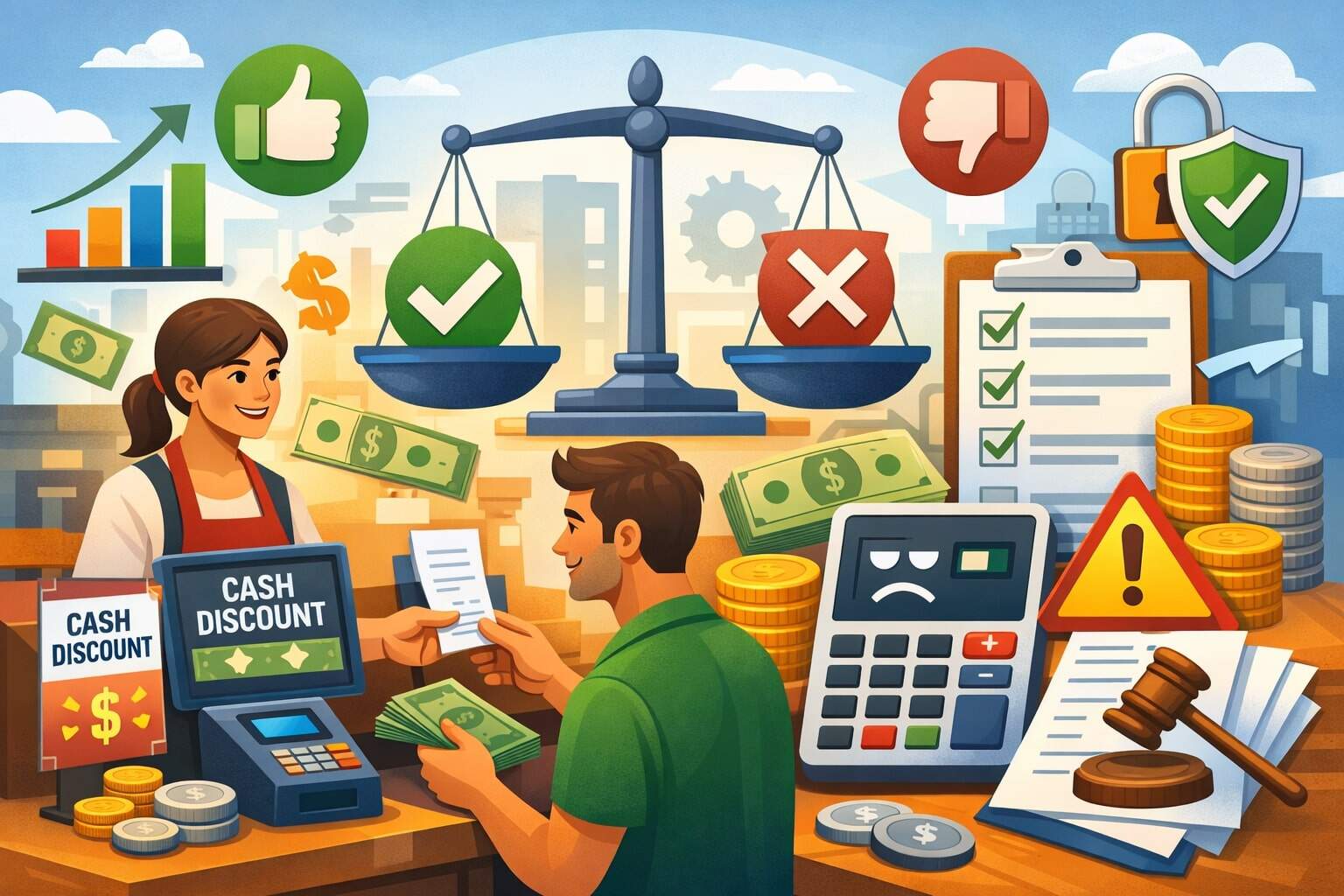
Cash discount programs are pricing strategies where you build card acceptance costs into your listed price and then offer customers a discount for paying with cash (or another non-card method).
Done correctly, cash discount programs can reduce processing expense, stabilize margins, and keep pricing transparent—without triggering the stricter rules that apply to credit card surcharges.
But cash discount programs are not “set it and forget it.” Compliance depends on how you present prices, what your receipt shows, how your POS is configured, and whether your “discount” is genuinely a discount (not a mislabeled mandatory fee).
With payment networks tightening enforcement and states increasing price-transparency scrutiny (including “all-in price” laws like California’s SB 478 guidance), the safest approach is to design cash discount programs as a true discount from a clearly disclosed card-inclusive price.
In this guide, you’ll learn how cash discount programs work, the real pros and cons, the most common compliance mistakes, and how to build a future-proof setup that customers understand quickly.
What cash discount programs are and how they work
Cash discount programs work best when you think about them in reverse: you are not “adding a fee for cards.” Instead, you are setting your standard price to reflect your cost of doing business (including card acceptance), and then offering a discount when customers choose a payment method that costs you less to accept.
A compliant structure typically looks like this:
- Displayed/advertised price = card-inclusive price (the “standard” price).
- Cash price = discounted price (usually a percentage lower).
- Discount is clearly disclosed before purchase (entry + checkout + online cart).
- Receipt shows a discount (not a “surcharge” line item).
Payment networks explicitly recognize “discount offers” commonly referred to as cash discounts, while surcharging (adding an extra fee to credit card transactions) has its own caps, notice rules, and formatting requirements.
Visa, for example, distinguishes cash discounts from surcharges and outlines detailed surcharge requirements such as advance notice, specific disclosures, and limits for credit card surcharging.
This distinction matters because merchants often implement “dual pricing” or “non-cash adjustment” models that unintentionally behave like a surcharge in practice—especially when the lowest price is advertised but customers only discover an extra amount at the register. That’s where complaints, chargebacks, and enforcement risk grow quickly.
To keep cash discount programs clean: advertise the card price, disclose the cash discount clearly, and ensure the receipt reflects a discount.
Cash discount programs vs surcharging vs convenience fees
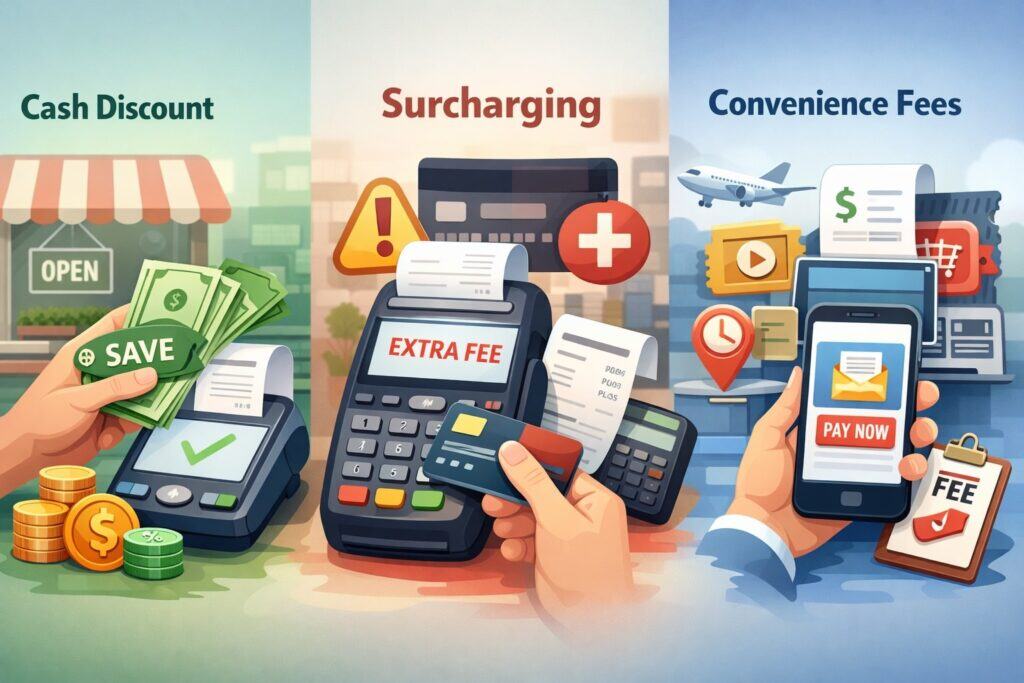
Cash discount programs are frequently confused with surcharging and convenience fees because all three can change what customers pay based on how they pay. The differences are not just semantics—they change your compliance burden.
Cash discount programs
Cash discount programs offer a discount for paying with cash (or another non-card method) from a card-inclusive standard price. When customers pay by card, they pay the standard listed price. When they pay by cash, they receive a discount.
Because the card price is the default price, the customer experience is typically smoother. Customers don’t feel “penalized” for using a card; they feel “rewarded” for using cash. That perception can reduce disputes and negative reviews.
Surcharging
Surcharging is an added fee on credit card transactions. Networks allow it under strict conditions and limits. Visa’s surcharge rules include requirements like notifying your acquirer in advance, restricting surcharges to credit cards (not debit/prepaid), and capping the surcharge (e.g., to the merchant discount rate or 3%, whichever is lower, per Visa’s published guidance). Mastercard also publishes surcharge rules and caps and requires disclosures.
Surcharging can be legal in many places, but it is also restricted or prohibited in certain jurisdictions, and disclosure formatting can be heavily regulated. For example, Connecticut explicitly prohibits surcharges but allows cash discounts.
Convenience fees
Convenience fees are a different category: they’re generally tied to offering an alternative payment channel (for example, online or phone payments when the normal channel is in-person). Convenience fees can be misunderstood and misused, and network rules can be strict about when they’re allowed.
If your goal is to reduce processing expenses at the counter, cash discount programs are often simpler than convenience fees and less compliance-heavy than surcharging—when structured correctly.
The biggest benefits of cash discount programs

Cash discount programs have real upside, especially for businesses with tight margins or high ticket sizes where processing costs materially impact profit. The key is to understand the benefits that matter in day-to-day operations—not just in marketing.
Margin protection and predictable cost recovery
Card acceptance costs can fluctuate as ticket size, card mix, and rewards usage change. Cash discount programs can help stabilize margins because your standard price already accounts for acceptance expenses. That makes profitability more predictable across seasons and customer traffic patterns.
This stability also helps pricing discipline. Instead of silently raising prices every time acceptance costs rise, you can maintain a consistent pricing model and let customers choose whether to pay the standard price (card) or earn a discount (cash). Over time, that can produce better customer trust than “mystery fees” at checkout.
Lower effective processing expense
When customers shift even a portion of transactions to cash, your blended processing expense can drop meaningfully. That’s especially true for businesses with many small-to-mid transactions, where per-transaction fees stack up quickly.
Even when customers still pay by card, properly structured cash discount programs can reduce the temptation to impose a surcharge (which can create more disputes and tighter compliance requirements). In practice, many merchants prefer cash discount programs because they can be perceived as more customer-friendly while still supporting cost recovery.
Simpler customer messaging than surcharging
“Pay with cash and save” is easier to communicate than “credit cards cost extra.” That matters at the register, on signage, on menus, and in online checkout flows. Clear language reduces staff friction and keeps your team from having to debate policy with customers.
It also helps reduce complaint risk. Many negative customer experiences around payment pricing come from surprise. Cash discount programs—when displayed and disclosed correctly—reduce surprise.
Potential reduction in chargebacks and disputes
While chargebacks are complex, confusion about unexpected pricing is a common trigger for disputes and “customer complaint” chargebacks. Clear disclosure and a receipt that shows an actual discount can reduce the “I didn’t agree to this fee” problem.
This is also where compliance and customer experience overlap: the more transparent your cash discount programs are, the lower your dispute risk tends to be.
The real downsides and trade-offs of cash discount programs
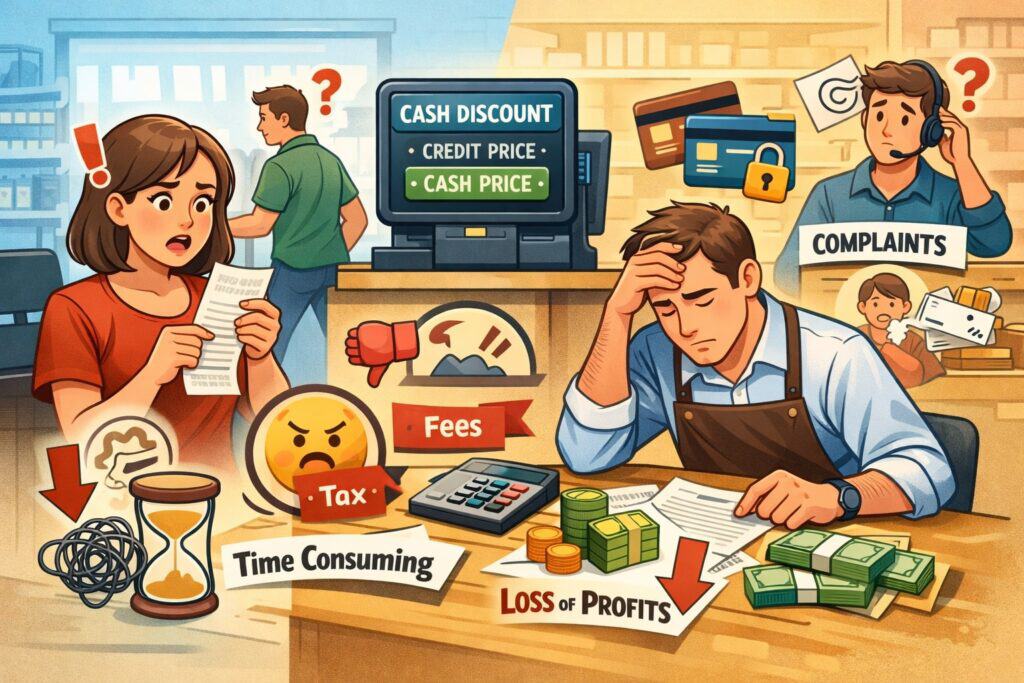
Cash discount programs are not magic. They come with operational, reputational, and compliance trade-offs that you should evaluate before rollout.
Customer perception and competitive pricing pressure
Even though cash discount programs can feel better than surcharging, some customers will still interpret the standard (card) price as “higher than expected.” If competitors advertise a lower sticker price and only add fees later, you might feel pricing pressure—especially online.
That’s why your messaging matters. You’re not trying to “hide a fee.” You’re presenting an honest standard price and offering savings for lower-cost payment methods. Short, consistent signage and trained staff can prevent confusion.
Increased cash handling and related risk
If more customers pay cash, you handle more cash. That can increase:
- Deposit runs and bank trips
- Cash counting time
- Till discrepancies
- Theft exposure (internal and external)
You may need stronger cash controls: dual counts, cameras, deposit schedules, and documented reconciliation procedures. The savings from cash discount programs should be weighed against these operational costs.
POS complexity if your system is not designed for it
Not all POS systems handle dual prices cleanly. If your POS requires manual overrides, inconsistent prompts, or staff calculations, your risk of errors rises fast. Errors create customer complaints and can undermine compliance if receipts are inconsistent.
A strong implementation includes POS configuration that automatically applies the discount based on tender type, prints compliant receipt language, and supports online checkout disclosures.
Compliance drift over time
Many businesses launch cash discount programs correctly and then drift:
- The new staff stopped explaining it.
- Signage gets removed during remodels.
- Online listings show the cash price but not the standard price.
- Receipts change after a software update.
Because enforcement and consumer expectations are rising, compliance drift is one of the biggest hidden risks. Treat cash discount programs like a policy that requires quarterly checks—not a one-time setup.
Compliance fundamentals for cash discount programs
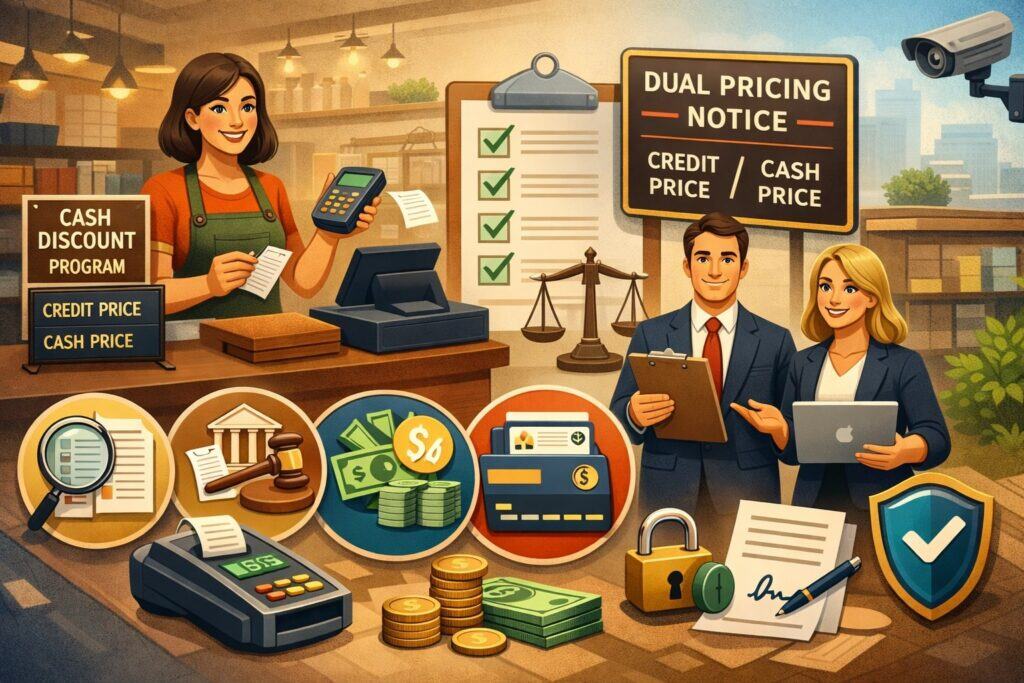
Compliance for cash discount programs is about truth in pricing. The “discount” must be real, clearly disclosed, and consistent across the customer journey.
Advertised price must be the standard (card-inclusive) price
A common compliance failure is advertising the lowest price (cash) and then effectively adding a mandatory amount for card payments at checkout. That can look like a surcharge or a hidden fee—even if you call it a “non-cash adjustment.”
Price transparency laws are increasingly focused on ensuring customers see the full price they must pay without surprise mandatory add-ons. California’s SB 478 guidance, for example, emphasizes that advertised prices should include required fees (with limited exceptions).
Even outside that state, the broader trend is clear: regulators and customers want “all-in” clarity. The safest approach for cash discount programs is to make the posted price the card price and explicitly state the cash discount wherever prices appear.
Clear and conspicuous disclosure at key points
At minimum, disclosures should be present:
- At entry (door/window sign)
- At point of sale (register signage)
- Where prices are displayed (menus, shelf tags, service lists)
- Online (product pages and cart/checkout)
Visa’s published surcharge Q&A highlights the importance of clear disclosure for surcharging at point of entry, point of sale, and on receipts—while also distinguishing cash discounts as permitted discount offers. Even though cash discount programs are not surcharges, the disclosure discipline is a good benchmark for transparency.
Receipts must reflect a discount
Your receipt should show the standard price and then a discount line when cash is used. Avoid receipt labels that imply a surcharge or a mandatory fee, because that can confuse customers and invite disputes.
A clean receipt presentation supports your story: “Our standard prices reflect card acceptance. Pay with cash and receive a discount.”
Debit card handling must be carefully designed
Surcharging rules often prohibit applying surcharges to debit/prepaid cards (Visa’s surcharge guidance explicitly restricts surcharging to credit cards and not debit/prepaid). Even though cash discount programs are different, many POS implementations accidentally treat debit like credit, which can cause confusion and complaints.
A best-practice approach is to define tender types clearly and train staff to avoid telling customers “debit has a fee.” Instead, keep the message centered on the cash discount and the standard price.
State and local legal considerations that can affect cash discount programs
Cash discount programs are widely used, but legal details can still matter—especially when states restrict surcharging and scrutinize how prices are displayed.
Jurisdictions that prohibit surcharges often allow cash discounts
Some jurisdictions prohibit surcharges while explicitly allowing discounts. Connecticut’s consumer guidance states that businesses cannot add a surcharge for paying by card but can offer a cash discount. This is one reason cash discount programs are a common alternative when surcharging is risky or prohibited.
Price transparency laws can indirectly impact how you present cash discount programs
Even where cash discount programs are legal, how you advertise can be regulated. “All-in pricing” requirements can make it risky to advertise a low price and then add a mandatory amount later.
California’s SB 478 guidance describes an “Honest Pricing Law” approach that prohibits advertising a price that does not include required fees (with limited exceptions). For merchants using cash discount programs, the practical takeaway is: advertise the standard price and clearly disclose the cash discount everywhere the price appears.
When to involve counsel
If you operate in multiple states, sell regulated products, or have complex billing (subscriptions, service contracts, B2B invoicing), it’s worth getting legal review of your disclosure language. The cost is small compared to the cost of disputes, enforcement actions, or forced rollbacks.
How to implement cash discount programs the right way
A clean implementation is equal parts pricing design, POS configuration, signage, and staff training. If any of those are weak, you’ll feel it immediately at checkout.
Step 1: Choose a pricing model you can explain in one sentence
Your front-line sentence should be simple:
- “Our listed prices are our card prices. Pay with cash and you’ll receive a discount.”
If you can’t explain it simply, customers won’t trust it. Staff will also improvise explanations, which increases complaint risk.
Step 2: Configure your POS for automatic tender-based discounting
Your POS should:
- Treat the displayed price as the standard price
- Automatically apply a discount when cash is selected
- Print a receipt that clearly shows the discount
- Keep reporting consistent for accounting
Avoid systems that require manual math or override buttons for every transaction. That creates inconsistency—your biggest enemy in compliance.
Step 3: Use signage that is specific and consistent
Signage should be clear, readable, and placed before the customer commits to purchase. It should avoid confusing language like “added fee for cards” if you’re running cash discount programs. It should also match your receipts and employee script.
Consistency matters more than clever wording.
Step 4: Train staff with scripts and edge-case handling
Train staff to handle:
- “Why is it cheaper with cash?”
- “Is this a fee for using my card?”
- “Does debit count?”
- “What about refunds?”
- “What about tips?”
You want staff to respond calmly and consistently, without debating. A short script, plus a manager escalation path, prevents conflicts at the counter.
Step 5: Audit monthly, refresh quarterly
Audit checklist:
- Door and register signs present and readable
- Online disclosures visible before checkout
- Receipt shows discount correctly
- Prices displayed match the standard price
- Staff can explain it accurately
Cash discount programs fail more often from neglect than from bad intent.
Common compliance mistakes that trigger complaints, fines, and processor issues
Most “cash discount programs gone wrong” share a few patterns. Fix these and you eliminate the majority of risk.
Advertising the cash price as the default
If you advertise the lower price and then customers pay more at checkout when they use a card, customers feel misled. Regulators and networks often view that structure as a hidden fee problem.
This is exactly the scenario that price transparency enforcement is designed to discourage. California’s SB 478 guidance is an example of the broader “no hidden mandatory add-ons” direction.
Calling it a “non-cash adjustment” without clear explanation
Vague labels create mistrust. If your receipt shows “non-cash adjustment” but signage says “cash discount,” customers may believe you’re adding a fee, not offering a discount.
Inconsistent signage (or no signage)
Even if your receipts are perfect, missing signage leads to surprise. Surprise leads to disputes.
Networks emphasize clear disclosure for surcharging, and while cash discount programs are not surcharging, the “clear before purchase” principle is still the safest standard.
Applying the discount incorrectly (or not at all)
If staff forgets to select cash tender or the POS misapplies the discount, you create instant conflict. Your POS must be configured to make the correct outcome the default outcome.
Poor handling of returns and refunds
Refund rules should be written and consistent:
- If a customer paid cash and received a discount, the refund should match what they paid.
- If a customer paid by card at the standard price, refund the standard price.
Mismatched refunds create complaints fast.
Accounting, taxes, and receipts for cash discount programs
Cash discount programs must also make sense in your books. A great POS setup will help, but you still need to understand how reporting should look.
Revenue recognition and discount treatment
Typically, the standard (card) price is your gross sales price, and the cash discount reduces the amount collected for cash transactions. Your reporting should allow you to track:
- Gross sales at standard prices
- Discounts given (cash discounts)
- Net collected
This visibility is important not only for accounting but also for measuring program impact.
Sales tax calculation
In most retail contexts, sales tax is calculated based on the taxable selling price after discounts. Your POS should handle this correctly—especially if you apply the cash discount at the end of the sale.
Because tax rules can vary by product type and jurisdiction, verify with your tax advisor that your system’s tax calculation matches your local requirements.
Receipt language as customer support
Receipts are evidence. If a customer disputes a transaction, your receipt should clearly support your pricing model. A receipt that shows “Cash Discount” as a deduction is far more defensible than a receipt that looks like a surprise fee.
Cash discount programs for online, invoicing, and B2B payments
Cash discount programs are easiest in-person. Online and invoiced payments introduce additional complexity because customers may see pricing in multiple places before payment.
Online checkout disclosures
Online, customers are more sensitive to “added at checkout” pricing. If you run cash discount programs online:
- Display the standard price on product pages
- Disclose the cash discount near the price
- Reinforce the disclosure in cart and checkout
- Ensure the final total is consistent with the disclosure
This is also where price transparency laws matter most, because online advertising is easy to screenshot and share.
Invoicing and pay-by-link flows
For invoices, keep it simple:
- Invoice shows standard amount due
- Payment instructions explain the cash discount option (if applicable)
- If offering a discount for ACH or cash, show it as a discount, not as a “card fee”
Avoid adding a last-minute “card fee” line item unless you are intentionally running a compliant surcharge program and meeting the surcharge rules and caps published by the networks.
B2B customer expectations
Business buyers may accept differential pricing more readily, but they still expect clarity and consistent documentation. Strong invoices and payment pages reduce friction and help you get paid faster.
Industries that benefit most from cash discount programs
Cash discount programs can work across many verticals, but the best fit is usually where:
- Ticket size is meaningful
- Processing costs impact profitability
- Customers are used to paying by cash or debit
- Price display can be standardized (menus, shelf tags, service lists)
Common strong-fit examples include:
- Quick-service restaurants and cafes
- Auto repair and service
- Professional services with in-person pay
- Convenience and specialty retail
- Home services (especially when offering multiple payment methods)
The key factor is your ability to deliver a consistent customer experience. If you have many channels (online + phone + in-person) and lots of price exceptions, you’ll need stronger controls to keep cash discount programs consistent.
Customer experience best practices for cash discount programs
Customer experience is compliance’s best friend. The more customers understand your pricing, the fewer disputes you face.
Use “save” language, not “fee” language
The best-performing messaging focuses on saving:
- “Pay with cash and save X%.”
- “Discount available for cash payments.”
Avoid framing that sounds like punishment for cards.
Keep signage readable and minimal
One sign at entry and one at checkout is the baseline. If you have menus or shelf tags, include a short note where prices are displayed.
Teach staff to stay calm and consistent
Your staff should never argue about interchange, network rules, or “what other stores do.” A simple explanation and an offer of choice is enough:
- “Those are our standard prices. Cash gets a discount.”
Offer multiple options
Some customers won’t carry cash. If your business depends on card volume, make sure your program doesn’t feel like a barrier. The goal is margin protection—not pushing customers away.
Future outlook and predictions for cash discount programs
Cash discount programs are likely to grow, but the “rules of the road” are tightening in three ways:
1) More price transparency enforcement
Laws and guidance pushing all-in pricing—like California’s SB 478 “Hidden Fees” guidance—signal a broader direction: regulators don’t want consumers to discover mandatory costs at the end of the purchase.
For cash discount programs, that means the compliant, future-proof path is to advertise the standard price and clearly disclose the discount everywhere.
2) Increased payment network scrutiny and data-driven enforcement
Networks have a strong incentive to protect customer trust. Visa’s surcharge guidance shows how detailed network expectations can be, including notice, disclosure, and restrictions on what can be surcharged.
Even if you’re not surcharging, merchants using confusing “adjustment” models may receive more attention as enforcement becomes more automated.
3) More automation in POS and payments compliance
Merchants will increasingly rely on POS providers and payment partners to keep cash discount programs consistent across channels, receipts, and disclosures. Expect more “compliance-by-configuration” tools: standardized signage kits, receipt templates, tender rules, and automated audits.
FAQs
Q.1: Are cash discount programs legal?
Answer: Cash discount programs are broadly permitted when structured as a true discount from a standard price and disclosed clearly. In places where surcharging is prohibited, cash discount programs are often explicitly allowed as an alternative (Connecticut’s guidance is one example).
Q.2: How is a cash discount program different from a surcharge?
Answer: A cash discount program reduces the price when a customer pays with cash. A surcharge adds an extra fee when a customer pays with a credit card. Networks publish specific rules for surcharging, including limits and disclosures, while also recognizing cash discounts as discount offers.
Q.3: Do I need signs for cash discount programs?
Answer: Yes. Clear disclosure before purchase is one of the most important protections against complaints and disputes. Place signs at entry and at the register, and add disclosure where prices are displayed (including online).
Q.4: Should the receipt show a “fee” or a “discount”?
Answer: For cash discount programs, the receipt should show a discount applied when cash is used. Avoid wording that looks like a surcharge or a mandatory card fee, because it creates confusion and increases dispute risk.
Q.5: Can I apply the program to debit cards?
Answer: Be cautious. Visa’s published rules for surcharging restrict surcharges to credit cards and prohibit surcharging debit/prepaid.
Cash discount programs are not surcharging, but many POS setups confuse customers when debit is treated inconsistently. A best practice is to keep the message centered on the cash discount and ensure your tender logic is clear and consistent.
Q.6: What’s the most common reason merchants get in trouble with cash discount programs?
Answer: The most common issue is advertising the cash price and then charging more at checkout for card payments. That can look like a hidden fee or a surcharge in practice—especially under modern price transparency expectations (including “all-in” pricing guidance like California’s SB 478 page).
Q.7: How do I make cash discount programs rank-friendly and customer-friendly online?
Answer: Use the standard price everywhere online, clearly label the cash discount near the price, repeat it in cart/checkout, and ensure your final total matches your disclosure. Consistency is what protects both conversion rate and compliance.
Conclusion
Cash discount programs can be a powerful, practical way to protect margins and reduce processing expense—without the higher friction and stricter rule set that often comes with surcharging. The benefits are real: predictable cost recovery, improved margin stability, and simpler customer messaging.
But the success of cash discount programs depends on transparency. Your standard price should be the price customers see first. Your cash discount should be clearly disclosed before purchase, applied automatically by your POS, and reflected as a discount on the receipt.
With price transparency enforcement increasing (and “all-in pricing” expectations becoming more common), the safest long-term strategy is to design cash discount programs so customers never feel surprised.
Leave a Reply