By merchantservicesindustry December 18, 2025
Accepting payments online is no longer a “nice to have.” It’s a core business capability that affects revenue, customer trust, cash flow, fraud exposure, and even how fast you can scale.
When you accept payments online, you’re not just adding a checkout button—you’re building a system that moves money securely from a customer’s bank or card issuer into your business account, while managing identity checks, authorization rules, compliance, disputes, refunds, and reporting.
This complete guide breaks down exactly how to accept payments online in a way that’s reliable, secure, conversion-friendly, and future-ready.
You’ll learn the main approaches (hosted checkout vs API), the best payment methods to offer, how fees really work, what compliance actually means in day-to-day operations, and how to reduce fraud and chargebacks without hurting approval rates.
You’ll also get practical implementation steps you can follow whether you sell products, services, subscriptions, digital goods, or invoices.
And because the online payments landscape changes quickly, the guide includes current security expectations and forward-looking predictions on tokenization, passkeys, Click to Pay, and real-time bank payments that will shape how businesses accept payments online over the next several years.
Understand the Online Payments Ecosystem Before You Accept Payments Online
To accept payments online confidently, you need a simple mental model of what’s happening behind the scenes. Most payment problems—unexpected holds, sudden declines, delayed funding, account terminations, chargeback spikes—come from misunderstanding roles and risk responsibilities across the ecosystem.
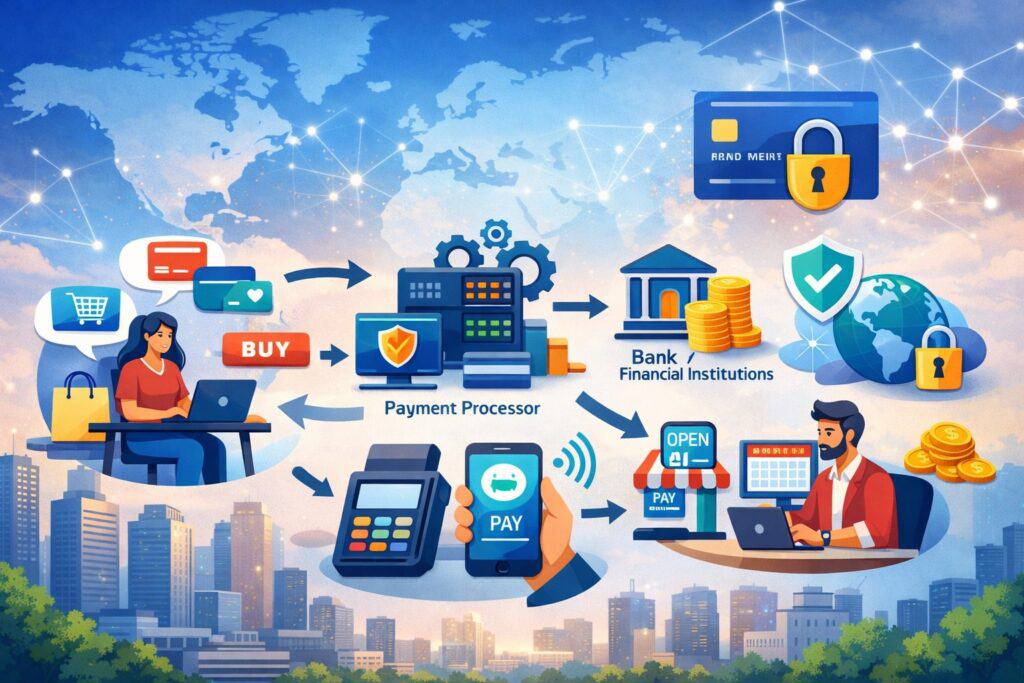
When a customer pays online with a card, the transaction typically involves: the customer, your online storefront or app, a payment gateway (or gateway-like layer), a payment processor, an acquiring bank (the institution that supports your merchant account), the card network, and the customer’s issuing bank.
Each participant has rules. Each participant sees different data. And each participant can cause an approval, decline, review, delay, or reversal.
If you accept payments online via bank transfer methods (like ACH-style bank payments), the flow and timing change. Authorization may not be “instant” the same way card authorization is, settlement windows differ, returns have different rules, and fraud signals look different.
If you accept payments online for subscriptions, you also add lifecycle complexity—upgrades, downgrades, proration, retries, card updates, and involuntary churn controls.
The Key Parties and What They Do
To accept payments online, you’ll interact with several “layers,” even if your provider bundles them. Your storefront collects payment details. Your gateway routes the payment securely and returns a response.
Your processor moves transaction data into the banking network. Your acquirer sponsors you (and takes on risk). Card networks define message formats and operating rules. The issuer approves or declines based on funds and risk logic.
This matters because the person who “told you no” during a decline is often not the same party who can “fix it.” If you accept payments online and see sudden declines, you may need to adjust fraud settings, improve data sent in the authorization, or change routing—rather than assume customers don’t have money.
How a Typical Online Card Payment Works
When you accept payments online, the transaction usually follows a predictable path: customer submits details → you tokenize or transmit securely → authorization request is sent → issuer responds approved/declined → if approved, you capture → funds settle → payout to your bank account.
Small implementation choices—like using tokenization, collecting accurate billing address data, sending customer email, adding Level 2/3 data for certain business payments—can improve approval rates and reduce disputes. Accepting payments online becomes easier when your checkout and data quality support the issuer’s decision-making.
Define Your Use Cases and Business Model to Accept Payments Online Smoothly
Before you pick any provider, get clear on how you’ll accept payments online in real life. Many businesses choose a tool that works for a single checkout flow, then struggle when they add invoices, subscriptions, or a marketplace model. A “complete” setup supports what you do today and what you’ll do next.
Start by listing your payment scenarios: one-time purchases, deposits, recurring billing, invoices, tips, pay-by-link, mobile app payments, or selling through multiple channels. Then define your operational needs: partial refunds, split payments, authorization holds, delayed capture, shipping-based capture, taxes, and accounting reconciliation.
If you accept payments online for services, you may need payment links, invoices, or stored payment methods for follow-up charges. If you accept payments online for digital goods, you may need more fraud controls because delivery is instant. If you accept payments online for subscriptions, you need billing automation and dunning tools.
The more precisely you define use cases, the easier it becomes to choose the right mix of payment methods, risk tools, and integration approach without rebuilding later.
One-Time Purchases vs Subscriptions vs Invoicing
One-time checkout is simplest: customer pays, you deliver. Subscriptions add: recurring schedules, card updater support, retry logic, and proration. Invoicing adds: payable links, due dates, partial payments, and follow-ups.
To accept payments online across all three, look for a platform that supports multiple payment experiences under one account, with consistent reporting and a unified customer record. Otherwise, you’ll fight mismatched data, duplicate customers, and confusing payout reconciliation.
Marketplaces and Platforms Have Special Rules
If you accept payments online while paying out to third parties (vendors, creators, drivers, partners), you’re often building a marketplace/platform flow. That usually requires onboarding sub-accounts, identity verification, payout schedules, and clear handling of refunds and disputes.
A marketplace model is not just “regular checkout plus payouts.” It’s a compliance and risk model. Plan for it early if it’s on your roadmap, because switching architectures later can be painful.
Choose the Right Provider Model to Accept Payments Online Reliably
To accept payments online, you’ll typically choose between (1) an all-in-one payment facilitator style platform, (2) a traditional merchant account with a payment gateway, or (3) a hybrid where you get some flexibility plus managed risk tools.
The “right” choice depends on how much control you need, how quickly you want to start, and how sensitive your business is to underwriting and risk reviews.
All-in-one platforms can help you accept payments online quickly with minimal setup. They often bundle the gateway, tokenization, checkout UI, and dashboards. But some businesses outgrow them when they need custom pricing, multiple processing options, specialized risk rules, or more stable underwriting for higher volumes.
Merchant accounts can provide more tailored underwriting and pricing. They can also offer more configurability for how you accept payments online (like specific MCCs, advanced fraud tools, or more control over dispute processes). The tradeoff is additional setup time and more decisions to make.
If you expect rapid growth, higher average ticket sizes, subscription billing, or multiple sales channels, it’s usually worth selecting a provider model that won’t force a re-platform within a year.
Payment Facilitator vs Dedicated Merchant Account
Payment facilitators (often called “aggregators”) onboard you under their umbrella. Dedicated merchant accounts typically onboard your business directly with an acquiring relationship.
When you accept payments online under an aggregator model, you may see faster onboarding but stricter automated monitoring. When you accept payments online via a dedicated merchant account, you may get more stability and pricing options, but onboarding can include deeper review.
Questions That Prevent Expensive Mistakes
Before you commit, ask: How are reserves handled? What triggers funding delays? How are chargebacks represented? Can you export all transaction and dispute data? What’s the support path during an outage? Can you accept payments online on multiple websites/apps under one reporting view? Can you add a second processor later?
These questions matter more than a small pricing difference. The cost of downtime, frozen funds, or broken reconciliation is usually higher than a few basis points.
Pick the Best Ways to Accept Payments Online Across Your Sales Channels
There isn’t one single way to accept payments online. High-performing businesses usually support multiple payment entry points so customers can pay how and where they want, while the business keeps reporting centralized.
Common methods include a hosted checkout page, embedded checkout, payment links, online invoices, recurring billing portals, in-app purchases, and virtual terminals for manual entry (used carefully). The right mix depends on your customer journey and how you sell.
If you accept payments online only through one checkout page, you may lose revenue from customers who want invoice-based purchasing, approvals workflows, or pay-by-link. On the other hand, offering too many options without consistent branding can confuse customers.
A practical approach: start with a conversion-optimized checkout, then add invoices and payment links for sales-assisted or B2B-style flows. If you have subscriptions, add a customer portal for card updates and plan changes.
Hosted Checkout vs Embedded Checkout
Hosted checkout is easier to launch and can reduce your compliance scope because sensitive fields are handled by the provider. Embedded/API checkout gives you more control over UX but requires stronger development practices and security discipline.
Many businesses accept payments online using hosted checkout first, then migrate to embedded checkout when they have product-market fit and want to optimize conversion.
Payment Links and Invoices for Faster Collections
Payment links help you accept payments online without building complex checkout flows. You can collect deposits, take phone orders safely (by sending a link), and close invoices faster.
Invoices with pay-now buttons are especially effective for service businesses. They reduce friction, shorten time-to-cash, and improve customer experience.
Offer the Right Payment Methods to Accept Payments Online in 2026 and Beyond
Customers expect choice. To accept payments online competitively, you should support the payment methods your audience trusts, while balancing fraud risk, cost, and settlement timing.
Cards remain a baseline, but wallets and bank-based payments are increasingly important. Many buyers prefer paying with saved wallet credentials because it’s faster and feels safer than typing card numbers. Meanwhile, bank payment options can lower costs and reduce certain fraud types, especially for larger invoice payments.
“Buy now, pay later” options can improve conversion for certain products, but they also add policy and reconciliation considerations. In recent updates, regulators have shifted positions on BNPL guidance, so businesses should treat BNPL as a program that needs ongoing compliance monitoring rather than a set-and-forget toggle.
Finally, expect tokenization and “one-click” style experiences to expand. Networks and large payment brands are pushing toward reduced manual card entry and more token-based credentials as a default, which changes how you accept payments online and how you optimize checkout for repeat customers.
Cards and Wallets Are the Minimum Standard
If you accept payments online, support major card brands and at least the most common wallets your customers use. Wallets can reduce typing, reduce checkout abandonment, and often produce stronger authentication signals.
Wallet-based payments also tend to reduce exposure of raw card numbers to your environment because credentials are tokenized or handled through wallet security models.
Bank Payments, Real-Time Options, and What to Watch
Bank payments can be great for larger ticket sizes and recurring bills where customers prefer direct account debits. They can also reduce processing cost compared to cards.
Over the next few years, real-time and near-real-time bank payment experiences are expected to become more common in checkout flows, especially as user expectations shift toward instant confirmation and faster availability of funds.
BNPL: Conversion Lift vs Operational Complexity
BNPL can increase conversion and average order value for certain categories. But it introduces new dispute patterns, customer service workflows, and regulatory attention.
Given that BNPL guidance has changed recently (including withdrawals of certain guidance documents), you should keep BNPL policies updated, ensure disclosures are clear, and monitor customer complaints closely.
Understand Pricing and Fees Before You Accept Payments Online at Scale
If you want to accept payments online profitably, you must understand how you’re being charged. Many businesses focus on the headline rate and miss the real drivers: interchange categories, card mix, authentication outcomes, cross-border usage, refunds, disputes, and platform fees.
Card pricing generally includes interchange (paid to the issuer), network assessments (paid to the card network), and the processor’s markup. You can’t negotiate interchange, but you can influence it through how you accept payments online—your data quality, your business type, and transaction parameters.
Chargebacks and disputes also have costs beyond fees: lost goods/services, operational time, possible penalties, and risk reviews. Refunds can reduce revenue but may not refund all fees, depending on provider policy.
Bank payments have different structures: per-transaction fees, return fees, and sometimes verification fees. Wallets can have card-like pricing or special program pricing, depending on the rails underneath.
The Practical Drivers of Your Effective Rate
Your “effective rate” is what you pay after everything: discounts, fees, disputes, refunds, and platform charges. To manage it, track payment method mix, average ticket, approval rates, refund rate, dispute rate, and fraud rate.
When you accept payments online, improving approval rates by even 1–2% can often be worth more than shaving a few basis points off pricing—because more approved revenue flows through with the same fixed costs.
Avoid Surprises: Reserves, Holds, and Rolling Risk Controls
Some providers apply reserves or delayed funding for newer businesses, higher risk categories, or rapid volume spikes. That isn’t automatically “bad,” but it can break cash flow if you didn’t plan for it.
If you accept payments online and your volume will grow quickly, ask upfront how reserves are triggered, how they’re released, and what reporting you’ll see.
Security and Compliance: How to Accept Payments Online Safely Without Slowing Checkout
Security is not optional when you accept payments online. But “security” shouldn’t mean adding friction everywhere. The best systems combine strong controls (tokenization, script integrity, monitoring, secure authentication) with a checkout that stays fast and simple.
Payment security is shaped heavily by industry standards and network rules. One of the biggest compliance frameworks for card payments is PCI DSS.
Recent versions include stronger expectations for e-commerce environments—especially around client-side scripts and payment page integrity—and the PCI Security Standards Council has published guidance around adopting future-dated requirements by specific deadlines.
At the same time, networks and major payment organizations are pushing tokenization harder to reduce manual card entry and lower fraud. Tokenization also changes how you store customer payment credentials and how you design saved-payment experiences when you accept payments online.
PCI DSS for E-Commerce: What It Means in Practice
If you accept payments online with cards, PCI DSS impacts how you handle payment pages, scripts, third-party tags, and storage of any sensitive data. For many businesses, the simplest compliance approach is to avoid touching raw card data at all by using hosted fields or hosted checkout.
The PCI Security Standards Council has highlighted guidance for e-commerce requirements and the timeline to adopt future-dated PCI DSS v4.0.1 requirements, which has pushed many online sellers to tighten client-side controls (script inventory, authorization, integrity checks, and monitoring for tampering).
Even if you outsource most payment handling, you still need to manage third-party scripts carefully. Marketing pixels, A/B testing tools, chat widgets, and analytics tags can become an attack surface on payment pages.
When you accept payments online, your security posture is only as strong as the weakest script running on that checkout page.
Tokenization, Network Tokens, and Why They Matter
Tokenization replaces sensitive card details with a token that is useless if stolen. Network tokenization goes further by using tokens managed within card network ecosystems, which can improve security and reduce fraud.
Industry reporting shows ongoing pushes by major networks to expand tokenization adoption because it helps reduce fraud and supports modern checkout experiences.
For businesses, tokenization is foundational for safely storing payment methods for subscriptions, “save my card,” and one-click purchases. If you want to accept payments online for repeat customers, tokens are the safe way to do it.
3-D Secure, Click to Pay, and Smarter Authentication
EMV 3-D Secure (3DS) has evolved to support better risk-based authentication and smoother customer experiences. Adoption has historically faced friction concerns, but updated resources emphasize using 3DS to reduce e-commerce fraud while maintaining conversion—especially when implemented thoughtfully.
Click to Pay (based on EMV Secure Remote Commerce) is part of the broader industry push toward consistent, token-enabled checkout experiences. If you accept payments online and want to reduce manual entry, these standards are increasingly relevant.
Fraud Prevention and Chargebacks: Keep Approval Rates High While You Accept Payments Online
Fraud prevention is a balancing act. If you accept payments online and block too aggressively, you’ll lose good customers and lower approval rates. If you’re too permissive, you’ll invite fraud and chargebacks that threaten your ability to keep processing.
Start by separating fraud types: stolen card fraud, account takeover, friendly fraud (disputes from real customers), refund abuse, and triangulation schemes. Each requires different signals and responses.
Your fraud tools should include basic checks (AVS/CVV where applicable), device fingerprinting, velocity rules, behavior analysis, and negative lists.
But the most overlooked lever when you accept payments online is data quality. Issuers make better decisions when they see consistent customer identity information, shipping/billing alignment, clear descriptors, and accurate metadata.
In many cases, improving what you send in the authorization message increases approvals and reduces disputes at the same time.
Build a Layered Fraud Stack (Not One Magic Tool)
A layered approach means you don’t rely on a single rule. Combine: bot protection, IP and device checks, velocity limits, behavioral signals, and selective step-up authentication (like 3DS) for riskier orders.
This keeps checkout smooth for most customers while giving you strong protection where it matters. If you accept payments online at scale, this approach is typically more profitable than aggressive blanket rules.
Chargeback Prevention That Works in the Real World
Chargebacks are often a customer service problem disguised as a payments problem. Clear billing descriptors, fast support, transparent refund policies, shipping proof, and proactive communication reduce disputes.
When you accept payments online, design your post-purchase experience to prevent “I don’t recognize this charge” scenarios. Send confirmation emails. Use a recognizable descriptor. Provide easy refund paths. Make it simpler for customers to contact you than to file a dispute.
Checkout UX That Converts: How to Accept Payments Online Without Losing Customers
Checkout is where revenue becomes real. If you accept payments online and your checkout is slow, confusing, or distrustful, customers leave—even if your pricing and product are great.
A high-converting checkout is fast, mobile-friendly, accessible, and transparent. It minimizes form fields, supports guest checkout, offers trusted payment methods, and communicates security without being alarmist. It also handles errors gracefully. If a card is declined, the message should help the customer fix the issue without blaming them.
Trust signals matter. Customers look for consistent branding, clear total cost, shipping timelines, return policies, and recognizable payment options. They also expect modern conveniences like saved addresses, autofill, and wallet payments.
As tokenization expands and major networks push toward reduced manual entry, checkout UX will increasingly revolve around tokenized credentials and one-click experiences. If you accept payments online, you should design for that future now by supporting saved payment methods safely and making returning customer checkout effortless.
Mobile Checkout Optimization Is Non-Negotiable
Most online traffic is mobile-heavy for many industries. Your checkout must load quickly, avoid tiny form fields, support autofill, and provide clear progress indicators.
When you accept payments online, measure mobile conversion separately. If mobile lags, fix UX before buying more ads. Otherwise, you’ll pay for traffic that can’t convert.
Reduce Friction Without Reducing Security
Use risk-based authentication rather than forcing every user through extra steps. Keep security controls behind the scenes when possible, then step up only when signals indicate higher risk.
That’s how modern payment systems accept payments online securely while protecting conversion.
Technical Implementation: Step-by-Step Setup to Accept Payments Online
You can accept payments online with minimal code or with a fully custom integration. The best choice depends on your team and how much control you need.
A no-code or low-code approach usually means hosted checkout, payment links, and simple plug-ins. It’s fast, stable, and often reduces your exposure to sensitive data.
A custom API approach lets you design every detail—saved payment methods, in-app flows, marketplace payments, and deep reporting—at the cost of more engineering and more responsibility.
A smart implementation plan focuses on reliability and observability. That means: testing in sandbox, handling webhooks correctly, building idempotency into payment creation, logging failures, and ensuring customer-facing status pages reflect the real payment state.
If you accept payments online for subscriptions, you also need lifecycle logic: retries, card updates, proration rules, and customer portal experiences.
Hosted Checkout Implementation Checklist
A strongly hosted checkout launch includes: branded checkout pages, correct success/cancel handling, server-side order creation, webhook-based confirmation (not just front-end redirects), and clear refund workflows.
When you accept payments online, never rely solely on the customer’s browser redirect to confirm payment. Webhooks are how you confirm the truth.
API Integration Checklist for Custom Flows
If you build custom, prioritize: tokenization, secure key management, rate limiting, validation, and webhook verification. Store only what you need. Keep logs free of sensitive data. Use idempotency keys so retries don’t double-charge.
These details are what make “accept payments online” stable in production instead of fragile under real traffic.
Payouts, Accounting, and Reconciliation After You Accept Payments Online
Getting paid isn’t the end of the payments story. Businesses often discover the hardest part of accepting payments online is reconciling orders, refunds, fees, and payouts in a way finance teams can trust.
You’ll typically see transaction-level data (authorizations, captures, refunds), balance-level data (available vs pending), and payout-level data (lumps sent to your bank). The mapping between these layers must be clear, especially when you have partial refunds, disputes, subscription changes, and multiple sales channels.
To avoid confusion, ensure your payment system supports exportable reports, consistent transaction IDs, and webhook events that let your system update order status automatically. If you accept payments online across multiple brands or domains, keep them unified under a reporting structure that finance can audit.
Also plan for payout timing. Card payouts often arrive on a schedule, while bank-based payments can have different settlement and return windows. Your cash flow planning should match the reality of how you accept payments online.
Refunds and Returns Must Be Built Into Your System
Refunds aren’t rare edge cases. If you accept payments online, refunds are part of customer experience. Build quick refund tools, clear policies, and automated customer notifications.
A clean refund process reduces disputes because customers feel taken care of.
Disputes Affect Accounting More Than You Expect
Disputes can temporarily remove funds, add fees, and create negative balances in your payout account. If you accept payments online at scale, you need a dispute ledger and an internal workflow to track evidence, deadlines, and outcomes.
Cross-Border, Multi-Currency, and Expansion Considerations When You Accept Payments Online
Even if your business focuses locally, online commerce naturally attracts out-of-region buyers. If you accept payments online and start seeing cross-border transactions, you’ll face new variables: higher fraud risk, different issuer behavior, currency conversion, shipping challenges, and different dispute expectations.
Multi-currency pricing can improve conversion for international customers, but it adds complexity. You’ll need to decide whether to price in local currencies or charge in your home currency and let the issuer convert. You’ll also need to understand how refunds work across currencies, and how FX fees impact your margin.
Compliance also shifts when you expand. Certain regions have stronger customer authentication expectations and different consumer protections. For example, if you sell into regions with strict authentication requirements, you may need to use step-up authentication more often.
The best approach is to treat expansion as a payments project, not just a marketing project. Accept payments online in new markets only after you’ve validated fraud controls, shipping timelines, and customer support readiness.
Localized Checkout and Payment Preferences
Different buyers prefer different payment methods. In some places, bank transfers dominate. In others, wallets are standard. To accept payments online globally, you may need local payment methods and local acquiring options.
Even if you don’t add many new methods, localizing language, address formats, and error messages can improve approvals and reduce checkout abandonment.
Scaling and Reliability: How to Accept Payments Online Without Downtime
As volume grows, your payments stack needs redundancy, monitoring, and routing flexibility. Many businesses learn this the hard way: a single provider outage or an internal webhook failure can stop revenue instantly.
To accept payments online reliably, you need: monitoring for payment success rate and latency, alerting for webhook failures, replay tools for events, and clear incident playbooks. You should also consider multiple payment methods or backup providers if downtime would be catastrophic.
Payments orchestration can help at scale by routing transactions, managing retries, and consolidating reporting. But orchestration is not a magic fix—it’s an architectural choice. If you accept payments online through multiple processors, you’ll need to handle token portability, consistent fraud policy, and unified customer experience.
Smart Routing and Retry Strategy
Retries can recover revenue from transient failures, but sloppy retries can cause duplicates and chargebacks. Use idempotency, backoff logic, and clear customer messaging.
When you accept payments online, “retry” should be a controlled system behavior, not a frantic button-click.
Token Strategy for Multi-Provider Setups
If you plan to use multiple providers, ensure your tokenization approach won’t trap you. Some token formats are provider-specific. Network tokenization and standardized vaulting strategies can reduce lock-in, but they require planning.
Tokenization trends and industry pushes make this an increasingly important scaling topic.
Industry-Specific Tips to Accept Payments Online With Fewer Issues
Different industries face different approval patterns and fraud pressure. If you accept payments online for services, disputes may be “service not as described.”
If you accept payments online for digital goods, fraud risk can be higher because delivery is instant. If you accept payments online for high-ticket items, issuers may require stronger identity signals.
Your policies and payment setup should match your business reality. For example, subscriptions need transparent billing descriptors and easy cancellation to reduce disputes. Physical goods need clear shipping proof and delivery timelines. B2B-style invoicing needs purchase order reference fields and partial payment support.
Also understand that some business types face stricter underwriting and monitoring. If you operate in a regulated or higher-risk category, you should choose a provider model that can support that profile long-term, rather than forcing you into repeated onboarding cycles.
Subscriptions: Minimize Involuntary Churn
Use card updater tools, smart retries, and customer portals to keep payment methods current. When you accept payments online for recurring billing, reducing involuntary churn can be as valuable as acquiring new customers.
Digital Goods: Delivery Controls Reduce Fraud
Consider delayed fulfillment for suspicious orders, email verification, device checks, and limits for first-time buyers. If you accept payments online for instant delivery, a small delay for high-risk orders can save significant losses.
Future of Online Payments: Predictions for How Businesses Will Accept Payments Online
The next 3–5 years will bring major shifts in how businesses accept payments online—mostly driven by security improvements, reduced manual entry, better authentication, and a push toward tokenized credentials.
First, tokenization is becoming a default expectation rather than an advanced feature. Industry coverage shows ongoing efforts by major networks to increase tokenization adoption because it reduces fraud and improves user experience.
Second, “one-click checkout” will increasingly rely on secure tokens plus stronger customer authentication methods like biometrics and passkeys. Mastercard has publicly described a future that reduces manual card entry while using tokenization and modern authentication experiences.
Third, authentication standards like EMV 3DS and checkout standards like Click to Pay will keep evolving to balance security and conversion. EMVCo continues to publish guidance and updates in this space, signaling that the ecosystem is still actively advancing.
Finally, fraud prevention will become more adaptive. Expect more real-time risk scoring, device-based identity, and AI-driven detection—paired with less friction for trusted repeat customers. Businesses that accept payments online will compete not just on products, but on how safe and effortless paying feels.
What You Should Do Now to Stay Future-Ready
Choose providers and architectures that support tokenization, modern authentication, reliable webhooks, and multi-channel payment experiences.
Build your payments stack as a product: measure conversion, approvals, dispute rate, refund rate, and payout timing. The businesses that win will treat “accept payments online” as a constantly optimized system.
FAQs
Q.1: What’s the fastest way to accept payments online without a developer?
Answer: The fastest way to accept payments online without a developer is usually a hosted checkout page, payment links, or invoicing tools provided by a payment platform.
These options let you accept payments online by sending customers a secure link or embedding a simple button on a site builder page. They also reduce technical complexity because the provider handles the sensitive payment fields, tokenization, and much of the compliance burden.
To get started, you typically create an account, complete business verification, connect your bank account for payouts, and configure your products or invoices. Then you publish checkout links or add a plug-in to your website.
You can accept payments online within a day in many cases, but you should still test the full flow: successful payment, failed payment, refunds, confirmation emails, and webhook-based status updates if you use any integrations.
Even in a no-code setup, you’ll get better results if you optimize your checkout copy, ensure your billing descriptor is recognizable, and provide clear customer support details. That reduces disputes and makes it easier to accept payments online sustainably rather than just quickly.
Q.2: Do I need PCI compliance if I use a hosted checkout?
Answer: If you accept payments online with cards, PCI compliance still applies—but the scope can be dramatically smaller if you use a hosted checkout or hosted fields. The main idea is: the less your systems touch raw card data, the less compliance burden you carry.
With hosted checkout, customers enter card details on the provider’s secure page or embedded secure fields. Your servers never see the raw card number, which reduces risk.
However, you still need to secure your website, manage access controls, and ensure your checkout pages aren’t compromised by malicious scripts—especially given the increased focus on e-commerce page integrity and client-side script controls in newer PCI guidance.
In practical terms, using hosted checkout is one of the best ways for small and mid-sized businesses to accept payments online while keeping PCI obligations manageable. But it’s not “zero work.” You must still follow security best practices and keep third-party scripts under control on any pages that lead into payment flows.
Q.3: Why are payments getting declined even when customers say they have funds?
Answer: Declines are often risk decisions, not balance decisions. When you accept payments online, issuers use fraud models and data quality signals to decide whether to approve. A customer can have plenty of funds and still get declined if the issuer sees unusual behavior, mismatched billing data, or missing information.
Common causes include: incorrect billing address or postal code, unusual device/IP location, high-risk product patterns, repeated attempts, mismatched name/email signals, or high dispute history for that card. Your fraud tool settings can also cause “merchant-side declines,” where your system blocks the payment before it reaches the issuer.
To improve approvals, tighten data quality (collect accurate billing info), reduce repeated rapid retries, use tokenization for returning customers, and consider selective authentication (like 3DS) for higher-risk scenarios. Done well, these steps help you accept payments online with fewer false declines and better customer experience.
Q.4: How can I reduce chargebacks when I accept payments online?
Answer: To reduce chargebacks, treat the root cause first: confusion and unmet expectations. The biggest chargeback drivers are “I don’t recognize this charge,” “I didn’t receive it,” and “not as described.” Clear product pages, accurate shipping timelines, proactive order updates, and a recognizable billing descriptor reduce disputes.
Next, build a clean refund process. Customers often dispute when they can’t reach support or feel stuck. If you accept payments online, make contact easy and refunds straightforward. Offer tracking, proof of delivery, and detailed receipts.
Then use layered fraud tools: device checks, velocity rules, behavior signals, and step-up authentication where needed. Also consider using tokenization and modern checkout standards, since the industry is pushing toward token-based credentials to reduce fraud and improve trust.
Finally, monitor chargeback reasons monthly and adjust policies. Chargeback reduction is a continuous improvement loop for any business that wants to accept payments online at scale.
Q.5: Should I offer BNPL to accept payments online, and is it safe?
Answer: BNPL can improve conversion and increase average order value in some categories, especially when buyers want smaller installments. If you accept payments online and your customers are price-sensitive or your items are mid-to-high ticket, BNPL can be a meaningful lever.
Operationally, BNPL adds complexity: customer service questions increase, refund workflows can differ, and disputes can look different than standard card transactions. Compliance expectations can also shift.
Recent regulator updates show changes in BNPL guidance and priorities, which is a reminder that BNPL is not static from a policy perspective.
BNPL is “safe” when you treat it like a program: you keep disclosures clear, train support staff, reconcile payments correctly, and stay current on policy updates. If you do that, BNPL can be a strong addition to how you accept payments online—without creating unnecessary risk.
Q.6: What’s the best long-term strategy to accept payments online as I grow?
Answer: The best long-term strategy is to build a payments stack that can evolve without forcing a full rebuild. That means choosing an integration approach that matches your resources, ensuring your provider supports tokenization and modern authentication, and setting up strong operational foundations: monitoring, webhook reliability, reconciliation, dispute workflows, and clear policies.
As you scale, focus on approval rates and customer lifetime value—not just fees. A system that accepts payments online with high approval rates, low fraud, and low churn will outperform a slightly cheaper system that creates friction and declines.
Future-proofing also matters. The industry direction is toward tokenized credentials, reduced manual card entry, and one-click checkout experiences supported by tokenization and modern authentication.
Design now for saved payment methods, returning customer speed, and secure data handling. That’s how you accept payments online today while staying ready for what’s next.
Conclusion
To accept payments online successfully, think in systems—not shortcuts. Start with a clear understanding of your payment use cases, then choose a provider model that matches your growth plans.
Offer the payment methods your customers expect, and implement a checkout that’s fast, trustworthy, and mobile-first. Build layered fraud prevention that protects revenue without crushing approvals. And don’t ignore the “back office” side—payout timing, refunds, disputes, and reconciliation are where many payment programs succeed or fail.
Security and compliance should be designed into your setup from day one. Modern expectations—like stronger e-commerce page integrity controls and the broader push toward tokenization—are shaping how businesses accept payments online right now, not “someday.”
Leave a Reply