By merchantservicesindustry December 18, 2025
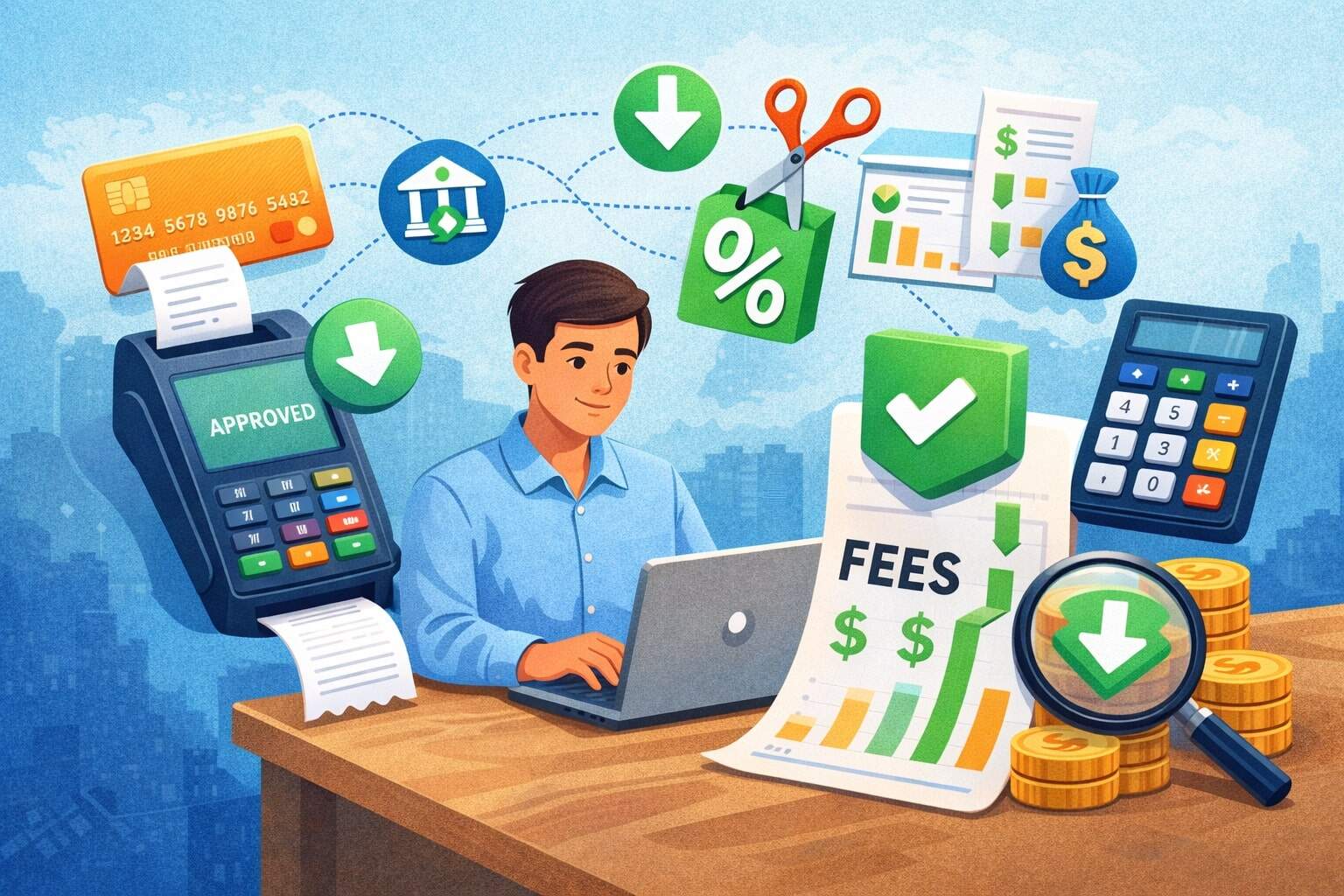
Credit card acceptance is convenient for customers, but expensive for merchants. If you want to lower credit card processing fees without hurting sales, you need to understand what drives your rate, which levers actually move the needle, and which “discount” offers are just marketing.
Most businesses can lower credit card processing fees by improving transaction quality (how a payment is captured and verified), choosing the right pricing model, reducing risk signals that trigger downgrades, and negotiating the processor’s markup with real data.
Some businesses can also lower credit card processing fees by steering payments (legally and ethically), optimizing debit acceptance, and using Level 2/Level 3 data for commercial cards.
In late 2025 there were also notable developments around interchange-fee disputes and proposed rule changes that could affect future costs and card acceptance strategies.
This guide shows you how to lower credit card processing fees step-by-step, with practical actions you can apply whether you take payments in-store, online, over the phone, or through invoicing—plus realistic forecasts for where fees are headed next.
Understand What You’re Really Paying (And Why Your “Rate” Keeps Changing)
To lower credit card processing fees, start by separating the three big cost buckets that make up almost every card transaction:
1) Interchange (set by the card networks and paid to the card-issuing bank). Interchange varies by card type (rewards vs. basic), acceptance method (chip, tap, keyed), business category, and data quality. It’s not negotiable with your processor.
2) Network assessments and brand fees (paid to the card networks). These include network fees that can change seasonally and differ by brand and transaction attributes. Card brands typically publish updates in cycles, and processors pass these through.
3) Processor markup (the part you can negotiate). This includes your provider’s margin, gateway fees, monthly fees, statement fees, risk fees, compliance fees, and various “service” add-ons. This is usually where the biggest savings are hiding.
A common mistake is comparing providers by one advertised rate. A better approach is comparing your effective rate: total fees divided by total processed volume, plus a separate look at “per-transaction” fees.
Your effective rate changes when your mix changes—more keyed transactions, more rewards cards, more online fraud pressure, more refunds, more commercial cards without enhanced data, and more small tickets can all push costs up even if your markup didn’t change.
If your goal is to lower credit card processing fees, you need to pull a current merchant statement and categorize every line item into interchange, network, and markup. When you do that, negotiations get easier, and optimization becomes measurable.
Choose a Pricing Model That Actually Helps You Lower Credit Card Processing Fees

A processor can charge you in several ways. Picking the wrong model makes it harder to lower credit card processing fees, because it hides costs or bundles them in ways that work against you.
Interchange-plus pricing is usually the most transparent: you pay interchange + network fees + a fixed processor markup (like “X% + Y¢”). This is often the best starting point for merchants who want to lower credit card processing fees because it cleanly separates non-negotiable costs from negotiable ones.
Tiered pricing groups many interchange categories into “qualified / mid / non-qualified” buckets. It can be simpler to read, but it often makes it difficult to lower credit card processing fees because the “mid” and “non-qualified” tiers can be inflated, and downgrades become profit.
Flat-rate pricing (one rate for everything) is predictable and can be fine for very small volumes, but it’s usually not ideal for merchants trying to lower credit card processing fees at scale because the blended rate includes margin to cover worst-case scenarios.
Subscription / membership models (a monthly fee + low markup) can lower processing costs for higher volume merchants, but only if you audit all add-ons (gateway, PCI, support tiers, batch fees, chargeback programs). Otherwise, the savings can disappear.
To select correctly, match the model to your reality: average ticket size, percent card-present vs. card-not-present, refund rate, business category, and whether you accept a lot of premium rewards cards.
If you process meaningful volume, a transparent model with a clearly negotiable markup is the most reliable path to lower credit card processing fees.
Interchange-Plus Done Right: The Negotiation Checklist That Saves Real Money
If you’re on interchange-plus (or switching to it), focus your negotiation on what’s controllable. To lower credit card processing fees, push for:
- A single, simple markup (percentage + per-item) with no extra “non-qualified” bumps.
- Reduced or eliminated monthly minimums, statement fees, batch fees, and “platform” fees.
- Clear terms on gateway pricing if you run online payments.
- Transparent pass-through of network fees, with no padded “non-defined” categories.
Then validate the offer by asking for a side-by-side cost analysis using your last full month of transactions (not a “sample”). If the provider won’t do it, do your own: you only need total volume, transaction count, refunds, card-present vs. card-not-present mix, and a statement with line items.
Also watch for contracts that look cheap but lock you into expensive equipment leases, long auto-renewals, or liquidated damages. The fastest way to lower credit card processing fees is often renegotiating your markup—without getting trapped in a bad agreement.
Fix Downgrades, Data Gaps, and “Avoidable” Fees That Inflate Your Costs

A big portion of your processing expense comes from transactions “qualifying” poorly. If you want to lower credit card processing fees, you must improve how transactions qualify.
For in-person transactions, chip and contactless typically qualify better than keyed. For online, strong address verification and security signals help. For phone and invoice payments, you need the right settings and fraud controls so you don’t pay “penalty” pricing.
Here are common cost inflators:
- Keyed entry when you could use tap, chip, QR, pay-by-link, or saved credentials (tokenization).
- Late batching (capturing after a delay), which can cause higher costs depending on programs and settings.
- Missing AVS/CVV for card-not-present payments (when allowed), increasing risk and sometimes costs.
- Excessive refunds and reversals, which still carry fees and can worsen your risk profile.
- Poor descriptor hygiene causing disputes (more chargebacks = more fees).
You can often lower credit card processing fees by tightening operational discipline: train staff, standardize checkout steps, enforce capture timing, and configure your POS/gateway correctly.
Level 2 and Level 3 Data: One of the Most Overlooked Ways to Lower Credit Card Processing Fees
If you serve business customers who pay with commercial cards, enhanced data can materially lower credit card processing fees on eligible transactions. “Level 2” and “Level 3” data can include tax amount, customer code, invoice number, line-item detail, unit cost, and other fields—depending on the card type and program rules.
The key is that your POS, invoicing platform, or gateway must support collecting and passing this data at authorization/capture. Many businesses assume they “take corporate cards” and therefore get corporate benefits, but without enhanced data, commercial cards can price at more expensive tiers.
To implement this:
- Confirm your software supports Level 2/3 for the payment method you use (virtual terminal, invoice, ERP integration, or gateway).
- Map your invoices so tax, shipping, and line items populate the right fields.
- Ensure your capture process sends the enhanced data consistently (not just sometimes).
This is one of the few operational changes that can lower credit card processing fees without asking customers to change behavior—especially in B2B settings.
Optimize Debit Acceptance and Routing to Reduce Total Processing Cost

If you want to lower credit card processing fees, you should care about debit—not just credit. Debit transactions can be cheaper than credit, but only when they’re accepted and routed efficiently.
First, make sure your checkout flow supports PIN debit when appropriate (and when customers prefer it). Second, ensure your POS is configured for the right routing options your provider supports. Third, monitor your statement for debit network fees that quietly rise over time.
Card brand programs and debit network fee schedules are updated periodically, and changes can affect merchants depending on how transactions are routed and categorized.
The goal isn’t to “force” debit; it’s to remove friction so customers who want to pay debit can do so smoothly. In many everyday retail settings, nudging more volume to debit (ethically, with clear options) can lower credit card processing fees across the month—especially if your average ticket is small and your per-item fees are painful.
Reduce Small-Ticket Pain: The Per-Transaction Fee Problem (And How to Solve It)
For coffee shops, quick-service, convenience, salons, and other small-ticket businesses, the per-transaction component (the “¢” part) is often the real enemy. A few cents here and there becomes huge at scale.
To lower credit card processing fees on small tickets:
- Negotiate the per-item fee aggressively (even small changes matter).
- Encourage contactless to speed checkout and reduce errors/refunds.
- Consider minimum purchase policies only where permitted and customer-friendly (but avoid tactics that frustrate buyers).
- Use bundles (e.g., “combo pricing”) so the average ticket rises naturally.
- Reduce duplicate authorizations and void/rebill patterns that create extra fees.
Small-ticket optimization is less about interchange and more about transaction design. When you redesign the buying moment, you can lower credit card processing fees while improving throughput.
Use Surcharging, Cash Discount, or Dual Pricing Carefully (Compliance Matters)
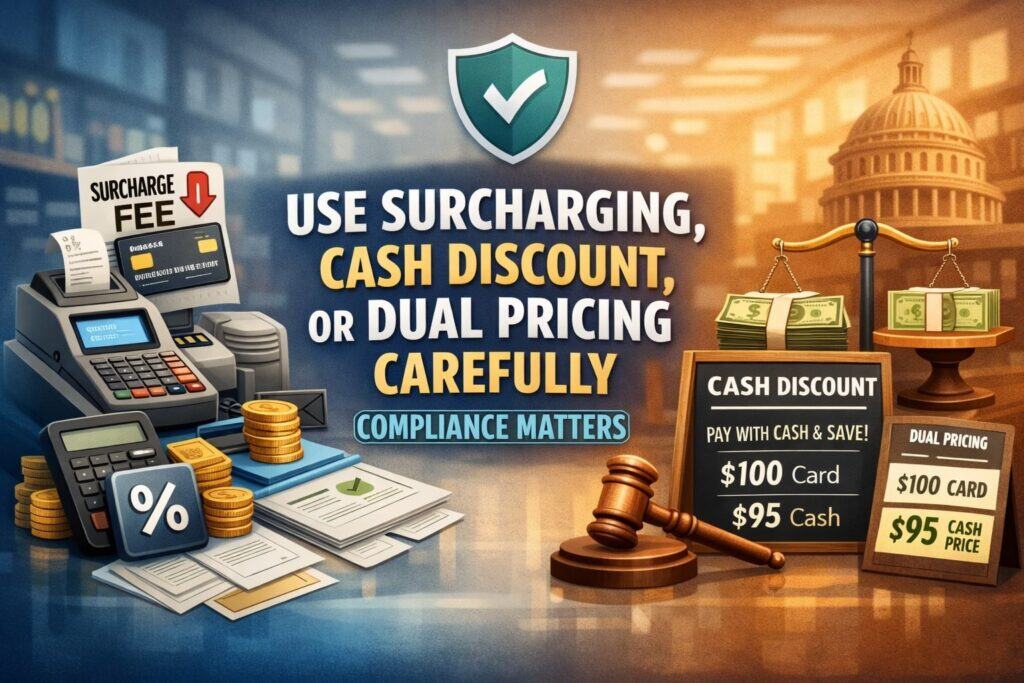
Many merchants explore surcharging or cash discount programs to offset costs. Done correctly, these can help you lower credit card processing fees (or more accurately, reduce your net cost). Done incorrectly, they can trigger compliance issues, customer complaints, or disputes.
Card network rules typically allow credit card surcharging under specific conditions, while prohibiting surcharges on debit and prepaid in many cases.
Visa’s merchant guidance emphasizes that surcharging applies only to credit and must follow specific requirements. Mastercard also publishes surcharge rule guidance, including caps and permitted approaches.
Because laws and card brand rules interact—and can differ by state—you should verify legal requirements for your specific location and business type before implementing any program.
Important practical advice if you’re using these strategies to lower credit card processing fees:
- Be transparent at the door, at the register, and on receipts.
- Don’t surcharge debit (even if the terminal says “credit” on a debit card).
- Set your surcharge to comply with brand caps and disclosure rules.
- Train staff on how to explain pricing clearly without arguing with customers.
These programs work best when your customers understand the value and when your checkout experience stays simple.
What Customers Will Tolerate: Messaging That Protects Sales While You Lower Credit Card Processing Fees
Even if a surcharge or dual pricing approach is allowed, the customer experience determines whether it helps or hurts. To lower credit card processing fees without losing revenue:
- Use plain language: “Card price / cash price” or “A service fee applies to credit cards.”
- Keep signage consistent across entry, menu, and checkout.
- Avoid surprise fees at the final screen—this is where complaints and chargebacks start.
- Offer alternatives: ACH, debit, pay-by-link, or digital wallet.
If your market is price-sensitive, consider focusing first on behind-the-scenes optimization (pricing model, markup negotiation, transaction quality). Those methods lower credit card processing fees without changing your public pricing at all.
Audit Your Processor Like a Pro: Hidden Fees, Junk Add-Ons, and Contract Traps
A reliable way to lower credit card processing fees is eliminating “silent” costs that don’t show up in the advertised rate. Many merchants overpay because they never audit these line items:
- PCI “program” fees far above normal compliance costs
- Monthly “regulatory product” bundles
- Gateway fees stacked on top of platform fees
- Equipment insurance, helpdesk tiers, or security packages you don’t use
- Excessive chargeback “monitoring” subscriptions
- Annual fees that jump after the first year
To audit quickly:
- Export 3–6 months of statements.
- List every fee that isn’t interchange or a known network assessment.
- Total them as a monthly “overhead.”
- Divide by volume to see how much they add to your effective rate.
Then request a fee cleanup. If they refuse, that’s often your signal to shop. The fastest path to lower credit card processing fees is removing unnecessary monthly charges and compressing markup into one transparent number.
Also review your contract terms: auto-renewal windows, early termination fees, and equipment leases. Processing savings can evaporate if you’re trapped. A fair agreement gives you flexibility while you work to lower credit card processing fees over time.
Future Outlook: Where Processing Fees Are Headed (And How to Prepare)
Processing costs evolve due to network fee updates, competitive pressure, regulation, fraud trends, and changes in consumer payment behavior.
In late 2025, reporting indicated ongoing settlement discussions and proposals involving interchange fees and merchant acceptance rules, including potential changes that could lower fees modestly over multiple years and expand merchant flexibility in card acceptance categories—though such agreements still require approval and may face criticism from merchant groups.
What’s likely in 2026 and beyond if you’re trying to lower credit card processing fees:
- More pressure on surcharging/fee transparency: networks and regulators tend to focus on consumer clarity and consistent disclosure.
- More routing and choice debates: merchants and networks continue to clash over competition, network selection, and premium card costs.
- Fraud-driven cost shifts: as online fraud tactics evolve, risk controls may become more necessary (and sometimes more expensive), making optimization a moving target.
- Growth of account-to-account payments (bank transfer rails) for invoices and larger tickets, especially where instant options and request-for-payment features improve.
The best preparation is building a “fee control system,” not doing a one-time switch. Merchants who continually monitor qualification, dispute rates, checkout patterns, and statement line items consistently lower credit card processing fees year after year.
FAQs
Q.1: What is a “good” processing rate?
Answer: A “good” rate depends on your business type, average ticket, and how you accept cards. Instead of chasing a single percentage, aim to lower credit card processing fees by improving your effective rate month-over-month. Compare providers using your real transaction mix, not a quote.
Q.2: Is interchange negotiable?
Answer: No. Interchange is set by the card networks and paid to issuing banks. You can lower credit card processing fees by negotiating the processor markup, reducing avoidable fees, and improving qualification so you don’t fall into more expensive categories.
Q.3: Does accepting tap/contactless reduce fees?
Answer: It can. Tap often reduces operational errors and speeds checkout. While interchange is category-based, better acceptance methods can reduce downgrades and fraud-related costs, helping lower credit card processing fees over time.
Q.4: Will raising prices be easier than optimizing fees?
Answer: Sometimes raising prices is simpler, but it can reduce conversion. Many merchants can lower credit card processing fees without raising sticker prices by renegotiating markup, reducing add-ons, and optimizing debit and data quality.
Q.5: Are cash discounts and surcharging the same?
Answer: Not exactly. “Cash discount” frames the lower price as the default, while surcharging adds a fee to credit card transactions under specific rules. Both can affect customer perception. If you use them to lower credit card processing fees, do it with strict compliance and clear signage.
Q.6: How often should I review my processing?
Answer: At least quarterly, and immediately after any noticeable rate spike. Network and interchange changes can occur periodically, so ongoing monitoring helps you lower credit card processing fees consistently.
Conclusion
To lower credit card processing fees, don’t start by switching providers on a promise. Start by measuring your effective rate, separating interchange from markup, and eliminating hidden overhead. Then choose a pricing model that stays transparent as your business grows.
Next, attack the operational drivers: reduce keyed entry, fix batching and authorization/capture settings, improve data quality, and implement Level 2/3 where it applies. Make debit acceptance frictionless. If you explore surcharging or dual pricing, follow brand rules and disclosure requirements carefully.
Finally, treat fee reduction as a continuous process. Fees, fraud patterns, and network programs change. Merchants who monitor monthly statements, tune checkout flow, and renegotiate markup with evidence will reliably lower credit card processing fees—without sacrificing customer experience or growth.
Leave a Reply