By merchantservicesindustry February 3, 2026
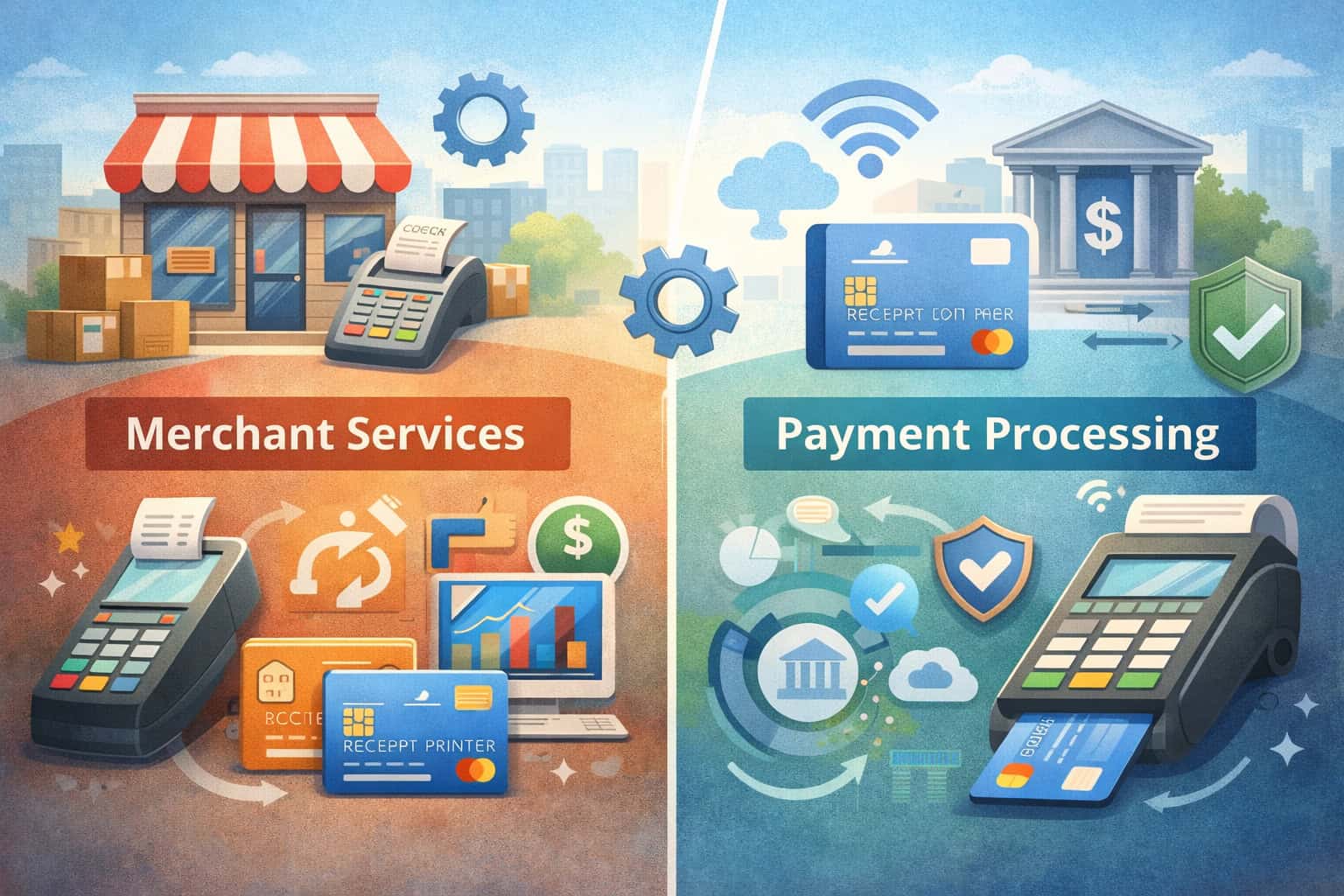
If you’ve ever compared providers and felt like every website uses the same words differently, you’re not imagining it. “Merchant services” is often used as a broad umbrella term, while “payment processing” is usually one specific part of the money-movement engine.
The problem is that many providers market themselves as “merchant services companies” even when they mostly sell processing, and many “processors” also bundle hardware, software, and support that looks like full merchant services.
That confusion has real consequences. When you’re evaluating merchant services vs payment processing, you might focus only on the processing rate and overlook contract terms, chargeback tools, gateway fees, funding speed, or POS compatibility.
Or you might buy a terminal and assume you’re fully set up—only to discover you still need a gateway, an e-commerce integration, or a different pricing model for card-present vs. online transactions.
This guide breaks down merchant services vs payment processing in a way that’s practical and easy to apply. You’ll learn what each term includes, who the key players are, how fees actually work, what to watch for in contracts, and what future trends may change the landscape.
Along the way, you’ll see relevant terms (gateway, acquiring, interchange, PCI, chargebacks, tokenization, batching, ACH, real-time payments, and more) explained in plain language—so you can choose the right setup for your business and avoid expensive surprises.
Core idea behind merchant services vs payment processing
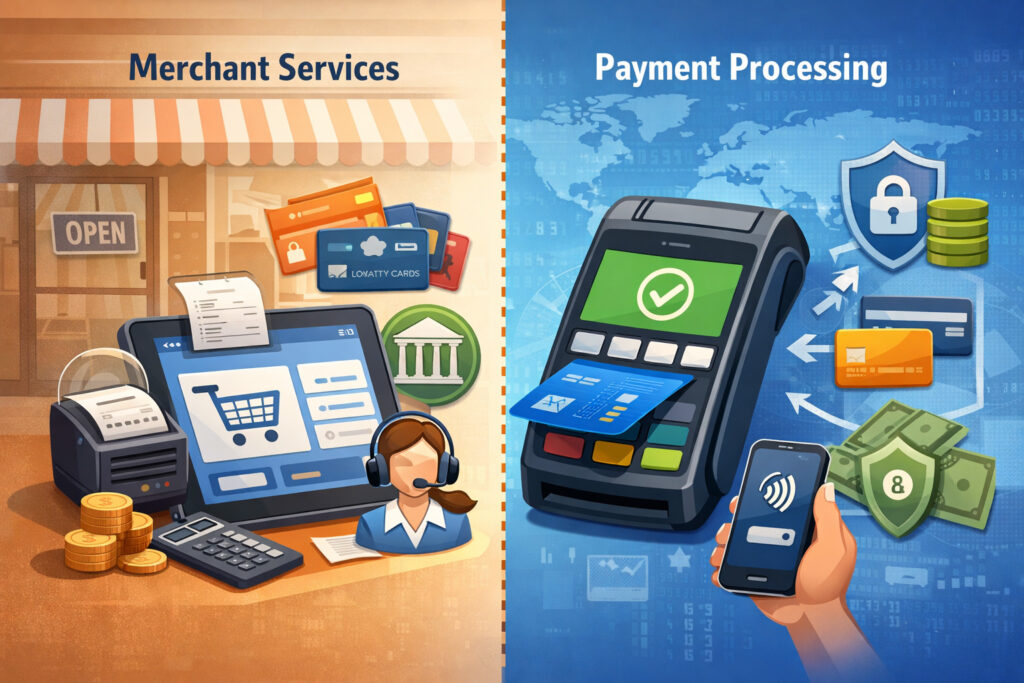
At the highest level, merchant services vs payment processing comes down to scope. Merchant services is the relationship and toolkit a business uses to accept and manage payments. Payment processing is the mechanism that authorizes, routes, and settles a transaction from a customer to your business bank account.
Think of merchant services as “everything needed to get paid and stay paid.” That can include the merchant account (or payment acceptance account), hardware, POS software, payment gateway, invoicing tools, recurring billing, fraud protection, chargeback management, reporting dashboards, customer support, and sometimes even lending or payroll add-ons. Providers often bundle these into one package and call it merchant services.
Payment processing, by contrast, is the “moment of truth” flow that happens when a customer taps, inserts, swipes, clicks, or pays through a wallet.
It’s the set of steps that checks whether the customer has available funds, whether the card credentials are valid, and whether the transaction meets risk rules—then moves transaction data through card networks and banking rails so your business eventually receives funds.
If you remember one thing, remember this: in merchant services vs payment processing, merchant services is the broader business solution, while payment processing is the transaction engine inside it.
Understanding the difference helps you compare providers apples-to-apples, negotiate better, and build a payment setup that matches how you actually sell—online, in-store, mobile, or all of the above.
The simplest way to separate the two
A practical way to separate merchant services vs payment processing is to ask: “What happens before, during, and after a transaction?” Payment processing is mainly the “during.” Merchant services cover “before and after” too.
Before the transaction, merchant services can include underwriting and account setup, terminal configuration, POS installation, gateway setup, staff training, payment links, invoice templates, tax settings, tip settings, and security controls. This is the operational layer that makes accepting payments smooth and consistent.
During the transaction, payment processing handles authorization and routing. It decides whether a payment is approved or declined and passes the transaction through the right network path. It also applies risk checks, data validation, and sometimes tokenization.
After the transaction, merchant services can include batching, funding visibility, reconciliation reports, dispute workflows, receipt systems, customer support, refunds, and analytics. Even if the processing rate looks great, weak “after” tools can cost time and money through delayed deposits, high chargeback losses, and messy bookkeeping.
So when comparing merchant services vs payment processing, don’t stop at the headline rate. Map what you’re buying across the full lifecycle: setup, acceptance, risk, funding, and management. That’s how you avoid hidden fees, mismatched hardware, and support gaps that show up only when you’re already live.
What “merchant services” includes in practice

Merchant services is a bundled category, and that’s why it’s often misunderstood. In the merchant services vs payment processing debate, merchant services typically includes everything required for a business to accept payments across one or more channels: in-person, online, mobile, phone orders, invoices, subscriptions, or marketplaces.
A merchant services package may include a merchant account or a payment facilitator arrangement, a payment gateway for online transactions, terminals or POS devices, virtual terminals for keyed payments, and a reporting portal.
It can also include add-ons that aren’t strictly required to process a payment, such as customer loyalty, gift cards, staff management, inventory tools, QR-code ordering, or integrated accounting exports.
Merchant services also includes ongoing operational support: device replacement policies, compliance guidance, dispute handling help, and sometimes risk monitoring. Some providers position these support services as the main value—especially for businesses that don’t want to “DIY” their payments stack.
Because merchant services is broad, two providers can both claim to offer “merchant services” while delivering very different experiences. One may sell basic processing with a terminal.
Another may deliver an integrated POS ecosystem with inventory, e-commerce, marketing, and advanced fraud tools. Both are “merchant services,” but only one may match your business needs.
When evaluating merchant services vs payment processing, merchant services is best viewed as your “payments operations department in a box.” The right merchant services setup reduces friction, improves acceptance rates, speeds up deposits, and creates clean records for accounting.
Common merchant services products businesses actually use
In the merchant services vs payment processing landscape, the most common merchant services components include:
- Merchant account setup and underwriting: This is where a provider reviews your business type, processing history, product mix, and risk indicators. Approval terms can include volume limits, reserve requirements, or additional documentation.
- Card-present acceptance tools: Terminals, countertop devices, mobile readers, and integrated POS systems all fall here. These tools often support chip cards, contactless payments, and digital wallets.
- E-commerce and omnichannel tools: Payment gateways, hosted checkout pages, API integrations, shopping cart plugins, and token storage. If you sell online, this layer often matters as much as the processing rate.
- Invoicing and recurring billing: Payment links, emailed invoices, stored customer credentials, subscription management, and automated retries for failed payments.
- Risk and dispute management: Fraud filters, AVS/CVV controls, 3DS options for online orders, chargeback alerts, and workflows to respond to disputes within deadlines.
- Reporting, reconciliation, and support: Dashboards, settlement reports, batch tracking, deposit mapping, user permissions, and customer service that can actually solve issues quickly.
So in merchant services vs payment processing, merchant services is the “full toolkit.” If you choose a provider based only on processing pricing, you may accidentally buy a toolkit that doesn’t fit your workflow—especially if you need online payments, subscriptions, or multiple locations.
What “payment processing” includes in practice
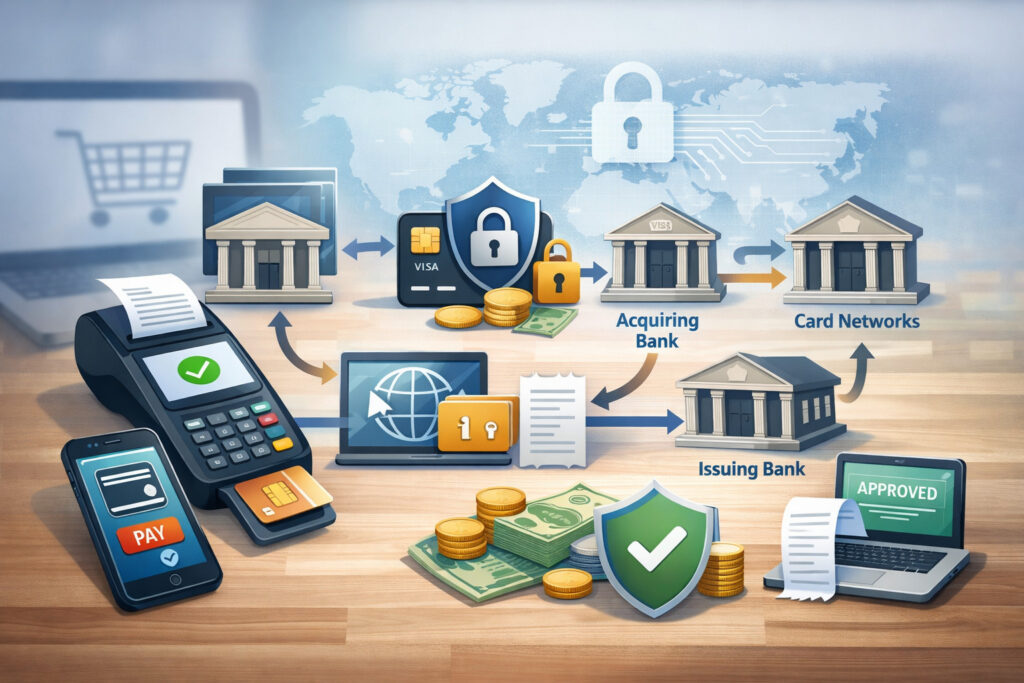
Payment processing is the set of systems and rules that make a payment “go through.” In merchant services vs payment processing, processing refers to the authorization, clearing, and settlement activities that route transaction data through networks and banks so funds can move to you.
Processing is not just “charging a card.” It includes verifying transaction data, applying risk rules, choosing routing paths, communicating with issuing banks, and creating settlement files. It also involves handling reversals, refunds, partial approvals, and edge cases like offline transactions or duplicate authorizations.
Payment processing also includes maintaining uptime, managing network certifications, ensuring data security requirements are met, and supporting new payment types as they emerge. A provider may market processing as a commodity, but the quality of processing directly affects approval rates, fraud rates, and customer experience.
In practice, payment processing is where many “invisible” costs live. A weak processing setup can cause false declines, slow deposits, high fraud, and frequent terminal errors. A strong processing setup can increase acceptance, reduce disputes, and provide cleaner reconciliation—sometimes delivering more value than a slightly cheaper rate.
So when comparing merchant services vs payment processing, remember that processing is a specialized function that impacts your revenue every day. It’s not only price—it’s reliability, acceptance, and risk performance.
Step-by-step: how a card and wallet transaction moves
A simplified view of merchant services vs payment processing becomes clearer when you see the processing steps:
- Payment initiation: The customer taps, inserts, swipes, clicks, or uses a wallet. The device or website collects payment data (or a token), plus transaction details like amount, currency, and merchant information.
- Data validation and security: The system confirms data is formatted correctly, applies encryption, and may tokenize sensitive details. For online payments, it may run checks like AVS (address match) and CVV verification.
- Authorization request: The transaction request is routed to the card network and then to the issuing bank (the customer’s bank). The issuer checks available funds, fraud signals, and account status.
- Authorization response: The issuer approves or declines. If approved, an authorization hold is placed on the customer’s account. The business receives an approval code and can complete the sale.
- Batching and capturing: Many businesses capture transactions in a batch (often at end of day). This “capture” tells the system to finalize the transaction for settlement.
- Clearing and settlement: Transaction data moves through network clearing, and the funds are settled through banking rails. Your deposit arrives based on the provider’s funding schedule and risk policies.
- Post-transaction events: Refunds, chargebacks, and retrieval requests can still occur. Processing systems track these and update reports and balances.
That’s payment processing in merchant services vs payment processing: a rules-driven transaction engine. Merchant services is everything that wraps around it to make that engine useful for your business day-to-day.
Key players in the ecosystem
Understanding who does what is essential when comparing merchant services vs payment processing because many providers play multiple roles—or outsource roles behind the scenes. When you know the roles, you can ask better questions, identify responsibility during problems, and avoid paying twice for the same function.
The most common players include the merchant (your business), the customer, the issuing bank, the acquiring bank (or acquiring institution), the processor, the card networks, and the gateway. Depending on the setup, you might also see an ISO/agent, a payment facilitator, a POS software company, and a fraud tool provider.
In many modern setups, one brand sells you a unified “merchant services” package, but the actual processing might be performed by a separate backend processor. That’s not automatically bad, but it affects support. If a transaction issue occurs, you want clarity on who can fix it and how fast.
This is also where “merchant services vs payment processing” becomes a business operations question. Merchant services providers often handle onboarding, devices, billing, and front-line support. Processors and acquiring partners handle network connections, settlement, and backend risk systems. Gateways handle e-commerce routing and token storage.
If you don’t understand the stack, it’s easy to blame the wrong layer when something breaks—or accept vague answers like “the bank declined it” when the real issue is a gateway misconfiguration or an overly strict fraud rule.
Who does what: processor, acquirer, gateway, ISO, and networks
Here’s the role breakdown for merchant services vs payment processing in plain language:
- Processor: The processor provides the technical infrastructure that routes transactions for authorization and settlement. Processors connect to networks, manage message formats, and support reporting and reconciliation files.
- Acquirer (acquiring institution): The acquirer sponsors the merchant’s ability to accept card payments. It’s the party connected to the merchant account relationship from a banking standpoint. The acquirer is heavily involved in underwriting and risk policies.
- Gateway: A payment gateway is common for online transactions. It securely captures payment details (or tokens), transmits transaction data to the processor, and often provides developer tools and plugins.
- ISO/agent: An Independent Sales Organization (ISO) or agent often sells merchant services on behalf of a backend processor/acquirer stack. They may provide support and pricing, but they typically don’t run the processing rails themselves.
- Card networks: The networks carry authorization and clearing messages between acquirers and issuers. They also define rules and assessments, and they influence dispute processes.
- Issuer: The customer’s bank makes the final approval decision for authorization and manages the customer’s account.
When evaluating merchant services vs payment processing, ask: “Who is my processor? Who is my acquirer? What gateway do I use? Who provides support at 8 PM on a Saturday?” Clear answers reduce downtime and finger-pointing when issues appear.
Pricing and fee structures
Pricing is where merchant services vs payment processing gets messy, because many fees are processing-related but billed through the merchant services relationship. It’s common to see a blended rate in marketing, but a more complex mix of line items on a statement.
In a typical card transaction, there are at least three layers of costs: interchange (paid to issuers), network assessments (paid to networks), and the provider’s markup (paid to the processor/merchant services provider).
On top of that, you may see monthly fees, gateway fees, PCI fees, chargeback fees, statement fees, device fees, and program fees for add-ons.
Pricing can be presented in several models: flat rate, tiered, or interchange-plus. Each has tradeoffs. Flat rate is simpler and predictable but may be higher for many businesses. Interchange-plus is more transparent and often cost-effective at scale, but statements look more complex. Tiered pricing can be hard to compare because “qualified” categories vary by provider.
The key is to align pricing with how you sell. Card-present transactions with chip and contactless tend to price differently than e-commerce transactions. Keyed transactions often cost more and carry more risk. If you do subscriptions, you’ll want to understand stored credential rules, retry logic, and dispute exposure.
In merchant services vs payment processing, the best pricing decision is rarely “lowest advertised rate.” It’s “lowest total cost for my real transaction mix, with terms I can live with.”
How to read statements and spot markups
To compare merchant services vs payment processing offers, you need to interpret statements like an analyst, not like a shopper.
Start by identifying your pricing model:
- Flat rate: One rate for most cards, often with separate rates for card-present vs online. Watch for extra fees like per-transaction, chargeback, or gateway charges.
- Interchange-plus: You’ll see interchange categories listed plus a consistent markup (for example, “interchange + X% + Y cents”). Look for the effective rate across a month, not one transaction.
- Tiered: Transactions are grouped into “qualified,” “mid-qualified,” and “non-qualified.” The risk is that many transactions drift into more expensive tiers due to card type, entry method, or business rules.
Then look for hidden or easily missed costs:
- Gateway and access fees (especially for e-commerce, invoicing, or virtual terminal access).
- Monthly minimums that require you to pay extra if volume is low.
- PCI compliance fees and non-compliance penalties.
- Batch fees (charged per settlement batch, sometimes daily).
- AVS/CVV fees for online verification.
- Chargeback and retrieval fees that add up quickly.
- Equipment leases that lock you in, often costing far more than buying hardware.
A smart approach in merchant services vs payment processing is to request a “total cost estimate” based on your last 60–90 days of transaction data. Any provider that refuses to model your actual mix is asking you to guess—and guessing is expensive.
Contracts, underwriting, and risk controls
Contracts and risk rules often matter more than a small difference in rate. In merchant services vs payment processing, merchant services is the relationship that defines your terms, while payment processing is the mechanism that enforces risk controls transaction by transaction.
Underwriting is the approval process that evaluates whether your business is eligible and what conditions apply. Depending on business type and history, underwriting can include volume caps, reserve requirements, delayed funding, or additional documentation like invoices, supplier agreements, and proof of fulfillment policies.
Risk controls continue after approval. A provider may monitor sudden spikes in volume, unusual ticket sizes, high refund rates, or elevated disputes. If risk thresholds are triggered, you may see funding delays, a reserve hold, or account review. Understanding these policies is crucial because they impact cash flow.
Contract terms can include early termination fees, auto-renewal clauses, equipment lease agreements, and fee changes with short notice. Some contracts bundle services in a way that makes switching hard. Others allow month-to-month flexibility.
For businesses that sell high-ticket items, pre-orders, or services delivered weeks later, risk controls become even more important. Providers want to ensure customers receive what they paid for. If your business model includes delayed fulfillment, your merchant services agreement should explicitly support that timeline.
In the merchant services vs payment processing decision, you’re not only buying a rate—you’re buying rules. The best provider for you is the one whose risk and contract terms match your business reality.
Why approvals, reserves, and terminations happen
In merchant services vs payment processing, the most stressful issues usually involve funding holds or account termination, and they’re almost always risk-driven.
Reserves are funds held back to cover potential chargebacks or refunds. They’re more common in higher-risk models, new businesses with limited history, or businesses with long delivery timelines. Reserves can be rolling (a percentage held and released after a set period) or fixed (a set amount held until risk decreases).
Funding delays can happen when the provider wants to confirm legitimacy of transactions, verify large orders, or review sudden spikes. This often occurs after a marketing campaign, seasonal surge, or a big invoice payment.
Terminations happen when the provider believes the account is outside policy or the risk is unacceptable. Triggers can include high chargeback ratios, prohibited products, misleading marketing, unusually high refunds, or suspicious patterns like repeated declined attempts.
To reduce risk events, keep clear documentation: refund policy, fulfillment timelines, customer support logs, and proof of delivery where possible. Use fraud tools appropriate for your channel: AVS/CVV for online, strong authentication options where needed, and careful review for unusually large orders.
When comparing merchant services vs payment processing, ask providers about reserve policy, funding timeframes, what triggers reviews, and what documentation they require to release holds. Transparent answers here are worth more than a tiny discount in processing markup.
Hardware, software, and integrations
Technology decisions can quietly determine whether your payment setup feels effortless or constantly frustrating. In merchant services vs payment processing, merchant services often include devices and software, while payment processing is the backend engine those tools connect to.
If you’re in-person, your choices range from basic terminals to full POS systems with inventory and staff features. If you’re online, your choices include hosted checkout pages, plugins for popular platforms, or custom API integrations.
Many businesses are omnichannel, so the real challenge is making in-store and online reporting align—and ensuring tokens, customer profiles, and returns are handled consistently.
Integration quality matters because it affects authorization rates, customer experience, and reconciliation. A “cheap” setup can become expensive if it causes duplicate charges, missing orders, checkout errors, or manual bookkeeping.
On the other hand, a slightly higher-priced merchant services package can save hours per week if it unifies inventory, reporting, and payment data.
Also consider future flexibility. If you might expand to multiple locations, add online sales, or introduce subscriptions, choose a setup that can grow without forcing a full replacement.
In merchant services vs payment processing, your hardware and software are the front-end experience customers see and staff relies on. The best processing engine is still a problem if the front end is slow, outdated, or hard to support.
POS, gateways, APIs, and omnichannel setup
A strong merchant services vs payment processing setup usually includes the right blend of these components:
- POS system: Best when you need more than payments: inventory, barcode scanning, multi-location management, employee permissions, and integrated receipts. POS systems can reduce errors and speed up checkout.
- Standalone terminal: Best when you just need reliable card-present acceptance with minimal complexity. Look for chip + contactless support, strong connectivity options, and simple end-of-day batching.
- Payment gateway: Essential for most online sales. A good gateway provides secure tokenization, fraud tools, easy platform plugins, and solid developer documentation if you build custom checkout.
- APIs and webhooks: Critical for custom workflows: marketplaces, split payments, subscription logic, in-app payments, or automated reconciliation. APIs should support token creation, payment capture, refunds, and dispute events.
- Omnichannel features: These help unify customer profiles, reporting, and refund handling across online and in-person. This is often where merchant services providers differentiate beyond basic processing.
When evaluating merchant services vs payment processing, ask what integrations are supported today and what it would take to add new channels later. The best answer includes clear documentation, realistic costs, and support that understands your use case.
Funding, settlement, and cash-flow management
Getting paid quickly and predictably is often more important than getting the lowest rate. In merchant services vs payment processing, funding speed and deposit clarity are part of the merchant services relationship, but they are enabled by processing and settlement mechanics.
Most card transactions don’t deposit instantly. Funds move through authorization, capture, clearing, and settlement. Your provider may offer next-day funding, two-day funding, or longer depending on risk profile, business type, and transaction channel. Some providers also delay the first few deposits for new merchants or after unusual volume spikes.
Deposit reporting matters just as much as speed. If you can’t tie deposits back to batches and individual transactions, reconciliation becomes painful. That pain increases if you accept multiple payment types (card-present, online, invoices, wallets) or if you operate multiple locations.
Refund timing also affects cash flow. Refunds can reduce upcoming deposits or create negative balances depending on volume. Chargebacks can remove funds and add fees, and they can occur weeks after the original sale.
In the merchant services vs payment processing conversation, funding is where you feel the real-world impact. If deposits are delayed, unclear, or unpredictable, your operations suffer—even if your processing rate looks great on paper.
Timelines, batching, and reconciliation
To manage cash flow in merchant services vs payment processing, you need to understand three practical concepts: batching, settlement timing, and reconciliation.
Batching is the process of grouping approved transactions and sending them for capture and settlement. Many businesses batch at close of business. If a batch isn’t closed properly, funding can be delayed. Some modern systems batch automatically, but it’s still important to monitor.
Settlement timing is the expected schedule for deposits. This can vary by provider, day of week, holidays, risk level, and transaction type. Card-present may fund faster than keyed or online, depending on the provider’s risk model.
Reconciliation is matching deposits to transactions. Strong merchant services tools provide batch reports, deposit mapping, fees detail, and export formats that align with accounting workflows. Weak tools force manual work and increase errors.
You’ll also want to understand how fees are deducted. Some providers deduct fees daily (net funding), while others bill monthly (gross deposits plus a separate invoice). Each approach affects bookkeeping and cash visibility.
When comparing merchant services vs payment processing, ask to see sample reports, deposit breakdown examples, and how disputes and refunds appear in the dashboard. Clarity here saves time and reduces costly accounting mistakes.
Choosing the right provider for your business
The right choice depends on your business model, not just price. In merchant services vs payment processing, merchant services is your operational platform, and payment processing is the core engine.
Different businesses prioritize different outcomes: higher approval rates, fewer chargebacks, better reporting, faster funding, or smoother omnichannel operations.
Start with your sales channels. If you’re primarily in-person, you’ll care about terminal reliability, POS integration, tip support, and offline modes. If you’re online, you’ll care about gateway flexibility, fraud tooling, subscription management, and developer support. If you’re mixed, you’ll care about unified reporting and consistent customer records.
Next consider your average ticket size and risk profile. Higher ticket businesses need clearer reserve terms and stronger chargeback workflows. Service businesses need support for delayed fulfillment and clear refund policies. Businesses with recurring billing need stored credential support and clean dunning tools.
Also consider your internal capacity. If you don’t have technical staff, you may want a provider with strong onboarding and support. If you have developers, you may prioritize APIs and control.
In merchant services vs payment processing, the best provider is the one that reduces friction for your specific workflow while keeping total cost and risk manageable.
Decision checklist by business model
Use this checklist to compare merchant services vs payment processing options in a structured way:
- Retail and in-person service: Prioritize durable hardware, fast checkout, simple refunds, strong support, and clear deposit mapping. Ask about tip adjustments, batch procedures, and device replacement policies.
- E-commerce and shipping: Prioritize gateway features, fraud tools, chargeback alerts, address verification, and strong reporting. Ask about tokenization, 3DS options, and how disputes are managed.
- Professional services and invoicing: Prioritize invoice workflows, partial payments, stored customer profiles, and easy receipt delivery. Ask about keyed transaction pricing and verification tools.
- Subscriptions and memberships: Prioritize recurring billing controls, retries, account updater tools, and clear cancellation/refund workflows. Ask how failed payments and dispute ratios are handled.
- Multi-location and franchises: Prioritize centralized reporting, role-based permissions, and consistent pricing across locations. Ask how onboarding new locations works and how deposits are separated.
A good merchant services vs payment processing comparison includes a pilot mindset: test the dashboard, test a refund, test a batch close, and test support responsiveness. Many problems show up in the “daily operations” layer, not in the advertised rate.
Negotiation and optimization strategies
Once you understand merchant services vs payment processing, you can negotiate and optimize with confidence. Many businesses negotiate only on rate, but real savings often come from reducing unnecessary fees, choosing the right pricing model, and improving transaction quality (which can lower costs and risk).
Negotiation works best when you bring data. Use your last few months of statements and transaction summaries: volume, average ticket, percentage of card-present vs online, refund rate, and dispute rate. This helps a provider price accurately and helps you evaluate whether their offer is truly better.
Optimization also includes operational changes. For example, reducing keyed entry, improving fraud screening, using EMV and contactless for in-person, and tightening refund policies can reduce disputes and lower risk flags. In e-commerce, improving checkout flows and using tokenization properly can increase approval rates and reduce false declines.
Also optimize your reporting and reconciliation. If you can reduce manual work, you’re saving money even if your processing fee difference is small. Merchant services is not just the cost of acceptance—it’s the cost of running payments day-to-day.
In merchant services vs payment processing, the most valuable win is usually not a tiny rate change. It’s a better overall system that improves cash flow, reduces disputes, and saves time.
Questions to ask and red flags to avoid
Ask these questions when evaluating merchant services vs payment processing proposals:
- What pricing model is this, and what is the estimated effective rate based on my actual mix?
- What are all monthly and per-transaction fees, including gateway, PCI, batch, and verification fees?
- What are the contract length, renewal terms, and early termination fees?
- What funding schedule should I expect, and what triggers funding holds?
- Is there a reserve policy, and under what conditions can it be added later?
- What dispute tools are included, and what is the per-chargeback fee?
- Who provides support, and what are support hours? Is there escalation for urgent outages?
- If I change POS or e-commerce platform later, what changes and what stays the same?
Red flags include vague pricing that avoids showing total costs, equipment leases with long commitments, unclear support ownership (“call the gateway” vs “call the processor”), and contracts that auto-renew without clear notice.
One legal and compliance note that matters for many businesses operating across multiple states: rules can differ by state, card network policy updates occur regularly, and federal compliance expectations can apply depending on the product category and payment method.
If you operate in the United States, confirm how your provider supports compliance and risk management for your specific model.
In merchant services vs payment processing, clarity is power. The more transparent the provider, the fewer surprises you’ll face after you sign.
Future outlook and predictions for merchant services vs payment processing
The payments world keeps evolving, and the line between merchant services vs payment processing may blur even further. More providers are bundling value-added services—fraud tools, analytics, subscription management, and even banking features—into one platform.
At the same time, new payment rails and authentication standards may reshape what “processing” looks like.
One major trend is the growth of account-to-account payments and faster settlement options. Real-time payment rails and instant bank transfers can reduce reliance on traditional card rails for certain use cases, especially invoicing, bill pay, and B2B transfers.
That doesn’t remove cards—cards remain dominant for many consumer purchases—but it creates more competition and more choices for merchants.
Another trend is deeper fraud intelligence and automation. AI-driven risk scoring, network tokenization, and behavioral analytics are becoming standard. Expect merchant services platforms to push more “auto-optimization” features that adjust fraud rules, route transactions for better approvals, and improve retry logic for recurring billing.
We’ll also see more software-led merchant services. POS and commerce platforms increasingly “own” the merchant relationship and embed processing as a backend utility. That can simplify setup but can reduce flexibility if you want to swap processors later.
In short, merchant services vs payment processing will still matter, but the best providers will deliver both: strong processing performance plus strong operational tooling.
What is likely to change next (and what won’t)
What’s likely to change in merchant services vs payment processing:
- Faster availability of funds: More merchants will expect quicker deposits, even if true instant settlement isn’t universal. Providers will compete on funding speed and transparency.
- More tokenization everywhere: Tokenization will expand beyond wallets into broader card-on-file use, reducing fraud and making recurring payments smoother.
- Smarter routing and acceptance optimization: Platforms will use data to reduce false declines and improve approvals, especially for online transactions and cross-border scenarios.
- Stronger identity and authentication tooling” Online payments will rely more on risk-based authentication, device signals, and adaptive verification rather than blunt “decline rules.”
What likely won’t change:
- Risk management still matters: Underwriting, reserves, and dispute ratios will remain central. Providers will still protect themselves against chargeback exposure.
- Total cost beats headline rate: As long as pricing includes multiple layers (interchange, assessments, markup, and add-on fees), merchants will need to evaluate the full picture.
- Support quality remains a differentiator: When your payments break, the best processing engine doesn’t matter if nobody can fix it quickly.
So the future of merchant services vs payment processing points toward more integrated platforms, more automation, and faster money movement—but also continued importance of transparency, risk alignment, and operational fit.
FAQs
Q.1: Is merchant services the same thing as a merchant account?
Answer: Not exactly. In merchant services vs payment processing, a merchant account is often one component of merchant services. Merchant services can include the merchant account relationship (or an alternative structure like a facilitated onboarding model), plus devices, software, gateways, reporting, and support.
A merchant account typically refers to the account structure that enables your business to accept certain payment types and receive settlement.
Merchant services are broader: it includes how you accept payments (terminal, POS, online checkout), how you manage them (reports, refunds, roles), and how you reduce risk (fraud tools, chargeback handling).
Some providers market “merchant services” when they mostly mean “we can give you a merchant account and process cards.” Others offer a full commerce stack that includes inventory, loyalty, and employee features. That’s why it’s important to ask what’s included and what costs extra.
If you’re comparing offers, treat “merchant account” as the acceptance relationship and “merchant services” as the overall package. That framing makes merchant services vs payment processing far easier to evaluate.
Q.2: Can I buy payment processing without merchant services?
Answer: In practice, you’ll always have some merchant services, even if minimal. Payment processing needs a way to connect you to the acceptance ecosystem—an account structure, settlement rules, and compliance controls. But you can choose a lean setup: for example, processing plus a basic terminal, without a full POS or advanced add-ons.
Many businesses start with a minimal merchant services package and later add tools as they grow: invoicing, subscriptions, advanced fraud controls, or a POS system. Others start with a full merchant services platform to avoid rebuilding later.
So in merchant services vs payment processing, it’s less about buying one without the other and more about choosing how comprehensive your merchant services toolkit should be while ensuring the underlying processing is reliable and cost-effective.
Q.3: Why do my online payments cost more than in-person payments?
Answer: This is common in merchant services vs payment processing because online payments carry different risk signals and typically higher fraud exposure.
In-person EMV chips and contactless transactions provide stronger verification at the point of sale. Online transactions rely on address checks, CVV, device signals, and fraud filters, and the issuer may apply stricter risk decisions.
Online transactions can also have additional fees: gateway fees, verification fees, tokenization-related costs, and sometimes different processing markups depending on entry method. Keyed transactions (typing card numbers) often price similarly to online, sometimes higher.
To reduce costs, improve transaction quality: use AVS/CVV appropriately, enable stronger authentication options where needed, reduce manual entry, and keep consistent billing descriptors to reduce disputes.
In merchant services vs payment processing, lowering risk can indirectly lower total cost by reducing chargebacks and improving approval rates.
Q.4: What’s the best pricing model for small businesses?
Answer: There isn’t one universal best model in merchant services vs payment processing; it depends on your volume, ticket size, and channel mix.
Flat-rate pricing is simple and predictable, which is helpful when you’re starting out or when you want easy bookkeeping. Interchange-plus is often more transparent and can be cost-effective as volume grows, especially if you have a stable transaction mix and want to see the true underlying costs.
Tiered pricing can be harder to evaluate because the definitions of “qualified” categories vary and many transactions can land in expensive tiers. If you’re offered tiered pricing, ask for a breakdown based on your real transaction mix and compare it to an interchange-plus estimate.
The best approach in merchant services vs payment processing is to compare total monthly cost, not just one rate, and to weigh contract flexibility and support quality alongside pricing.
Conclusion
Choosing between merchant services vs payment processing isn’t about picking one and ignoring the other. Payment processing is the transaction engine that approves and settles payments.
Merchant services is the complete toolkit and relationship that makes that engine useful for daily operations—hardware, software, gateways, reporting, support, and risk tools.
If you focus only on the processing rate, you can miss the bigger drivers of cost and pain: hidden fees, weak reporting, slow funding, poor dispute handling, and rigid contracts.
If you focus only on the merchant services “features,” you can miss whether the underlying processing performance is strong—reliable uptime, good approval rates, and fair risk policies.
The smartest way to evaluate merchant services vs payment processing is to map your real workflow: how you sell, how you refund, how you handle disputes, how you reconcile deposits, and how fast you need funds.
Then compare providers using your actual transaction mix and insist on transparent, written answers to pricing, terms, funding schedules, and support responsibilities.
Payments will continue to evolve—faster rails, smarter fraud controls, more embedded platforms—but the fundamentals will remain: choose a setup that fits your business model, keeps total cost predictable, and gives you operational control.
When you understand merchant services vs payment processing, you can build a payment stack that supports growth instead of slowing it down.
Leave a Reply