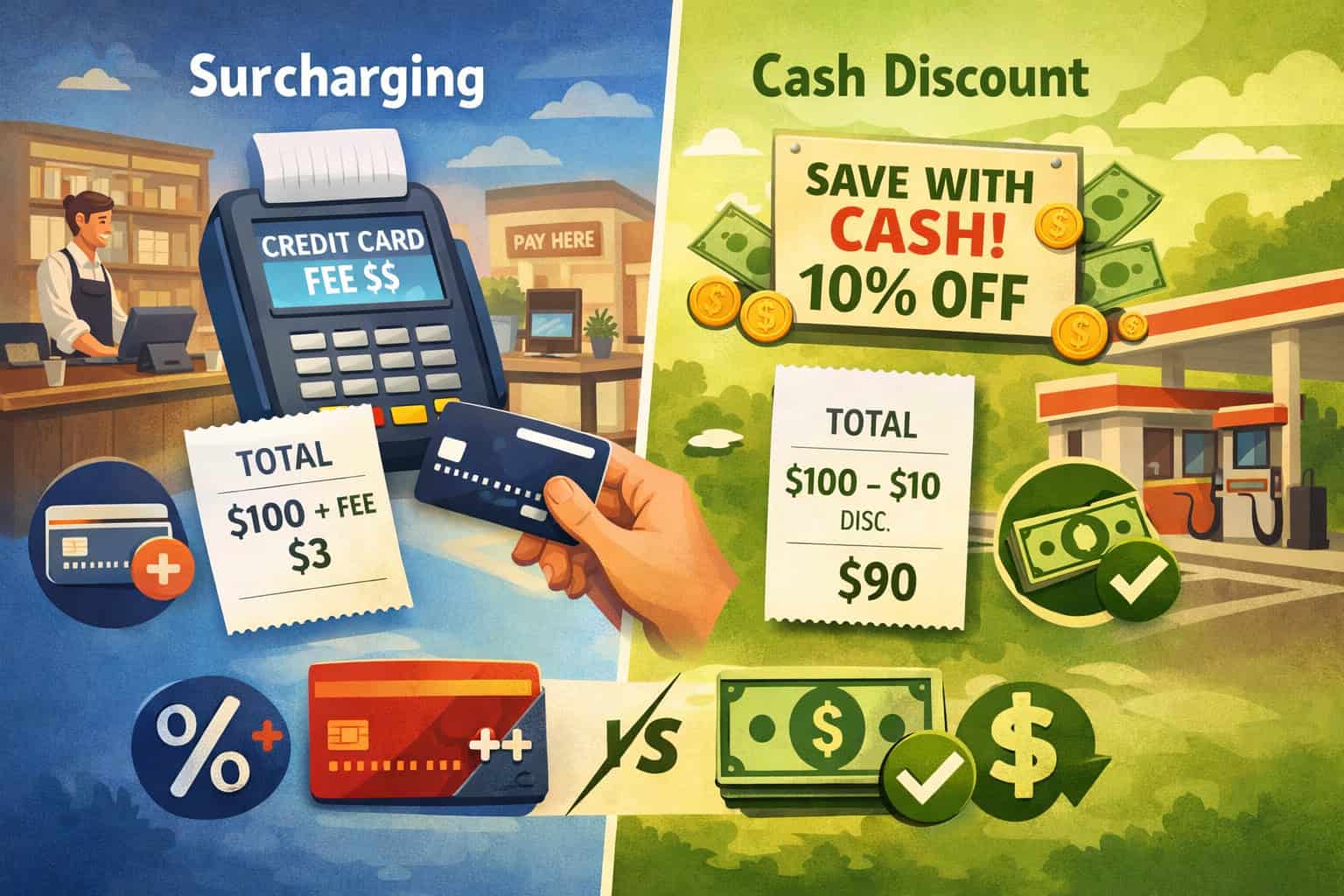
Card acceptance makes it easier to get paid, but it also eats into margins. For many business owners, processing fees feel like a cost that keeps rising quietly in the background until it starts showing up in pricing decisions, staffing, or cash flow.
That is why the conversation around surcharging vs cash discount programs has become so important. Both models are designed to address card acceptance costs, but they are not the same thing.
They work differently, create different customer experiences, and come with different compliance responsibilities. Confusing the two can lead to pricing mistakes, checkout friction, and avoidable problems with processors or card brands.
If you have ever wondered about credit card surcharging vs cash discount, this guide breaks it down in a practical way. You will learn what is credit card surcharging, what is a cash discount program, the difference between surcharge and cash discount, and how to decide which approach makes sense for your business model.
You will also see where business owners go wrong, how to explain each model to customers, and how to build a setup that reduces fees without creating bigger problems elsewhere.
Why businesses compare surcharging and cash discount programs
Business owners usually start exploring these models for one reason: they want to keep more of each sale. Processing costs can feel especially painful in industries with tight margins, price-sensitive customers, or frequent small-ticket transactions.
When you are paying card fees on almost every sale, even a small percentage can add up fast over the course of a month.
But fee reduction alone should not drive the decision. The better question is how you want to recover costs and how visible you want that pricing choice to be to customers. Some businesses prefer a separate fee on eligible credit card transactions.
Others would rather bake card acceptance costs into their standard price and offer a discount to customers who pay with cash. On paper, both can help you reduce credit card fees legally, but the customer experience feels very different.
This is also why the topic gets confusing. Many businesses use terms like dual pricing, non-cash adjustment, service fee, or surcharge interchangeably even when the actual pricing model behaves differently at the register.
That is where misunderstanding starts. Your signage may say one thing, your receipt may show another, and your processor may classify it differently than you expected.
A good decision requires looking at more than savings. You also need to think about:
- How customers react to visible price differences
- Whether your staff can explain the program clearly
- How your POS system handles pricing and receipts
- Whether your processor supports the model correctly
- What card brand and state-level requirements apply
For background on broader fee-saving options, resources on how to lower your credit card processing fees and cash discount programs can help put these pricing models into context.
Why this decision affects more than payment costs
The choice between surcharging and cash discounting changes the way customers perceive your business. A surcharge can feel like an added penalty to one customer and a fair cost recovery method to another.
A cash discount can feel like a savings opportunity to one customer and a hidden card price increase to someone else. The structure matters, but so does the presentation.
It also affects operations behind the scenes. If your pricing model increases cash usage, you may reduce card expense but create more cash handling, more balancing work, and more room for till errors.
If your model relies on a separate fee for credit card use, your receipts, signage, employee scripts, and checkout flow all need to line up cleanly.
That is why payment processing cost reduction strategies should never be viewed in isolation. Saving money on acceptance costs is only a win if the program is understandable, sustainable, and implemented correctly.
What credit card surcharging is and how it works
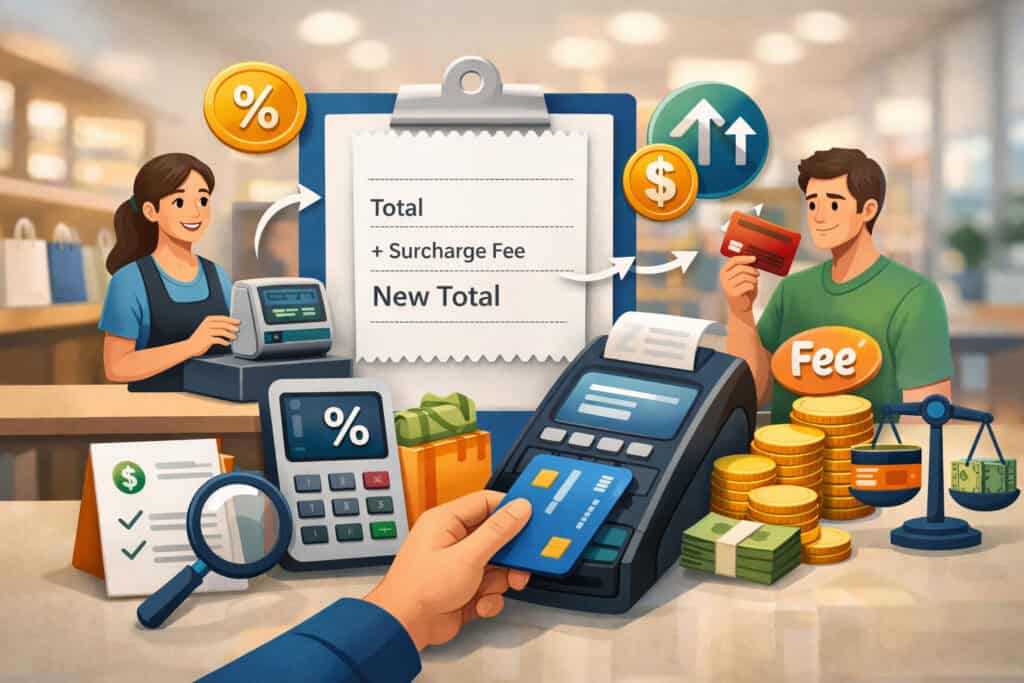
When people ask what credit card surcharge is, the simplest answer is this: it is an added fee applied to an eligible credit card transaction to help offset card acceptance costs. The listed price stays the regular price, and the surcharge is added when the customer chooses to pay with a credit card.
That last part matters. In a surcharge setup, the customer paying with cash is usually paying the posted price. The customer using an eligible credit card pays more than the posted price because an extra amount is added at checkout. This is the core of surcharge fees explained in practical terms.
Card networks treat surcharging as a specific type of fee program, not a general pricing shortcut. That means it comes with rules around disclosure, caps, and card-type eligibility.
Visa’s published merchant guidance says surcharging applies only to credit cards, not debit or prepaid cards, and limits the surcharge amount to the merchant’s discount rate or a network cap, whichever is lower. Mastercard also publishes merchant surcharge rules and disclosure requirements.
A surcharge program often appeals to businesses that want to keep shelf or menu pricing unchanged while recovering some processing costs from customers who choose higher-cost payment methods. The idea is straightforward, but the execution has to be precise.
What a surcharge looks like in a real transaction
Imagine a service business with a posted invoice total of $100. If the customer pays by cash, check, or another lower-cost method, the total remains $100. If the customer pays with an eligible credit card, the business adds a disclosed surcharge, and the final amount rises based on the allowed fee structure.
That setup sounds simple, but it can go sideways quickly if the business does any of the following:
- Applies the fee to debit cards
- Fails to disclose the fee before payment
- Uses the wrong receipt language
- Exceeds permitted caps
- Treats a non-compliant fee as a “service charge” to make it sound different
This is why credit card surcharging vs cash discount is not just a wording issue. In a surcharge model, the listed price is not the highest price. The final amount for a credit card customer is higher than the advertised base price.
Why some businesses choose surcharging
Surcharging can make sense when a business wants to recover credit card costs without repricing the entire menu, product catalog, or service sheet. It is often attractive to businesses where credit card usage is common, ticket sizes are meaningful, and management wants card users to absorb more of the acceptance cost directly.
Some businesses also like the accounting simplicity of keeping the base price unchanged and isolating the extra amount tied to eligible credit card use.
From a strategy standpoint, it is one of the more visible ways to reduce credit card fees legally when it is structured and disclosed correctly. But visibility is also the risk. Customers notice it immediately.
What a cash discount program is and how it works
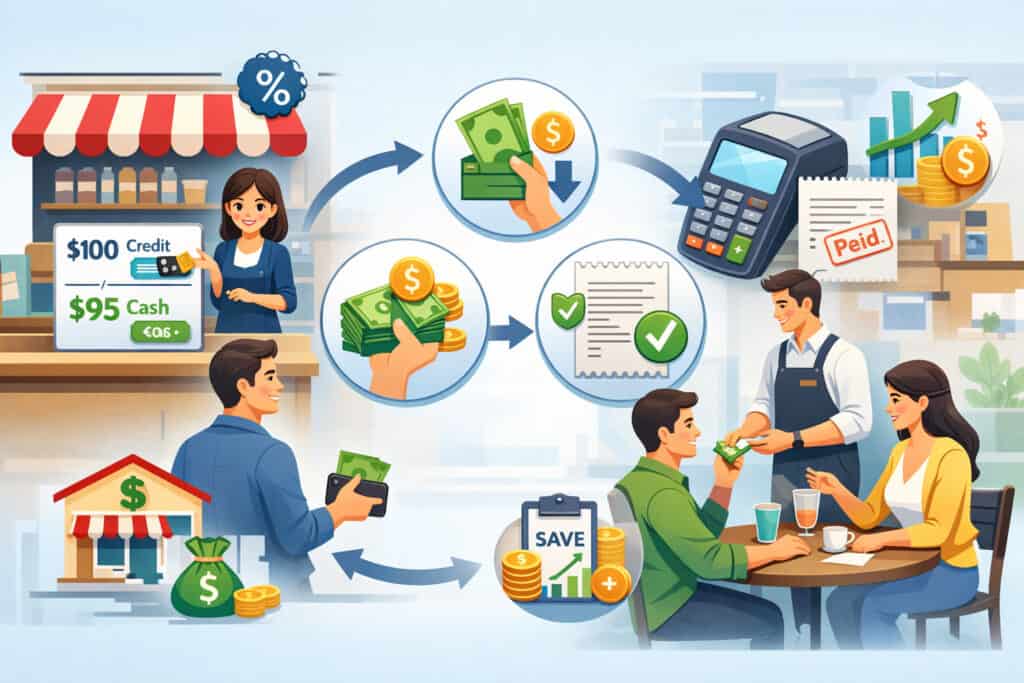
If you are asking what a cash discount program is, think of it as the reverse of surcharging. Instead of adding a fee when someone pays with a credit card, the business sets a standard listed price that reflects card acceptance costs and then offers a discount when the customer pays with cash or another qualifying lower-cost method.
That makes the pricing structure feel different even when the business goal is similar. Under a cash discount setup, the standard displayed price is typically the card price. The customer paying by card pays that standard price.
The customer paying by cash receives a discount from that price. This is why many merchants describe it as a cash discount pricing model rather than a card penalty model.
Payment networks distinguish cash discounts from surcharges. Visa’s merchant materials recognize discount offers, while separately regulating surcharges with tighter requirements.
That difference is important because many businesses accidentally build what acts like a surcharge while labeling it as a cash discount. When the advertised price is really the lower cash price, and card users are hit with an extra amount at checkout, the program may function more like a surcharge in practice.
A properly structured cash discount program is meant to present the standard price first and then reward the lower-cost payment choice.
What a cash discount looks like at the register
Picture a retail item displayed at $100. That is the standard price. If a customer pays with a card, the total stays $100. If the customer pays with cash, the system applies a discount and the final amount drops below $100.
That distinction is what separates a legitimate cash discount from a mislabeled fee. The receipt should support that story by showing the standard amount and then a discount line for the cash tender.
When the receipt instead shows a fee or adjustment added to the card transaction, you are drifting away from a true cash discount structure.
A lot of businesses like this approach because “pay with cash and save” is often easier for customers to accept than “pay with a card and pay extra.” It can also fit naturally with in-person environments where cash is still part of everyday operations, such as convenience stores, some restaurants, repair shops, automotive businesses, and neighborhood retail.
Why businesses choose a cash discount pricing model
Many business owners prefer cash discounting because it frames the pricing difference as a savings rather than a penalty. That can soften customer resistance. It also gives merchants a way to recover card costs while encouraging more cash usage, which may lower blended acceptance costs over time.
That said, cash discounting is not effortless. If more customers shift to cash, the business may save on card fees but spend more time on cash management, deposits, drawer balancing, and shrink control. The real benefit depends on your customer mix, average ticket, and operational discipline.
The key difference between surcharge and cash discount programs
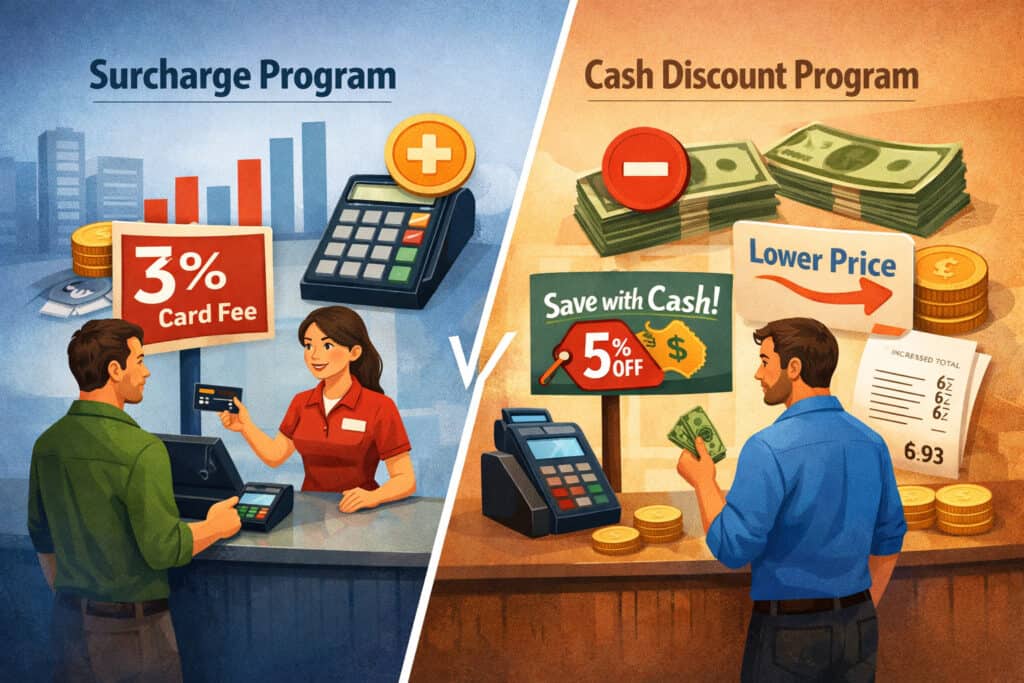
The difference between surcharge and cash discount comes down to one core question: what is your regular price?
In a surcharge model, the regular price is the posted price, and an added amount appears only when a customer uses an eligible credit card. In a cash discount model, the regular price is usually the displayed card-inclusive price, and a discount is applied when a customer pays with cash.
That sounds subtle, but it changes compliance treatment, receipt formatting, customer perception, and even whether the program is being described accurately.
This is why discussions around surcharging vs cash discount programs often become messy. A business owner may think they are offering a discount, while the actual checkout flow makes card users pay more than the displayed price. If that happens, the business may be operating closer to surcharging than to true discounting.
Here is a side-by-side comparison:
| Feature | Surcharging | Cash Discount Program |
| Posted or standard price | Base price before surcharge | Standard price usually includes card acceptance cost |
| What card customer pays | More than posted price if surcharge applies | Standard displayed price |
| What cash customer pays | Usually posted price | Less than standard price after discount |
| Applies to | Eligible credit cards only, subject to rules | Cash or qualifying lower-cost tenders get discount |
| Card network treatment | Specific rules, notices, and caps apply | Treated separately from surcharges when structured as a true discount |
| Common customer reaction | “I am being charged extra for using a card” | “I can save if I pay with cash” |
| Biggest risk | Non-compliance, especially around disclosure and debit handling | Poor presentation that turns the program into a disguised surcharge |
The practical lesson is simple: your signage, receipt, advertised prices, and processor setup all need to tell the same story. If they do not, you invite confusion.
Why the pricing story matters so much
Customers rarely think about payment pricing models the way businesses do. They notice what the sign says, what the receipt says, and whether the final amount matches what they expected. If those pieces do not line up, they do not care what term you use internally.
That is why the difference between surcharge and cash discount is more than a legal or industry distinction. It is the difference between a pricing experience that feels understandable and one that feels like a trap. A business owner may focus on the back-end math, but the customer experiences only the front-end explanation.
This is also where processors and POS systems matter. Some platforms are better at supporting one model than the other. A poor configuration can make an otherwise valid idea look sloppy or misleading at checkout.
The easiest way to remember the difference
A simple way to remember it is this:
- Surcharge: card customer pays extra
- Cash discount: cash customer pays less
That shorthand is not the entire compliance picture, but it is a strong starting point. If your pricing experience does not fit that logic, stop and recheck the structure before you roll it out.
Legal and compliance basics every business owner should understand
Legal and compliance questions are one of the biggest reasons business owners hesitate. That caution is justified. These models touch payment network rules, processor requirements, receipt language, and state-level pricing standards. Even when the concept is allowed, poor implementation can still create trouble.
For surcharging, official card brand guidance is especially important. Visa’s merchant surcharge materials say merchants must follow disclosure rules, surcharge only credit cards, and stay within allowed limits. Mastercard also publishes merchant surcharge requirements and explains that surcharging is subject to limitations and disclosures.
State-level rules matter too. Some jurisdictions prohibit surcharges while allowing cash discounts. Connecticut’s consumer guidance is a clear example: it says businesses cannot impose a surcharge for paying with a card but can offer a cash discount.
Price transparency rules can also affect how businesses present cash discount programs. California’s attorney general guidance on hidden fees emphasizes that advertised prices generally need to include required fees, reinforcing the broader idea that customers should not discover mandatory add-ons too late in the purchase process.
Compliance issues that matter for surcharging
A surcharge program usually needs more guardrails than a cash discount program. At a minimum, a business should confirm that:
- Surcharging is permitted where it operates
- The processor and acquiring setup allow it
- The surcharge applies only to eligible credit cards
- Customers are told about the surcharge before payment
- The receipt reflects the surcharge properly
- The fee does not exceed the permitted limit
The most common failure is not malicious intent. It is a sloppy execution. A business adds a flat fee to all card transactions, including debit. Or it posts one price and only mentions the extra fee after the customer is ready to pay. Or it uses a generic “service fee” label that does not match the actual program.
Compliance issues that matter for cash discounting
Cash discounting is often seen as easier, but that does not mean it is risk-free. The biggest compliance issue is making sure the discount is real and clearly presented as a discount from the standard price. If the lowest cash price is advertised as the main price and card customers are effectively charged more later, the setup may behave like a surcharge.
A cleaner cash discount structure usually includes:
- A clearly posted standard price
- A visible statement that cash receives a discount
- Receipts that show the discount, not a card fee
- Consistent pricing language in-store and online
- POS programming that applies the discount automatically based on tender type
How payment processors and card networks treat each model
Processors and card networks do not view all fee-recovery models the same way. That is a major reason the language you use matters less than the way your pricing works in practice.
Surcharging is treated as a specific regulated program. Networks publish rules about notice, eligibility, and limits. Acquirers and processors also tend to have their own onboarding requirements, supported workflows, and risk reviews before enabling it.
In many cases, a business cannot simply decide to start adding a surcharge overnight without involving its processor. Visa’s guidance makes clear that merchant surcharging operates under defined rules and active enforcement. Mastercard’s merchant materials say the same in different terms.
Cash discounting is generally treated differently because it is framed as a discount from a standard price rather than a fee added to a credit card transaction. But processors still care about how it is set up.
If a so-called cash discount program really functions like a non-compliant surcharge, the processor may see it as a risk issue, and customers may complain regardless of the label.
This is why businesses should not pick a model based only on sales promises from a provider. They should ask exactly how the terminal, POS, gateway, signage, receipt, and reporting will work.
What processors usually look at before supporting surcharging
A processor supporting surcharging may want to know your business type, sales environment, card-present versus card-not-present mix, and whether your POS can handle required disclosures and receipt formatting. That is because the risk of complaints and misapplication is much higher when the program is not integrated correctly.
Processors may also distinguish between industries where customers are accustomed to payment method pricing differences and industries where the same fee structure is more likely to trigger pushback. A business with invoices, service calls, or high average tickets may be evaluated differently than a quick-service retail environment.
The point is not that one model is always preferred. It is that processors typically want the operational details to match the program being requested.
What processors usually look at before supporting cash discounting
For cash discounting, the processor is more likely to focus on whether the pricing model is presented as a real discount and whether the platform can support the right receipt logic. A good setup should show the standard price consistently and apply the discount cleanly when the qualifying tender is selected.
Some processors also support related models that get marketed under names like dual pricing or no-cost processing. Those can overlap with cash discount ideas, but the details still matter. If you cannot tell whether the price on the shelf is the standard card price or the discounted cash price, you need more clarity before launching.
For educational context, How to Reduce Payment Processing Costs is useful because it places surcharge and discount programs alongside other fee-control methods rather than treating them as the only options.
Pros and cons of surcharging
Surcharging can be attractive because it directly targets one of the biggest pain points in card acceptance: the credit card processing expense tied to eligible transactions. For some businesses, that makes it feel like the most straightforward answer to surcharge fees explained. But like most pricing choices, its strengths and weaknesses show up fast in the real world.
One of the biggest advantages is visibility. The business is not silently absorbing the cost. It is openly attaching a fee to a higher-cost payment method. That can protect margins and create a clearer internal accounting picture of how much card acceptance is costing the business.
But visibility cuts both ways. The more obvious the fee is, the more likely customers are to react emotionally. Some accept it without issue. Others see it as a penalty, even when it has been disclosed correctly.
Advantages of surcharging
Surcharging can work well when a business wants to preserve listed prices while recovering some credit card expense from the customers who choose that payment method. It can also help in service environments where the invoice total is already the main focus and payment happens at the end.
Key advantages include:
- Direct recovery of eligible credit card costs
- Less need to reprice every product or service
- Potential margin protection on credit-heavy transactions
- Simpler message internally: credit card use may cost more
In the right environment, it can be one of the more immediate payment processing cost reduction strategies available. Businesses with larger tickets may feel the savings more clearly than businesses with very small average sales.
Drawbacks of surcharging
The biggest drawback is customer friction. A surcharge is a visible add-on, and customers often dislike surprise extras even when they are warned in advance. Businesses that compete heavily on convenience, speed, or low-friction checkout may find that the customer experience cost outweighs the fee savings.
Other drawbacks include:
- More compliance burden than cash discounting
- No surcharges on debit or prepaid cards under network rules
- Stronger risk of disputes over signage or explanation
- Possible negative reviews tied to checkout surprise
- Greater need for staff training and scripting
Surcharging can also be a poor cultural fit for some brands. If your business depends on hospitality, warmth, and low-friction repeat visits, a visible card penalty may feel off-brand even when it is allowed.
Pros and cons of cash discount programs
Cash discounting is often presented as the friendlier alternative to surcharging, and in many cases that is true. The reason is simple: a discount feels psychologically different from a fee. Customers tend to respond better to “save with cash” than “pay extra with a card.”
That customer perception advantage is one of the strongest reasons businesses choose the cash discount pricing model. It can preserve margins while making the pricing conversation feel less confrontational.
But cash discounting has trade-offs of its own, especially for businesses that already operate with very little cash on hand or want a smooth, mostly digital checkout experience.
Advantages of a cash discount pricing model
The clearest strength of a cash discount program is how it frames the transaction. The standard price is the normal price. The customer paying with cash gets rewarded. That often creates less resistance at the register and fewer arguments over fairness.
Other benefits include:
- Often easier customer messaging than surcharging
- Can reduce overall processing expense when cash use increases
- May be simpler to operate in places where surcharging is restricted
- Can align well with in-person, local, and repeat-customer businesses
- Often supports margin stability without a visible card penalty
Many businesses also find that cash discounting creates fewer emotionally charged interactions. Customers may still prefer to pay by card, but they are less likely to feel singled out or punished.
Drawbacks of cash discount programs
The main downside is operational. If the program works well, you may end up handling more cash. That means more trips to the bank, more reconciliation, and more exposure to theft or cash-handling mistakes.
Additional drawbacks include:
- Increased cash management burden
- Potential confusion if pricing is displayed poorly
- Risk of drifting into disguised surcharge behavior
- Need for consistent signage and receipt formatting
- Possible perception that listed prices are higher than competitors
Cash discounting can also be a weak fit for businesses that are overwhelmingly online or where customers rarely carry cash. In those environments, the theoretical savings may not materialize because almost everyone still pays by card.
When each model makes sense for different types of businesses
There is no universal winner in surcharging vs cash discount programs. The better fit depends on how your business gets paid, what your customers expect, and how comfortable you are managing a visible pricing difference.
Surcharging often makes more sense for businesses that invoice clients, perform field services, or sell higher-ticket items where customers may be less price-sensitive to a visible payment-method fee.
In those environments, the business may prioritize direct recovery of credit card costs and have more room to explain the fee before payment is finalized.
Cash discounting often makes more sense for local retail, food service, convenience, automotive repair, and neighborhood service businesses where cash is still a realistic payment method and where framing the difference as savings can reduce tension.
In these settings, the language of a discount often feels more natural than the language of a surcharge.
Businesses that may benefit more from surcharging
Surcharging can be a better fit when:
- Credit card use is common and average ticket size is meaningful
- Customers are used to invoice-style or service-based billing
- You want to leave base pricing largely unchanged
- Your staff can explain the program clearly before payment
- Your processor and POS system support compliant implementation
Professional services, specialty contractors, B2B sellers, and some appointment-based businesses may fall into this category. The fee becomes part of a known payment conversation rather than a surprise add-on in a fast retail moment.
Businesses that may benefit more from cash discounting
Cash discounting can be a better fit when:
- You still receive a meaningful amount of cash payments
- Repeat customers value clarity and familiarity at checkout
- You want the price difference framed as savings
- You are concerned about customer pushback to a surcharge
- You operate in a place where surcharge risk is less attractive
Restaurants, corner stores, market vendors, independent retailers, repair shops, and some personal service businesses often find this model easier to communicate. It may also be a more natural fit if you are exploring broader fee control ideas, as discussed in How to Reduce Payment Processing Costs.
Customer experience, perception, and communication differences
The financial side of these programs matters, but customer perception is what determines whether the rollout succeeds. A pricing model that technically works but repeatedly irritates customers can hurt more than it helps.
With surcharging, the emotional trigger is obvious. Customers see an extra charge tied to their choice to use a credit card. Even when they understand why it exists, they may still dislike it. That does not automatically make surcharging a bad choice, but it means communication needs to be handled carefully.
With cash discounting, the reaction is often softer because the business is offering savings rather than imposing a visible penalty. But that advantage only holds when the program is presented clearly. If the customer feels the card price is being hidden until checkout, the goodwill disappears quickly.
How customers usually react to surcharges
Customers tend to judge surcharges based on three things: surprise, amount, and explanation. If the surcharge is clearly disclosed before payment, modest in size, and explained calmly, many customers will accept it. If they discover it late or feel tricked, frustration rises fast.
Businesses using surcharging should pay attention to:
- Sign placement before checkout
- Website and invoice disclosure
- Whether staff mention it naturally
- Whether the receipt matches the explanation
Even customers who understand credit card surcharging may still compare the experience with businesses that do not add visible fees. That comparison matters in competitive markets.
How customers usually react to cash discounts
Cash discounting usually performs better when the business already has a straightforward, neighborhood-style relationship with customers. “Cash saves you money” is easy to grasp. It feels optional rather than punitive.
Still, presentation matters. If the standard card price is not clearly posted, or the language around the program feels evasive, customers may view it as a hidden fee with better marketing. That is why every sign, menu, invoice, and receipt should reflect the same structure.
How to implement each model correctly
Implementation is where good ideas either turn into clean systems or messy problems. The structure may be sound, but if the POS is configured poorly, signage is inconsistent, or staff improvises explanations, the program can fail fast.
Whether you choose surcharging or cash discounting, the setup should begin with a full operational review. That means examining your POS system, online checkout, invoices, payment links, receipt formatting, and customer-facing signage.
It also means understanding what your processor supports and how your acquiring relationship treats the model.
No matter which option you pick, implementation should include:
- A documented pricing policy
- Terminal and POS configuration review
- Customer-facing signage before payment
- Receipt testing
- Refund policy alignment
- Staff training with actual scripts
How to implement surcharging the right way
Start with your processor. Confirm that surcharging is supported, that your system can apply it only to eligible credit cards, and that required notices and receipt formatting can be handled correctly. Do not assume your current terminal can do this without updates or reconfiguration.
Then review the customer journey. Customers should know about the surcharge before they commit to payment. That includes in-store signs, online checkout screens, service estimates, or invoices where relevant. The surcharge should not feel like a last-second surprise.
Finally, train staff. Employees should know how to answer questions such as why the fee exists, which payment methods avoid it, and why debit is treated differently.
How to implement a cash discount program the right way
For cash discounting, start by defining the standard price clearly. That price should be the one displayed wherever the customer sees pricing. Then configure your POS so that when cash is selected, the discount is applied automatically and shown on the receipt as a discount.
Next, review every place pricing appears. Shelf tags, menus, online listings, quotes, and invoices should all support the same pricing story. If some places show the card price and others show the cash price, confusion will spread immediately.
You should also set rules for refunds, exchanges, and voids. Customers and staff need to understand how the original tender type affects the final resolution.
Common mistakes to avoid
Many problems with surcharging vs cash discount programs do not come from the idea itself. They come from avoidable mistakes during setup or after rollout.
One of the biggest mistakes is choosing a model without understanding your own payment mix. If most of your card volume is debit, a surcharge strategy may recover far less than expected because debit is treated differently under network rules. If hardly anyone pays with cash, a cash discount program may produce less savings than the brochure promised.
Another common mistake is letting the program drift. A business may launch with proper signs and staff scripts, then months later the signs are removed, the POS is updated, the receipt changes, and new employees explain the program incorrectly.
Mistakes that commonly hurt surcharge programs
Common surcharge mistakes include applying the fee too broadly, failing to disclose it early enough, or using vague labels that confuse the customer. Businesses also get into trouble when they assume a flat “non-cash fee” is automatically acceptable just because the terminal can add it.
Watch out for:
- Charging debit card users a surcharge
- Posting no visible notice before payment
- Using inconsistent fee language
- Failing to match invoice, sign, and receipt wording
- Not confirming current processor support
Mistakes that commonly hurt cash discount programs
Cash discount programs most often fail when they are marketed as discounts but function as hidden card markups. If the advertised price is really the cash price and a higher amount appears only when the customer pays by card, the structure becomes much riskier.
Other frequent mistakes include:
- Not displaying the standard price clearly
- Printing a fee instead of a discount on receipts
- Using employee explanations that contradict signage
- Ignoring online pricing consistency
- Underestimating the burden of extra cash handling
How to decide which option is better for your business
Choosing between these two models should be a business decision, not a trend decision. The best answer depends on your transaction mix, margins, brand positioning, and customer expectations.
Start with the basics. What percentage of your sales are credit card, debit card, and cash? What is your average ticket? Are your customers highly price-sensitive? Do they expect a quick, frictionless checkout, or are they already used to reviewing invoices and fees? Do you operate mostly in-person, online, or both?
Then look at your operational reality. Can your POS support the model cleanly? Can your team explain it consistently? Are you willing to handle more cash if a discount program succeeds? Are you prepared for the compliance responsibilities if you surcharge?
A simple decision framework
A surcharge may be better when:
- Your customers often use eligible credit cards
- Your average ticket is large enough that cost recovery matters noticeably
- You want base pricing to remain unchanged
- Your checkout flow allows clear disclosure before payment
- Your brand can tolerate a visible card-use fee
A cash discount program may be better when:
- You still see meaningful cash usage
- You want a softer customer message
- You prefer a savings-oriented presentation
- You operate in a market where surcharge restrictions or customer resistance are stronger
- Your staff can comfortably explain the standard price and discount logic
Real-world style scenarios
A contractor sending service invoices may do well with surcharging because the final payment discussion already happens after the work is priced. A neighborhood deli may do better with cash discounting because customers make quick payment decisions and react more positively to visible savings.
A boutique with a mostly card-using customer base and almost no cash handling may decide neither model is ideal and instead focus on other fee-saving strategies.
That last point is important. You do not have to choose one of these options just because they are popular. Sometimes the better answer is renegotiating rates, improving card-present acceptance, optimizing interchange where possible, or adjusting pricing more broadly.
Frequently Asked Questions
Is surcharging the same as a convenience fee?
No. A surcharge is generally tied to eligible credit card use, while a convenience fee is usually tied to a specific payment channel or alternative way of paying. These terms are often confused, but they are not treated the same way by payment providers and card networks.
Can a business use both a surcharge and a cash discount at the same time?
In most cases, using both together creates confusion for customers and increases the risk of pricing mistakes. It is usually better to choose one clear model and apply it consistently across signage, receipts, and checkout.
Which model is easier for customers to accept?
Cash discount programs are often easier for customers to accept because they frame the difference as a savings opportunity instead of an added fee. Even so, customer response depends heavily on how clearly the pricing is explained before payment.
Does debit card handling matter when comparing surcharging and cash discount programs?
Yes. It is one of the most important differences. Surcharging generally applies only to eligible credit card transactions, not debit card transactions. Cash discount programs work differently, but businesses still need to explain payment options clearly to avoid confusion.
Is a cash discount program always safer than surcharging?
Not always. A cash discount program may be easier to present in some cases, but it still has to be structured correctly. If the pricing is unclear or the discount is not shown properly, it can create customer complaints and compliance issues.
What is the biggest mistake businesses make with these programs?
The biggest mistake is focusing on the label instead of how the pricing actually works in practice. A business can call something a cash discount, but if customers experience it like a fee added at checkout, it can still create problems.
Conclusion
Understanding surcharging vs cash discount programs is really about understanding how you want to price, explain, and recover payment acceptance costs. Both models can help protect margins. Neither model is automatic, risk-free, or right for every business.
Surcharging works by adding a disclosed fee to eligible credit card transactions. Cash discounting works by setting a standard price and offering a discount for cash. That is the heart of the difference between surcharge and cash discount, and it shapes everything that follows, from compliance to customer perception.
If your customers can tolerate a visible card-use fee and your systems support the rules cleanly, surcharging may be the better fit. If you want a softer, savings-based message and cash still plays a role in your business, a cash discount program may be the stronger option.
The best choice is the one that your customers understand, your team can explain, and your processor can support correctly.
When in doubt, slow down and test the full experience before launch. A pricing model should not only save money. It should also make sense the moment a customer reaches the register.
Leave a Reply