
By Joseph Bryson August 24, 2026
An acquisition announcement may sound like a corporate event far removed from daily payment operations, but consolidation can eventually affect who supports the account, which platform authorizes transactions, where reports appear, how deposits are labeled, and whether terminals or gateways need to be reconfigured.
For merchants, the most useful first question is not, “Who bought whom?” It is:
What exactly is changing—ownership, contract, processing platform, acquiring relationship, or only branding?
That distinction matters because several very different events are casually described as “my processor was sold.” An ISO may have a new owner while merchants remain on the same processor, acquiring bank, merchant ID, gateway, pricing schedule, and settlement setup.
At the other extreme, a processor acquisition may eventually lead to a backend platform conversion, new credentials, changed reports, new MIDs, terminal downloads, token-migration work, and revised settlement procedures.
Merchant acquiring consolidation therefore needs to be evaluated at the operational level rather than by the headline announcement.
The most useful framework is:
Ownership/Platform Change → Contract Review → Merchant Profile Mapping → MID/Gateway/Terminal Migration → Funding & Settlement Verification → Reporting/Chargeback Continuity → Post-Migration Audit
Merchants that follow this sequence are better positioned to identify what truly changed, preserve financial records, catch billing or funding discrepancies, and prevent a corporate transaction from becoming an operational surprise.
This guide explains ISO consolidation, acquiring mergers and acquisitions, merchant portfolio sales, processor migrations, gateway conversions, merchant account migrations, and the practical effects they can have on contracts, pricing, MIDs, settlements, chargebacks, reserves, reporting, PCI responsibilities, integrations, and customer support.
What Consolidation in Merchant Acquiring Actually Means
Consolidation in acquiring refers broadly to combinations, acquisitions, portfolio purchases, ownership changes, and technology rationalization among organizations involved in merchant payment acceptance. The phrase can cover corporate transactions as well as operational migrations, but those events should not be treated as interchangeable.
The payment ecosystem contains multiple layers. A merchant might receive sales and support from an independent sales organization, process through a large payment processor, have an acquiring financial institution responsible for the acquiring relationship, connect ecommerce transactions through a separate gateway, and use terminals or POS software supplied by still another vendor.
Mastercard’s current rules illustrate why identifying the parties matters: an acquirer is responsible for the merchant relationship under the merchant agreement, even where service providers participate in merchant servicing. Visa likewise distinguishes acquirers and their assigned identifiers from other merchant identifiers used in the broader ecosystem.
An announcement can therefore represent any of the following:
- An ISO ownership change, where the company servicing or selling the account gets a new owner.
- An ISO portfolio sale, where economic, servicing, or other contractual rights relating to selected merchant accounts are transferred subject to the applicable agreements.
- A processor or acquirer acquisition, where a larger organization buys another processing or acquiring business.
- A sponsor-bank change, which can affect the financial institution supporting an acquiring program.
- A backend processing-platform migration, where merchants are converted from one authorization, clearing, settlement, or reporting environment to another.
- A gateway migration, affecting ecommerce credentials, tokens, APIs, hosted payment pages, or recurring billing.
- A MID conversion, where a new merchant identifier is issued or legacy identifiers are mapped into a new hierarchy.
- A branding or support change, where little changes behind the scenes.
Corporate ownership and transaction-processing infrastructure are therefore different dimensions.
For background on the operational relationships among gateways, processors, acquiring banks, and merchant accounts, this guide to accepting payments online and understanding the payments ecosystem provides additional context.
ISO vs. Processor vs. Acquirer vs. Sponsor Bank
Merchants often use “processor” as an umbrella term for almost everyone involved with their account. During an acquisition, that shorthand can create confusion because each party has a different role.
An ISO or merchant-services provider may sell accounts, provide support, manage relationships, or perform services under arrangements with processors and acquirers. The processing platform handles technical transaction functions.
The acquirer occupies the acquiring side of the card-network relationship, while a sponsor bank may provide network sponsorship or regulated banking functions depending on the program structure.
Visa’s merchant agreement requirements require an acquirer to have a merchant agreement with each of its merchants for Visa card acceptance, helping clarify why merchants should distinguish the acquiring relationship from sales or support relationships.
A gateway, meanwhile, commonly sits between the merchant’s ecommerce or software environment and downstream processing services. Replacing the gateway can create major technical work even when the merchant’s contractual acquiring relationship remains substantially unchanged.
| Entity | Typical Role | What May Change After Consolidation |
| ISO/MSP | Sales, servicing, account administration, relationship support | Branding, ownership, support contacts, servicing procedures |
| Processor | Authorization, transaction processing, clearing interfaces, reporting and related technology | Platform, credentials, reports, settlement files, terminal parameters |
| Acquirer | Acquiring relationship and network responsibility | Agreement, underwriting relationship, risk oversight, settlement arrangements |
| Sponsor bank | Banking/network sponsorship within applicable program structures | Sponsorship, disclosures, settlement relationships, compliance processes |
| Gateway | Ecommerce transaction interface and connectivity | APIs, credentials, tokens, hosted pages, webhooks, recurring billing |
The Federal Reserve’s description of merchant acquiring similarly illustrates that processing, acquiring, and merchant funding may involve separate entities, and that merchant acquirers may outsource processing functions to third parties.
What Happens When an ISO Is Sold?

When an ISO is sold, the immediate merchant impact can range from almost nothing to substantial operational change.
An ISO acquisition merchant impact depends on what assets or entities were acquired, which contractual rights can be assigned, whether the processor and acquirer remain in place, and whether the new owner eventually decides to consolidate platforms.
A merchant might simply receive a notice stating that the ISO has new ownership and a new support address. Processing continues on the same system, the same MID stays active, deposits continue to the same bank account, and the merchant sees no technical change.
Another transaction may be followed months later by a processor conversion. The acquiring platform may be standardized, merchants may receive new credentials, terminal applications may be changed, statements may look different, and reporting may move to a new portal.
That is why “ISO sold merchant account” is not a single operational scenario.
A business should separate the event into three questions:
- Who owns or services the account now?
- Does the existing contractual relationship remain in effect or change?
- Is the transaction-processing infrastructure changing?
If only the first answer changes, the merchant experience may be largely administrative.
Merchant Portfolio Sale vs. ISO Company Sale
A merchant portfolio acquisition is different from acquiring an entire ISO company.
In a corporate acquisition, the buyer may acquire the legal entity that owns the ISO business. Depending on the transaction structure, contracts may continue with that entity, be affected by change-of-control provisions, or later be reorganized.
In a portfolio sale, selected merchant relationships, residual streams, servicing rights, contractual rights, or other assets may be transferred according to the purchase structure and underlying agreements. It would be inaccurate to say that every merchant agreement automatically moves simply because a portfolio changes hands.
Assignment language is important.
Merchants should review provisions addressing:
- assignment;
- successors and assigns;
- changes of control;
- amendments;
- notices;
- pricing;
- termination;
- equipment obligations;
- governing law.
The correct interpretation can depend on the agreement and applicable law. Businesses facing material contractual questions should obtain qualified legal advice rather than relying on a sales representative’s summary.
Does the Merchant Need to Sign a New Contract?
Not necessarily.
Possible outcomes include the existing agreement continuing without amendment, an assignment permitted by the agreement, an amendment to certain terms, an updated service schedule, a voluntary migration offer, or an entirely new merchant agreement.
Mastercard’s rules require an acquiring relationship to be supported by an effective merchant agreement and place primary responsibility for the acquiring program on the acquirer.
That network requirement does not determine every commercial assignment question between a merchant and the other entities servicing its account; the actual agreement and applicable law remain important.
A merchant receiving a new document should determine whether it is:
- a notice;
- an amendment;
- a replacement agreement;
- a pricing schedule;
- a new equipment agreement;
- a PCI or security notice;
- a migration consent;
- or a request for refreshed underwriting information.
Whether a merchant needs to execute new documents depends on the existing agreement, the transaction structure, assignment provisions, and any changes to the acquiring relationship.
Mastercard’s merchant agreement rules require an acquirer to maintain an effective written merchant agreement and identify the acquirer as primarily responsible for the acquiring relationship.
Do not treat those documents as interchangeable.
Merchant Rights and ISO Buyout Merchant Rights
There is no universal set of special “ISO buyout merchant rights” that automatically applies whenever an ISO is purchased.
A merchant’s rights generally arise from the merchant agreement, assignment and amendment provisions, notice requirements, pricing provisions, termination clauses, governing law, and any material changes actually being imposed.
For example, an ownership change alone does not necessarily create a penalty-free termination right. Conversely, if a provider proposes materially different terms, a merchant may have rights under its agreement or applicable law that deserve review.
A practical contract file should include:
- the original merchant agreement;
- all schedules and addenda;
- equipment agreements;
- amendments;
- pricing-change notices;
- acquisition or assignment notices;
- migration notices;
- correspondence concerning termination or renewal.
Long-term control of these records is part of effective merchant account management, especially when ownership or technology changes.
Processor Platform Migrations: MIDs, Underwriting, Pricing, and Settlement

A processor platform migration is an operational conversion that moves merchant processing from one technology environment to another. It may occur after a merger, but acquisitions and platform migrations are separate events.
A processor may acquire another business and continue operating both platforms for years. Conversely, a processor may migrate merchants between internal platforms without any ownership change.
A platform conversion can touch authorization routing, merchant identifiers, terminals, settlement files, reporting, dispute systems, fraud controls, gateways, and recurring billing.
| Event | Ownership Changes? | Processing Technology Changes? | Merchant Action May Be Needed? |
| ISO acquisition | Usually | Not necessarily | Sometimes |
| Portfolio acquisition | Economic/servicing ownership may change | Not necessarily | Sometimes |
| Processor merger | Usually | Not immediately in every case | Possibly |
| Backend platform migration | No requirement | Yes | Often |
| Gateway migration | No requirement | Yes for online payment layer | Often |
The critical mistake is assuming that acquisition automatically means conversion—or that a conversion automatically means a new merchant account.
Does Your MID Change?
The merchant ID, or MID, is an identifier used within an acquiring or processing relationship. Visa notes that an acquirer-assigned MID is distinct from the Visa Merchant ID used in Visa’s global merchant repository, and even related transaction identifiers are not universally identical.
During migration, several outcomes are possible:
- the current MID remains unchanged;
- the visible MID stays the same while internal identifiers change;
- a new MID is issued;
- multiple legacy MIDs are mapped to a new hierarchy;
- individual locations or channels receive different identifiers.
For a multi-location merchant, an undocumented MID change can create months of reconciliation problems.
Maintain a mapping such as:
Old MID → New MID → Location/Brand/Channel → Effective Migration Date
Add gateway IDs, terminal IDs, and settlement IDs where necessary.
That record helps accounting teams connect legacy transactions to refunds, disputes, deposits, statements, and historical reporting after the old portal disappears.
Merchant Profile Migration and Possible Re-Underwriting
A platform conversion requires a merchant profile to be represented correctly in the destination environment. Data may include:
- legal entity and DBA;
- TIN/EIN;
- business address;
- ownership or beneficial-owner information;
- merchant category code;
- sales channels;
- expected volume;
- average ticket;
- website;
- settlement bank account;
- terminal or gateway configuration.
Migration does not mean every merchant undergoes a full new underwriting process.
However, a conversion can reveal incomplete, outdated, or inconsistent data. A new acquirer relationship, materially changed business model, stale ownership record, new settlement account, materially increased volume, or missing verification may trigger KYC refreshes, bank validation, business review, or updated risk underwriting.
Visa’s merchant-screening resources show that acquirers use merchant business and ownership information as part of acquiring due diligence. Mastercard likewise requires merchant verification when entering into, extending, or renewing merchant agreements.
The correct principle is therefore:
Migration can create an underwriting or information-refresh event, but migration itself does not make full re-underwriting universal.
Pricing and Statement Changes
An acquisition does not automatically authorize any pricing change. What can change depends on the merchant agreement, amendments, notices, pricing provisions, and services being added or removed.
Merchants should preserve several normal pre-conversion statements and compare them with post-conversion statements.
Review:
- processor markup;
- per-transaction charges;
- monthly account fees;
- gateway charges;
- PCI-related fees;
- statement fees;
- authorization fees;
- chargeback fees;
- equipment charges;
- minimums;
- reserve adjustments.
Where interchange-plus pricing is used, separating network-related costs from processor markup can make post-migration comparison easier. This overview of interchange-plus pricing and processor markup explains the distinction.
One useful metric is:
Effective Processing Rate = Total Processing Cost ÷ Total Processing Volume × 100
Compare several representative processing periods before and after conversion. A single unusual month with seasonal volume, large refunds, annual fees, or unusual card mix can distort the result.
Funding, Settlement, and the First Deposit
Settlement deserves immediate attention after an acquirer migration or processing platform conversion because a successful authorization does not prove that funding is configured correctly.
The Federal Reserve distinguishes clearing—the exchange and confirmation of payment information—from settlement, which involves the actual transfer of funds between financial institutions. Merchant funding then depends on the acquiring and processor setup, batch timing, adjustments, reserves, and the merchant’s own banking arrangements.
Possible migration differences include:
- batch cutoff timing;
- funding schedule;
- ACH deposit descriptors;
- deposit grouping;
- fee deductions;
- reserve withholding;
- weekend or holiday treatment;
- batch numbering.
A first-deposit reconciliation should verify:
- Gross batch amount.
- Refunds.
- Chargebacks or adjustments.
- Fees deducted from funding.
- Reserve amounts.
- Expected net settlement.
- Actual bank deposit.
| Date | MID | Batch | Gross Sales | Refunds | Fees/Adjustments | Expected Deposit | Actual Deposit |
| Migration date | Old/New | Batch ID | $— | $— | $— | $— | $— |
For a deeper explanation of batch timing and merchant funding, review this guide to payment settlement cycles.
Terminals, POS Systems, Gateways, APIs, Tokens, and Recurring Billing
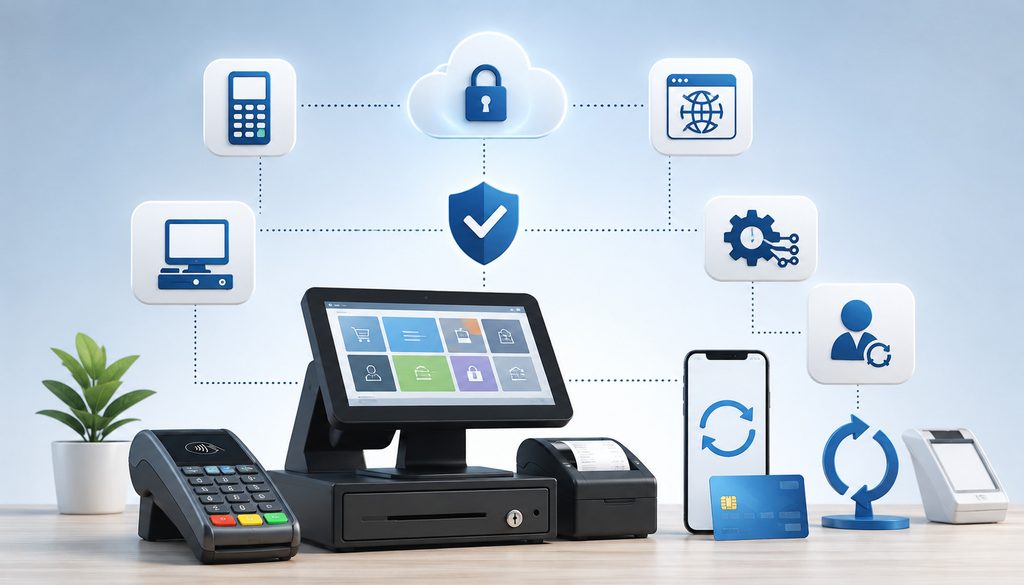
Technology often creates the greatest merchant workload in a processor migration. A business may have a perfectly valid agreement and correctly configured MID but still be unable to accept payments if its terminal application, gateway credentials, API integration, or token vault does not move correctly.
Physical devices may need new merchant parameters, software downloads, application settings, network configuration, or encryption-key management performed through approved service procedures.
Merchants should follow the processor, terminal vendor, and acquirer instructions rather than using undocumented service codes or attempting to manipulate cryptographic keys.
Integrated POS environments can be more complex. A merchant may depend on certified processor connections built into restaurant software, retail systems, practice-management systems, or enterprise commerce platforms.
Before cutover, verify that the destination platform is supported by the POS vendor and that production credentials, merchant parameters, test transactions, reversals, voids, refunds, and end-of-day batching have been validated.
Gateway, API, and Webhook Migration
A payment gateway migration may affect considerably more than the URL customers see at checkout.
Developers should confirm whether any of the following change:
- API endpoint;
- API version;
- authentication method;
- production credentials;
- gateway merchant ID;
- transaction identifiers;
- authorization/capture workflow;
- refund API behavior;
- token references;
- hosted fields or payment pages;
- webhook registration;
- webhook signing secret;
- event schema;
- retry behavior;
- sandbox environment.
A common migration failure occurs when authorization tests pass but downstream workflows do not. The checkout may successfully accept a payment while the order system never receives the webhook, the accounting system cannot recognize a new transaction ID, or the refund service still references the legacy platform.
Webhook processing should therefore be tested as a separate workflow. Verify signatures, duplicate-event handling, event ordering assumptions, retries, reconciliation jobs, and failure alerts.
During phased testing, never weaken authentication, signature validation, fraud filters, or security controls simply to make the new integration “work.”
Stored Credentials, Token Migration, and Subscriptions
Recurring billing can be one of the hardest elements of a payment gateway migration.
The phrase “stored card” may refer to very different technical arrangements. A credential could be stored in a gateway vault, processor vault, merchant-controlled compliant environment, or represented through a network payment token.
PCI SSC distinguishes proprietary acquiring tokens from EMV payment tokens and notes that acquiring-token solutions are proprietary rather than standardized across every provider. As a result, merchants should never assume one processor’s token can simply be copied into another processor’s system.
Before migration, determine:
- where the existing credential actually resides;
- who controls the vault;
- whether a documented secure migration process exists;
- whether the destination provider supports imported tokens;
- whether transaction metadata required for stored-credential processing will be preserved;
- whether network-token relationships continue;
- whether customer action or fresh authorization is necessary.
Subscription continuity should be validated around real billing dates, not merely through a single test card.
Monitor:
- recurring authorization success;
- billing date accuracy;
- token errors;
- retry logic;
- duplicate billing;
- declined subscriptions;
- account-updater behavior where used.
Refunds, Chargebacks, Reserves, and Historical Data Across the Cutover
Payment processing has a long operational tail. A transaction authorized on the legacy platform may be refunded or disputed long after the new platform is live.
That means migration planning must account for both new sales and old obligations.
Refunds can be difficult when the destination system does not contain the original transaction reference. Some merchants may need temporary legacy portal access or an approved legacy refund workflow until older transactions age out.
Never improvise by creating an unrelated credit or processing a negative sale unless the provider explicitly supports the procedure. A refund should remain traceable to the underlying customer transaction whenever the system and applicable rules require it.
Chargebacks and Legacy Dispute Access
Chargebacks may arrive after migration for transactions processed before cutover. The merchant therefore needs to know where dispute notices will appear and which organization will administer legacy cases.
Preserve:
- transaction receipts;
- order records;
- fulfillment evidence;
- customer communications;
- legacy statements;
- case IDs;
- dispute documents;
- representment submissions;
- old portal exports.
Ask whether legacy dispute cases will remain in the old portal, move to a new system, or be managed across both.
Visa’s current monitoring framework evaluates fraud and disputes at acquiring and merchant levels. A processor migration therefore should never be treated as a method for making historical risk or dispute obligations disappear.
A new MID does not automatically erase underlying merchant history.
Reserve Treatment
Reserves deserve their own reconciliation because a conversion can involve multiple entities and accounting systems.
Possible scenarios include:
- the existing reserve remains with the legacy acquiring relationship;
- reserve obligations are transferred under applicable arrangements;
- a new reserve is established;
- both legacy and destination systems hold separate amounts temporarily.
The exact result is contract-specific.
Create a reserve ledger containing:
- balance immediately before migration;
- amounts withheld afterward;
- releases received;
- contractual release conditions;
- legacy-provider responsibility;
- destination-provider responsibility;
- final outstanding amount.
If reserve amounts are material, obtain written confirmation of who controls them and where release activity will appear.
Reporting Crosswalk and Historical Data
Reporting changes can look minor but become expensive accounting problems.
A new processor may rename report fields, group batches differently, use different timestamps, change deposit identifiers, separate fees differently, or label disputes and reserves differently.
| Legacy Report Field | New Platform Field | Accounting Mapping |
| MID | Merchant/account identifier | Location/channel account |
| Batch ID | Settlement batch/reference | Daily sales batch |
| Deposit ID | Funding reference | Bank-deposit reconciliation |
| Processing fees | Fee category/expense | Processing expense |
| Chargeback | Dispute adjustment | Chargeback receivable/expense |
| Reserve | Reserve withholding/release | Restricted funds/reserve asset |
Before legacy access expires, preserve relevant:
- monthly merchant statements;
- transaction exports;
- deposit reports;
- batch records;
- dispute history;
- reserve reports;
- gateway exports;
- tax documents where applicable;
- contracts and amendments.
Processor or acquiring changes may also affect the names or identifiers shown on tax-reporting documents. Merchants should keep their legal name and taxpayer information accurate and consult a tax professional for business-specific reporting questions.
Security, PCI DSS, Fraud Controls, and Bank-Change Risk
A payment migration is simultaneously a financial and security event. New accounts are provisioned, old credentials are retired, temporary administrator access may be created, API secrets can change, service providers may change, and employees may receive unusual payment-related instructions.
That environment creates opportunity for both configuration mistakes and fraud.
Businesses should use MFA where supported, maintain least-privilege access, separate test and production credentials, securely transfer configuration files, rotate secrets where appropriate, document administrative accounts, and remove temporary migration access after cutover.
Security teams should also inventory which parties can store, process, transmit, or otherwise affect payment account data.
PCI DSS Responsibilities After Migration
PCI DSS responsibilities depend on the merchant’s actual cardholder-data environment and payment architecture—not simply on the name of the processor.
PCI SSC states that SAQ eligibility depends on the specific environment and that merchants should consult their compliance-accepting entity, typically an acquirer or payment brand, regarding appropriate validation.
Therefore, a backend processor conversion by itself does not automatically mean the merchant’s SAQ changes.
However, PCI scope or validation can change if the migration alters:
- checkout architecture;
- payment pages;
- gateway implementation;
- terminal environment;
- systems handling card data;
- third-party service providers.
For ecommerce merchants, seemingly small checkout changes can affect which controls and eligibility criteria apply. PCI SSC’s current guidance specifically addresses security responsibilities around hosted and embedded payment implementations.
If a new payment service provider becomes relevant to PCI scope, merchants should obtain appropriate compliance documentation where required, such as applicable Attestations of Compliance, and validate provider status through recognized sources.
Visa also maintains a registry through which merchants and clients can review registered service-provider compliance information.
Bank-Change Fraud During Processor Conversions
A migration announcement gives criminals a believable pretext for requesting changed settlement instructions.
An email that says, “Because of the processor conversion, complete this form with your new banking information,” can appear credible even when fraudulent.
The FBI advises businesses to independently verify requests to change account or payment information using established channels and not rely on contact details included in suspicious messages.
Use controls such as:
- authenticated processor portals;
- known account-management contacts;
- independently sourced support numbers;
- dual approval for settlement-bank changes;
- out-of-band verification;
- MFA;
- documented bank-change procedures.
Do not send sensitive banking credentials through ordinary email merely because a message references an upcoming conversion.
Fraud Controls and Authorization Rates
A new platform may handle fraud controls differently.
Review:
- AVS results;
- CVV handling;
- 3-D Secure where used;
- velocity limits;
- device-risk signals;
- review queues;
- fraud-scoring rules;
- recurring transaction indicators;
- tokenized transaction behavior.
Compare authorization performance before and after migration across card-present, ecommerce, recurring, and tokenized transactions.
A decline increase does not automatically prove that the destination processor performs worse. Merchant configuration, issuer behavior, fraud rules, token setup, routing changes, transaction data, and response-code mappings can all contribute.
Legacy and destination systems may also describe decline reasons differently. Instead of assuming numeric response codes are universally equivalent, map them into operational categories such as:
- issuer decline;
- suspected fraud;
- invalid credential;
- configuration error;
- technical failure;
- retryable condition.
That approach makes before-and-after analysis much more reliable.
Cutover Planning, Dual Processing, and the Post-Migration Audit
The safest merchant account migration is one treated as a controlled operational change rather than a single switch-flip.
A limited dual-processing or phased period can sometimes help validate specific locations, channels, terminals, or integrations. However, merchants must have strict routing controls so the same sale is not accidentally submitted to both systems.
Cutover plans should define ownership, testing, escalation, rollback, reporting, and reconciliation before production traffic moves.
A practical workflow is:
- Inventory affected MIDs, locations, channels, devices, gateways, and integrations.
- Map contracts, processors, acquirers, sponsor-bank relationships, and support ownership.
- Preserve legacy reports and statements.
- Verify migrated merchant-profile information.
- Test terminals and POS connections.
- Test gateway and API authorization, capture, void, and refund flows.
- Confirm token and recurring-billing plans.
- Independently verify settlement-bank information.
- Validate webhooks and reconciliation services.
- Confirm legacy dispute and refund procedures.
- Perform a controlled cutover.
- Reconcile the first deposits and monitor authorization performance.
| Area | Before Migration | After Migration |
| Contract | Save agreement and notices | Confirm applicable terms |
| MID | Document legacy IDs | Map destination IDs |
| Pricing | Save representative statements | Compare charges |
| Bank account | Verify existing settlement account | Confirm first deposits |
| Terminal/POS | Test compatibility | Validate EMV/contactless/batching |
| Gateway/API | Test sandbox/credentials | Monitor production traffic |
| Tokens | Confirm portability method | Monitor recurring success |
| Refunds | Define legacy procedure | Test old/new refunds |
| Chargebacks | Export open/history | Confirm case routing |
| Reporting | Download data | Build field crosswalk |
| PCI | Record existing architecture | Reassess changed scope |
What If the Migration Breaks Checkout?
Rollback planning should exist before checkout fails.
For ecommerce, define who can restore the previous gateway configuration, whether DNS or endpoint changes are reversible, how credentials are controlled, how queued orders are handled, and how the business will prevent duplicate capture when service returns.
For card-present locations, determine which devices or lanes can be moved back safely under approved processor procedures.
A rollback should not bypass fraud detection, signature validation, PCI controls, encryption, or authentication merely to recover acceptance faster.
Customer-facing effects should also be monitored. Changes may include:
- receipt details;
- merchant descriptor;
- saved-card prompts;
- temporary payment failures;
- checkout interface behavior.
Billing descriptors should remain accurate and recognizable. An unfamiliar descriptor can increase customer confusion and disputes.
Post-Migration Audit
The post-migration audit is where merchants determine whether the conversion actually worked financially and operationally.
Do not define success merely as “transactions are approving.”
Within the first normal processing cycles, audit:
- transaction volume;
- authorization rates;
- processor declines;
- technical declines;
- funding;
- settlement timing;
- effective processing rate;
- statement fees;
- refunds;
- recurring billing;
- descriptors;
- chargebacks;
- reserve balances;
- terminal functionality;
- gateway/API behavior;
- webhook delivery;
- support incidents.
| Metric | Before | After | Variance |
| Processing volume | — | — | — |
| Approval rate | — | — | — |
| Effective rate | — | — | — |
| Refunds | — | — | — |
| Chargebacks | — | — | — |
| Deposit timing | — | — | — |
| Support incidents | — | — | — |
There is no universal “correct” variance. The purpose is to identify unexplained change.
Batch cutoff changes are a good example. A later or earlier cutoff can shift transactions into different funding dates and create what looks like a missing deposit even when the money is simply grouped differently.
Common Consolidation and Migration Mistakes—and Questions Merchants Should Ask
Acquiring industry consolidation becomes risky when businesses assume that corporate, contractual, technical, and financial changes all happen together.
Common mistakes include:
- assuming an acquisition automatically changes the merchant agreement;
- ignoring assignment or amendment notices;
- assuming the MID must change;
- failing to save historical portal data;
- not mapping legacy MIDs to new ones;
- forgetting to test refunds;
- assuming stored tokens are portable;
- overlooking webhook and API changes;
- responding to bank-change instructions without independent verification;
- assuming chargeback history resets;
- failing to reconcile legacy and new reserves;
- missing fee-label changes;
- checking approvals but not settlement;
- treating a backend migration as an IT-only project.
Questions to Ask When Your ISO Is Sold
A merchant should obtain clear answers to operational questions before reacting to the transaction itself.
Ask:
- Who owns or services our account now?
- Does our current merchant agreement remain in effect?
- Is any agreement or right being assigned?
- Are we being asked to sign an amendment or a replacement agreement?
- Will pricing or fees change?
- Will the MID change?
- Will our acquiring bank change?
- Will support contacts change?
- Will funding procedures change?
- Will the gateway or POS relationship change?
- Will existing reports remain accessible?
- Are equipment obligations affected?
Document the answers rather than relying on conversations alone.
If support quality deteriorates after an ISO acquisition, document incidents, review contractual service and termination provisions, escalate through appropriate processor or acquiring channels, and evaluate alternatives when commercially and contractually appropriate.
Poor support does not automatically create a legal right to terminate without cost.
Questions to Ask Before a Processor Migration
Before a processor migrates platforms, the merchant needs a more technical checklist:
- What is the production cutover date?
- Will our MID change?
- Which legacy identifiers map to the new system?
- Will settlement cutoffs change?
- Will gateway or API credentials change?
- Which endpoints or transaction identifiers change?
- Are stored tokens portable?
- How will existing subscriptions continue?
- Can old transactions still be refunded?
- Where will pre-migration chargebacks appear?
- How are reserves being handled?
- Will statement format or fee labels change?
- What sandbox or certification testing is available?
- What is the rollback procedure?
- How long will legacy reporting remain available?
- Who owns escalation during cutover?
For multi-location businesses, ask these questions separately for every region, brand, channel, and MID. A migration may affect some merchant groups differently from others.
Should You Switch Processors After an Acquisition?
A change in ownership alone is not a strong reason to replace a functioning payment relationship.
Switching processors creates its own migration burden: underwriting, gateway work, terminal configuration, token migration, integrations, accounting changes, contract obligations, employee training, and settlement validation.
The better decision is to compare the post-acquisition relationship against actual business requirements.
Consider:
- total pricing and effective cost;
- authorization performance;
- funding reliability;
- contract terms;
- gateway and POS compatibility;
- reporting quality;
- dispute support;
- reserve treatment;
- customer service;
- migration burden;
- future scalability.
Acquirer consolidation can also produce operational improvements. Platform rationalization may deliver better APIs, improved reporting, consolidated portals, updated fraud tools, reduced legacy-system dependence, or stronger support workflows.
Those improvements should be measured, not presumed.
Migration risk is highest when there is poor data mapping, inadequate testing, unclear contract ownership, missing tokens, incorrect fee setup, settlement errors, limited legacy access, dispute-routing gaps, or weak escalation planning.
The best outcome is not necessarily staying or leaving. It is knowing what changed and making the decision from evidence.
Frequently Asked Questions
What happens when my ISO is sold?
An ISO sale may change ownership, branding, support contacts, or portfolio administration while leaving your processor, acquiring bank, MID, gateway, settlement account, and pricing unchanged.
In other situations, the acquisition may later be followed by a platform migration. Review the written notice and identify precisely which contractual and technical relationships are changing.
Does an ISO acquisition change my merchant contract?
Not automatically. Your existing contract may continue, may be assignable under its terms, may be amended, or may eventually be replaced. Review assignment, change-of-control, amendment, notice, pricing, renewal, and termination provisions rather than assuming the acquisition itself creates a new contract.
Can my merchant agreement be assigned to another ISO?
It depends on the agreement, transaction structure, and applicable law. Some agreements contain assignment or successors-and-assigns provisions, while others impose conditions. A merchant with a significant contractual concern should obtain qualified legal advice.
Will my MID change after an acquisition?
Not necessarily. An ISO acquisition can occur without a MID change. A MID is more likely to be affected if the acquiring relationship or processing configuration changes, but even platform migrations do not universally require new MIDs.
What is a processor platform migration?
It is the movement of merchant processing from one backend technology environment to another. It can affect authorization routing, merchant identifiers, settlement, reporting, terminals, gateway credentials, APIs, token vaults, recurring billing, disputes, and operational workflows.
Does a platform migration require re-underwriting?
Not in every case. A migration may involve profile validation, KYC refreshes, bank verification, ownership confirmation, website review, or risk review, particularly if merchant information is incomplete, stale, or materially changed. That is different from saying every merchant receives full new underwriting.
Can my processing rates change after an acquisition?
Rates do not automatically change simply because ownership changes. Any pricing change should be evaluated under the merchant agreement, applicable amendment and notice provisions, and the services being provided. Compare pre- and post-migration statements rather than relying only on a rate quote.
Will my deposits change when my processor migrates platforms?
They may, but they do not have to. Changes in cutoff times, batch grouping, fee deductions, ACH descriptors, funding schedules, or reserve accounting can alter how deposits appear. Reconcile the first several deposits against batch and settlement reports.
What happens to stored payment tokens during migration?
That depends on the token architecture. Gateway or processor tokens may be proprietary and platform-specific, while network payment tokens operate differently. Confirm ownership, portability, migration methods, stored-credential metadata, and whether customer action is required before cutover.
Can I still refund transactions processed on the old platform?
Often there is a supported method, but merchants should verify it in advance. A destination system may not contain the original legacy transaction reference, making continued access to the old platform or another approved refund workflow necessary.
What happens to chargebacks after processor migration?
Disputes can continue to arrive for pre-migration transactions. Merchants should preserve transaction records and determine whether legacy chargebacks will be handled in the old portal, moved to the new system, or managed through a separate process.
Does migration reset my chargeback ratio or risk history?
A merchant should not treat migration or a new MID as a way to erase risk history. Card-network and acquiring risk frameworks can evaluate merchants based on underlying activity, and dispute obligations can continue after a technical conversion.
What records should I download before a legacy portal closes?
Preserve merchant statements, transaction exports, settlement reports, batches, refund records, dispute history, reserve reports, gateway data, relevant tax documents, agreements, amendments, pricing notices, and MID mappings. Maintain them according to your legal, accounting, network, and business retention requirements.
Do I have a right to cancel if my ISO is sold?
There is no universal automatic cancellation right merely because an ISO changes ownership. Your rights depend on the agreement, assignment provisions, amendments, material changes, termination terms, applicable law, and the specific structure of the transaction.
What should I audit after a processing-platform migration?
Review approval rates, funding, deposit timing, pricing, merchant descriptors, recurring billing, refunds, disputes, reserve balances, fee labels, gateway and POS functionality, API and webhook behavior, reports, PCI implications, and support incidents. Compare representative before-and-after data rather than relying on anecdotal impressions.
Conclusion
Consolidation in acquiring is not one event with one merchant outcome.
An ISO can be sold without changing a merchant’s processor. A merchant portfolio can change hands without an immediate technology conversion. A processor merger can occur while legacy platforms remain intact, and a backend migration can happen without any acquisition at all.
That is why the most useful response to merchant acquiring consolidation is to identify exactly what is changing.
Follow the framework:
Ownership/Platform Change → Contract Review → Merchant Profile Mapping → MID/Gateway/Terminal Migration → Funding & Settlement Verification → Reporting/Chargeback Continuity → Post-Migration Audit
Start with contracts and responsible parties. Map old and new MIDs. Preserve legacy records. Verify merchant-profile data. Test POS, gateways, APIs, webhooks, refunds, and recurring billing. Independently confirm settlement instructions.
Reconcile deposits and reserves. Preserve access to historical disputes. Review PCI responsibilities when the payment architecture changes.
Finally, audit the new environment with actual before-and-after data.
For most merchants, the greatest consolidation risk is not the corporate acquisition itself. It is an unnoticed operational change—an incorrect MID mapping, a lost token, an unexpected fee, a changed cutoff, a missing dispute notice, an altered fraud rule, or a settlement discrepancy—that remains undiscovered because nobody compared the old environment with the new one.
Informational disclaimer: This article provides general educational information about payment processing, merchant acquiring, contracts, security, and operational migrations. It is not legal, tax, accounting, PCI-assessment, or individualized payment-processing advice.
Contract rights, underwriting requirements, settlement arrangements, network obligations, and migration procedures vary by agreement, provider, acquiring institution, jurisdiction, technology environment, and merchant profile.
Leave a Reply