
By Joseph Bryson October 7, 2026
If you want to switch from payment aggregator to merchant account, start evaluating dedicated processing around $50,000 in monthly card volume and make the review more serious near 80,000–100,000. Volume alone is not the deciding factor: repeated funding holds, transaction limits, weak support, recurring-payment dependence, and rising processing costs can justify moving sooner.
There is no universal aggregator volume threshold that requires every merchant to leave an aggregator such as a payment facilitator. The better question is whether the convenience that made aggregation attractive at the beginning still outweighs the costs and operational limits as the business grows.
Visa does have an important rule that sometimes gets oversimplified. Under its current public rules, an acquirer generally must enter into a direct merchant agreement with a sponsored merchant whose annual Visa transaction volume exceeds $1 million, subject to stated exceptions and transition rules.
Visa also explicitly allows the payment facilitator to continue providing payment services after the direct agreement is established. In other words, $1 million is not a universal instruction to abandon a PayFac.
For merchants deciding when to leave a payment aggregator, practical warning signs usually appear before a card-network rule forces structural changes.
This guide explains those warning signs, what a dedicated merchant relationship changes, what underwriting will request, what payment data can move, how to run a safe parallel migration, and which costs must be verified before signing.
When Should You Switch From Payment Aggregator to Merchant Account?
There is no single monthly sales number that makes a dedicated account automatically better.
A business processing $30,000 per month with low tickets, stable deposits, few disputes, and an inexpensive bundled POS may have little reason to move.
Another business processing the same $30,000 could have a completely different answer if it sells annual memberships, carries large fulfillment obligations, experiences frequent payout reviews, or cannot reach a human when funds are held.
A useful planning framework is:
| Monthly card volume | Recommended posture | What to examine |
| Under $20,000 | Aggregation is often still practical | Simplicity, software bundle, total effective rate |
| 20,000–50,000 | Start measuring the economics | Flat-rate cost, funding reliability, growth rate |
| 50,000–80,000 | Get dedicated-account comparison quotes | Markup, support, underwriting, gateway costs |
| 80,000–100,000+ | Conduct a formal processor review | Account structure, limits, pricing, settlement |
| $150,000+ | Dedicated processing deserves serious analysis | Contract leverage, redundancy, risk support, data portability |
These are business decision points, not card-network limits.
The right aggregator volume threshold for your company depends on average ticket size, transaction count, debit versus credit mix, card-present versus card-not-present volume, chargebacks, refund exposure, seasonality, recurring billing, and how damaging a delayed payout would be.
Businesses unfamiliar with the structural difference between aggregated and dedicated processing can first review this guide to how merchant accounts work.
Six Signals That You Have Outgrown Your Payment Aggregator

Monthly volume matters, but the operating signals around that volume matter more.
1. Your processing volume has become materially larger
Aggregators are attractive partly because onboarding is fast.
The provider can place many sponsored merchants within a payment-facilitator structure while handling risk monitoring, settlement, technology, and merchant servicing at scale.
Mastercard describes a payment facilitator as a service provider registered by an acquirer to facilitate transactions for sponsored merchants or submerchants.
That model works extremely well for many small businesses.
Problems can begin when a merchant grows much faster than the operating profile the platform expects.
Examples include:
- monthly volume doubling over several months;
- unusually large seasonal spikes;
- average tickets rising sharply;
- high-ticket transactions becoming routine;
- a shift from immediate delivery to future delivery;
- substantially more card-not-present volume;
- rapid growth in subscriptions or annual plans.
Growth itself is not suspicious.
But a large difference between expected and actual activity can trigger additional monitoring. If ordinary growth repeatedly creates payment reviews, your aggregator account stability deserves a serious evaluation.
2. Held funds are creating cash-flow risk
A single review does not automatically mean you need another processor.
Repeated payout interruptions are different.
Imagine that your business collects $120,000 in card sales each month but needs those deposits to pay suppliers every Friday. A three-day funding interruption may create a much larger problem than paying an extra $200 or $300 in processing fees.
Ask three questions:
- How many payout reviews occurred during the last 12 months?
- How much money was unavailable during each event?
- What business obligations depended on that money?
If funding unpredictability affects payroll, inventory, advertising, subcontractors, rent, or tax obligations, aggregator account stability has become a financial issue rather than merely a processor inconvenience.
A dedicated merchant account does not guarantee that funds will never be reviewed or held.
The difference is that underwriting generally occurs before full production processing begins. The acquirer or processor evaluates expected volume, tickets, products, delivery timing, refund exposure, chargebacks, and financial capacity before establishing the account.
That allows the risk structure to reflect the actual business more deliberately.
3. You keep encountering volume, ticket, or product limits
Another sign of when to leave a payment aggregator is repeated friction with operating limits.
Watch for:
- high-ticket warnings;
- transaction limits;
- payout limits;
- sudden reserve requests;
- frequent document requests;
- restrictions on specific products;
- inability to add additional locations or merchant IDs;
- difficulty changing an MCC or processing profile;
- recurring billing limitations;
- limited gateway flexibility.
The problem is not necessarily that the aggregator is doing something wrong.
Its risk model simply may no longer fit your business.
4. Support is no longer adequate for the amount of money flowing through the account
A business processing $4,000 a month may tolerate ticket-based support.
A company processing $400,000 a month may not.
When payment acceptance becomes operational infrastructure, support quality matters differently.
You may need:
- a named account manager;
- a direct risk escalation process;
- underwriting contacts;
- chargeback expertise;
- gateway support;
- after-hours escalation;
- faster explanations of funding exceptions.
If losing payment acceptance for one business day would materially affect revenue, support becomes part of the processor’s economic value.
5. Flat-rate pricing is becoming expensive
Simple pricing can be valuable.
But the bigger your volume becomes, the more expensive small differences in effective rate become.
Suppose you process:
$100,000 per month
At an effective processing cost of 2.90%:
$100,000 × 2.90% = $2,900
If another structure produces a verified all-in effective cost of 2.60%:
$100,000 × 2.60% = $2,600
The difference is:
$300 per month, or $3,600 annually.
At $300,000 per month, a 0.30-percentage-point difference becomes $900 per month.
That does not mean interchange-plus pricing is always cheaper. Transaction count, card mix, gateway fees, monthly costs, and processor markup all affect the result.
Use your real statements rather than advertised rates. This guide to interchange-plus pricing and processor markup explains how to separate pass-through costs from provider markup.
6. Payment processing has become a single point of operational failure
Early-stage businesses often prefer an all-in-one platform.
Checkout, invoicing, subscriptions, POS, stored cards, fraud settings, and settlements may all live inside one system.
The convenience is substantial.
The concentration risk can eventually become substantial too.
If one account restriction would simultaneously disable website payments, stored credentials, invoice links, recurring billing, POS transactions, and access to working capital, management should understand that dependency.
Moving to a dedicated account does not automatically solve business-continuity risk. But growth is a good time to examine how payment systems should be structured rather than allowing them to evolve accidentally.
Aggregator vs Dedicated Merchant Account
A payment facilitator to merchant account transition changes more than the name printed on the processing agreement.
| Factor | Aggregator / PayFac model | Dedicated merchant account |
| Initial onboarding | Usually streamlined | More detailed underwriting |
| Merchant structure | Sponsored merchant/submerchant relationship | Individually underwritten merchant relationship |
| Pricing | Frequently bundled or flat-rate | Often negotiable; may use interchange-plus |
| Account parameters | Standardized | More merchant-specific |
| Risk review | Heavy ongoing monitoring | Upfront underwriting plus ongoing monitoring |
| Support | Often standardized | May include dedicated contacts |
| Gateway choice | Can be tightly integrated | Often more configurable |
| High-volume negotiation | Limited in some programs | Often stronger |
| Contract complexity | Usually simpler | Frequently greater |
| Data migration | May be difficult | Depends on providers and gateway |
A dedicated account should not be described as a processor that “cannot freeze funds.”
It can.
Acquirers and processors still manage fraud, disputes, reserves, compliance risk, financial exposure, and abnormal processing activity.
The advantage is greater alignment between the approved processing profile and how the business actually operates.
What Real Underwriting Changes
When you switch from payment aggregator to merchant account, expect the new provider to ask more questions.
That is not automatically a negative.
Good underwriting establishes what the processor is knowingly agreeing to support.
An underwriter may evaluate:
- legal entity;
- ownership;
- business address;
- website;
- products and services;
- expected monthly volume;
- average ticket;
- maximum expected ticket;
- fulfillment period;
- cancellation terms;
- refund exposure;
- sales channels;
- prior chargebacks;
- financial strength;
- processing history.
Businesses can review the typical approval process in this detailed guide to how merchant accounts get approved.
Your own processing identity
A dedicated account normally gives the business merchant-specific acquiring credentials and parameters, commonly including a merchant identification structure tied to that relationship.
Do not treat “having your own MID” as a guarantee of stability.
A MID is an identifier, not immunity from risk management.
The real benefit is having the account underwritten around the merchant’s expected activity rather than depending only on streamlined onboarding followed by post-transaction monitoring.
What Underwriting Will Request From a Merchant Leaving an Aggregator

The smoothest dedicated merchant account migration starts before the application is submitted.
Create an underwriting folder containing the evidence the new provider is likely to request.
Processing history
Export three to six months of data where available, including:
- monthly sales volume;
- transaction count;
- average ticket;
- highest tickets;
- refunds;
- disputes;
- chargebacks;
- payout history;
- processing fees.
If your business is seasonal, 12 months may provide a more useful picture.
Underwriters need to distinguish normal seasonality from unexplained spikes.
Business documentation
Depending on the provider and merchant profile, you may be asked for:
- articles of organization or incorporation;
- EIN verification;
- ownership information;
- government identification;
- business licenses;
- business bank verification;
- website details;
- fulfillment policies;
- refund and cancellation policy;
- customer agreements;
- supplier documentation.
Financial documentation
Larger, high-risk, future-delivery, subscription, or rapidly growing merchants may face deeper financial review.
Possible requests include:
- recent business bank statements;
- profit-and-loss statements;
- balance sheets;
- prior-year financial statements;
- supplier invoices;
- proof of inventory;
- contracts supporting large transactions.
Do not exaggerate projected volume to obtain higher limits.
Do not artificially lower projected volume because you think it will make approval easier either.
The goal is to have your real operating profile approved.
Explain previous problems rather than hiding them
If you experienced a large reserve, extended payout review, unusual chargeback month, or prior processor termination, be prepared to explain what happened.
Provide evidence showing:
- why it happened;
- whether the problem was temporary;
- what changed;
- current dispute levels;
- current fulfillment performance;
- new controls.
A credible explanation is usually more useful than an application that conflicts with historical processor data.
Before submitting statements, you can use this merchant statement audit guide to identify fees, refunds, disputes, and settlement anomalies that should be understood first.
The Safe Dedicated Merchant Account Migration Sequence
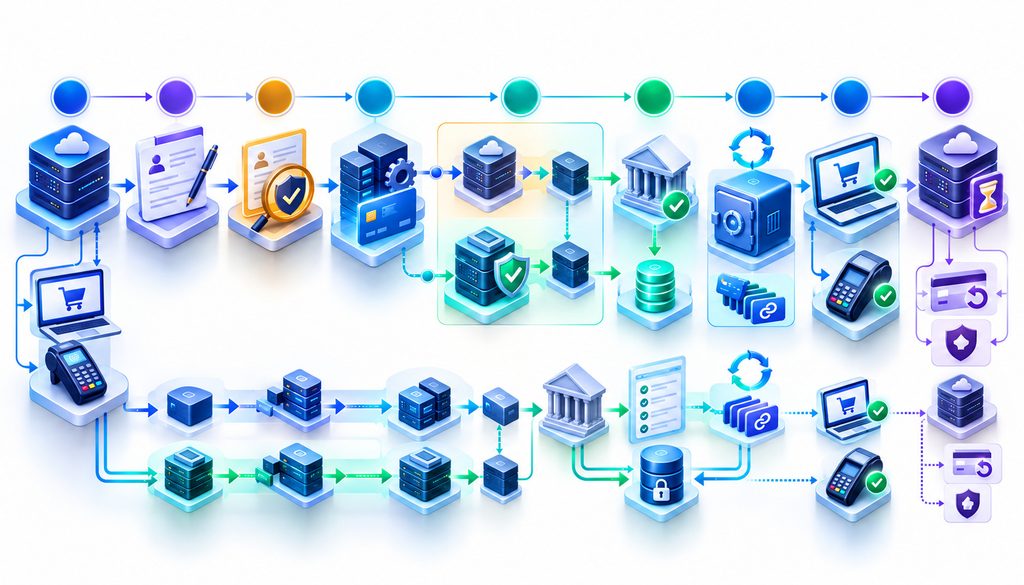
The biggest migration mistake is closing the aggregator first.
Do the opposite.
Step 1: Inventory every system that touches payments
Do not think only about checkout.
Create a migration sheet for:
| Payment dependency | Current system | Migration requirement |
| Ecommerce checkout | Aggregator | New gateway/API/plugin |
| Retail terminals | Existing POS | Reprogram or replace |
| Stored cards | Provider vault | Secure migration or recollection |
| Subscriptions | Billing platform | Token and subscription mapping |
| Payment links | Aggregator URLs | Recreate |
| Invoices | Existing platform | Update processor connection |
| Virtual terminal | Aggregator | Configure replacement |
| Refund workflow | Old platform | Maintain old access |
| Chargebacks | Old platform | Continue monitoring |
| Accounting | Existing integration | Remap deposits and fees |
| Webhooks/API | Existing credentials | Replace and test |
This step catches dependencies that become obvious only after something stops working.
Step 2: Apply while your aggregator is still processing normally
Submit the dedicated account application before changing production traffic.
Ask for written confirmation of:
- approved monthly volume;
- average ticket;
- maximum ticket expectations;
- MCC;
- approved products;
- card-present/card-not-present mix;
- recurring billing;
- settlement timing;
- reserve requirements;
- gateway;
- statement descriptor;
- contract term;
- termination fees.
Anything important that exists only in a sales conversation should be treated as unresolved until it appears in the agreement or written confirmation.
Step 3: Complete underwriting and board the new account
Answer underwriting questions quickly and consistently.
Do not begin routing large volumes merely because login credentials have been issued.
First configure the environment.
That may include:
- gateway API keys;
- POS devices;
- AVS settings;
- CVV rules;
- fraud filters;
- 3-D Secure settings;
- recurring transaction indicators;
- user permissions;
- refund permissions;
- batch cutoff;
- accounting integrations;
- webhooks.
Step 4: Run controlled production tests
A small test transaction confirms authorization.
It does not confirm successful merchant funding.
Run several representative transactions where practical:
- card-present;
- ecommerce;
- keyed;
- mobile;
- recurring;
- refund.
Confirm that the statement descriptor is correct and that transaction statuses flow through the gateway and reporting system as expected.
Step 5: Confirm settlement and the first real bank deposit
This is a critical checkpoint.
Authorization and settlement are not the same event.
An authorization tells you the issuer approved the transaction. Settlement and funding determine whether the processed funds reach the merchant.
The complete distinction is covered in this guide to payment authorization and settlement cycles.
Before increasing traffic, reconcile:
Processed sales
– refunds
– adjustments
– applicable withheld amounts
= expected net funding
Then verify the actual bank deposit.
Step 6: Parallel-run carefully
A short parallel-run period can reduce migration risk.
The objective is not to secretly divide transactions between accounts to avoid monitoring or volume limits.
It is to validate that the new, fully disclosed processing environment works before the old environment is shut down.
For example:
- new ecommerce customers may use the new gateway;
- existing subscriptions may temporarily remain on the old platform;
- one retail location may test new terminals before other locations cut over;
- new payment links may use the new system while historical links are identified and replaced.
Keep clear reconciliation records for both providers.
Step 7: Migrate recurring billing and stored credentials
This can be the most technically important stage of a payment facilitator to merchant account move.
Do not assume a token from Provider A can simply be copied into Provider B.
Usually it cannot.
A provider-specific token is often meaningful only inside the vault that created it.
Some providers support secure card-data migrations.
Square currently states that account owners can request transfer of card-on-file records directly to another PCI DSS Level 1-compliant payment processor. Square also says its average card export time can be up to two weeks.
Stripe similarly documents secure payment-data migration and instructs merchants to plan customer mapping and, where applicable, subscription remapping when changing processors.
Never ask an employee to export raw card numbers to an ordinary CSV file, email them, or manually move sensitive cardholder data.
Use the processors’ approved PCI-compliant transfer process.
Step 8: Move customer-facing payment entry points
Once the new system has successfully authorized, settled, and funded real transactions, migrate the remaining entry points.
Check:
- ecommerce checkout;
- mobile app;
- invoice links;
- SMS payment links;
- QR codes;
- email templates;
- saved bookmarks;
- customer portals;
- call-center scripts;
- POS terminals;
- virtual terminals;
- recurring billing.
Search the website and email templates for old hosted-payment URLs.
Old links are easy to overlook.
Step 9: Keep the old account open during runoff
Do not immediately close the aggregator after the final new sale.
Older transactions may still generate:
- refunds;
- chargebacks;
- retrieval requests;
- settlement adjustments;
- reserve releases;
- payout corrections.
Historical reporting may also be needed for bookkeeping, taxes, customer service, or dispute evidence.
The correct closure date depends on your return window, contractual obligations, provider agreement, unresolved disputes, and remaining subscription activity.
What Moves to the New Processor — and What Does Not?
This is where merchants often underestimate the migration.
Transaction history
Past transactions generally remain historical transactions of the original processor.
You may be able to export the data, but that does not mean the transactions become native transaction records inside the new processor.
Keep exports for:
- accounting;
- reconciliation;
- customer support;
- returns;
- chargebacks;
- audits.
Customer profiles
Basic customer information may be exportable.
That could include:
- name;
- address;
- email;
- phone;
- customer identifier.
Whether the new system can import those fields depends on the software.
Stored payment credentials
Card credentials are different.
Square states that its card export process is specifically for payment-card data and transfers that information directly to a qualifying PCI-compliant processor.
Stripe likewise supports processor-to-processor PAN migrations through a secure process.
The key principle is:
Sensitive payment credentials should move provider-to-provider, not through your employees’ spreadsheets or inboxes.
Tokens
Tokens frequently do not move directly.
The old processor may export underlying credentials securely. The new processor then creates its own token.
Your software may therefore need a mapping such as:
Old customer ID → new customer ID → new payment token
This mapping is essential for subscription businesses.
Subscription logic
Payment credentials and subscriptions are separate things.
Even if the card moves, you may still need to rebuild:
- plan IDs;
- subscription schedules;
- billing dates;
- trial status;
- coupons;
- retry logic;
- proration rules;
- invoice settings.
Stripe specifically tells migrating businesses to plan subscription remapping where applicable.
Payment links
Assume hosted payment URLs need to be recreated unless your new provider explicitly says otherwise.
Update website buttons, invoices, emails, QR codes, and customer-service templates.
How Long Does the Migration Take?
There is no universal approval timeline.
A clean, straightforward merchant account can move through underwriting faster than a complex business involving high tickets, delayed fulfillment, subscriptions, prior chargebacks, or large projected volume.
Use ranges for planning rather than promises.
| Migration stage | Practical planning range |
| Preparing documents | 1–3 business days |
| Underwriting | Several business days for straightforward cases; longer for complex files |
| Gateway/POS setup | 1–5 business days |
| Testing | 1–3 business days |
| First settlement confirmation | Depends on approved funding schedule |
| Credential migration | Several days to multiple weeks |
| Subscription remapping | Depends heavily on billing complexity |
| Full migration | Often roughly 1–4 weeks for an organized business |
Credential portability can become the longest dependency.
Square, for example, currently says card-on-file export can take up to two weeks.
If recurring revenue is important, start the credential conversation before selecting the final migration date.
Compare Costs in Writing Before Signing
A successful switch from payment aggregator to merchant account should improve economics, operating control, or both.
Never compare only the advertised processing percentage.
Mastercard’s current U.S. payment-facilitator rules require sponsored merchant agreements to include a distinct fee disclosure explaining how relevant merchant charges are calculated, including transaction processing, equipment, settlement, and termination charges.
Even when comparing a different account structure, that level of fee clarity is a good purchasing standard.
Ask the new provider to identify:
- interchange treatment;
- network assessments;
- processor basis-point markup;
- authorization fee;
- per-transaction fee;
- gateway fee;
- monthly account fee;
- monthly minimum;
- PCI-related fees;
- batch fee;
- AVS fees;
- tokenization fees;
- account updater fees;
- chargeback fees;
- retrieval fees;
- refund fees;
- equipment charges;
- software costs;
- funding fees;
- annual fees;
- early termination charges;
- migration charges;
- reserve requirements.
Mastercard itself notes that interchange is only one component of merchant acceptance cost and that merchant pricing is established through the acquiring relationship rather than Mastercard setting a merchant’s final retail processing price.
Compare effective cost, not sales quotes
Use:
Total monthly processing expense ÷ monthly card volume × 100
Suppose your aggregator produces:
- $150,000 in monthly card sales;
- $4,350 in processing expense.
Effective rate:
$4,350 ÷ $150,000 = 2.90%
Now assume a dedicated proposal produces an estimated:
- $3,900 transaction-related cost;
- $175 gateway/account costs;
- $75 additional service fees.
Total:
$4,150
Effective cost:
$4,150 ÷ $150,000 = 2.77%
Estimated monthly savings:
$200
Annualized:
$2,400
Would you undertake a complex migration for $2,400?
Maybe.
If the new arrangement also improves support, funding predictability, gateway flexibility, and recurring-payment portability, it may be worthwhile.
If it creates a long equipment lease, restrictive contract, large reserve, or expensive termination clause, it may not.
Real-World Example: A $110,000-Per-Month Service Business
Consider a home-services company processing approximately $110,000 monthly.
Its average ticket is $480. About 18% of customers use stored credentials for maintenance plans.
During its first year, the aggregator worked well.
During year three, the company experienced two funding reviews after seasonal sales spikes. Management also discovered that its flat pricing was materially more expensive than one dedicated proposal.
The company should not immediately cancel the aggregator.
Instead, it:
- exports 12 months of transactions, payouts, refunds, and disputes;
- gathers bank statements and business documents;
- obtains a dedicated-account proposal;
- verifies the pricing and reserve terms;
- asks both providers about stored-card migration;
- completes underwriting;
- configures the gateway;
- routes a limited group of new transactions to the new account;
- verifies settlement and bank funding;
- begins secure credential migration;
- maps recurring customers to new tokens;
- moves website and invoice payment links;
- keeps the aggregator accessible for old refunds and disputes.
The important lesson is not the company’s $110,000 volume.
It is the migration order.
The new system is proven before the old system is retired.
Frequently Asked Questions
What monthly volume is too high for a payment aggregator?
There is no universal maximum.
As a business planning rule, merchants processing roughly $50,000 per month should usually begin comparing dedicated-account economics, while merchants approaching 80,000–100,000 or more should perform a more formal review. Risk profile and operational needs can justify switching earlier.
Is $1 million per year an official payment facilitator limit?
Not exactly.
Visa’s current rules generally require an acquirer to enter into a direct merchant agreement with a sponsored merchant exceeding $1 million in annual Visa transaction volume, but the rule contains exceptions and allows the payment facilitator to continue servicing the merchant. It should not be presented as a universal requirement to leave every aggregator.
Will a dedicated merchant account prevent funding holds?
No.
It may make the approved processing profile clearer and provide better escalation options, but risk reviews and reserves can still occur.
Can I transfer customer cards to the new processor?
Possibly.
Both the old and new providers must support an appropriate secure migration process. Square documents direct card-on-file exports to qualifying PCI DSS Level 1 processors, while Stripe also documents secure PAN migrations.
Can I download card numbers myself and upload them to the new processor?
Do not handle the migration that way.
Sensitive cardholder credentials should use an approved PCI-compliant processor-to-processor process rather than ordinary spreadsheets, email, or manual exports.
How quickly can I switch?
Straightforward underwriting can sometimes move quickly, but a complete dedicated merchant account migration often depends more on gateway integration and stored-card portability than approval itself. Plan the full sequence rather than relying on an advertised account-approval time.
Is a dedicated account always cheaper?
No.
Higher volume can create negotiating leverage, but total cost depends on transaction mix, interchange, processor markup, transaction fees, gateway charges, software, equipment, monthly costs, reserves, and contract terms.
Switching at the Right Stage of Growth
The correct time to switch from payment aggregator to merchant account is not determined by one magic sales number.
Volume should trigger the review. Operational risk should make the decision.
Start comparing dedicated options when monthly card volume reaches roughly $50,000. Around 80,000–100,000, examine the economics and account structure closely. But move earlier if funding interruptions, transaction limits, subscription dependence, weak escalation support, or platform restrictions threaten normal business operations.
Just as importantly, do not confuse migration with cancellation.
A safe dedicated merchant account migration follows a deliberate sequence: document your existing environment, complete underwriting, configure the new MID and gateway, run controlled transactions, verify settlement, migrate stored credentials and recurring billing, switch customer-facing payment paths, reconcile both systems, and only then retire the old relationship.
That approach gives a growing merchant something more valuable than merely a different processing rate: a payment infrastructure designed for the business it has become rather than the business it was when it first opened an aggregator account.
Leave a Reply