
Getting approved to accept card payments is not always automatic. A business may submit a payment processing application expecting quick approval, only to receive a request for more documents, a conditional approval, or a denial. That can feel frustrating, especially for a new business owner who simply wants to accept payments from customers.
Understanding why merchant applications get declined helps business owners prepare more carefully before applying.
A merchant account risk review looks at business verification, ownership details, industry risk, chargeback history, website compliance, transaction volume, financial stability, sales methods, refund exposure, and documentation quality. If any of these areas raise concerns, the application may be delayed or denied.
A merchant application declined result does not always mean the business is illegitimate or permanently unable to process payments. Often, it means the underwriter could not verify enough information, saw a risk that was not explained well, found inconsistent details, or determined that the business model did not fit that provider’s risk tolerance.
This guide explains the most common reasons for merchant account denial, what underwriters review, what documents may be required, and how applicants can improve their chances before applying again.
What a Merchant Application Is
A merchant application is the form and supporting file a business submits when it wants to accept card payments, online payments, keyed transactions, mobile payments, virtual terminal payments, or POS transactions.
It gives the payment provider, processor, acquiring side, and underwriting team the information needed to evaluate the business before payment acceptance begins.
The application usually asks for legal business name, DBA name, business address, tax identification number, owner information, bank account details, website URL, product or service description, estimated transaction volume, average ticket size, highest ticket amount, sales channels, and business start date.
It may also ask whether the business processes in person, online, by invoice, over the phone, through subscriptions, or through recurring billing.
A merchant application is not only an administrative form. It is part of merchant due diligence. Underwriters use it to confirm that the business exists, the owners can be verified, the products or services are understandable, and the expected payment activity appears manageable.
For example, a restaurant accepting mostly card-present payments may be reviewed differently than an eCommerce seller accepting online orders for future delivery.
A service business collecting deposits may be reviewed differently than a retail store selling low-ticket items in person. The more risk a sales model creates, the more detailed the merchant account underwriting review may become.
How the Merchant Account Approval Process Works

A business owner who wants more background on approval steps can also review this guide on the merchant account approval process, which explains how applications, underwriting, verification, and supporting documents may be reviewed before approval.
The merchant account approval process usually begins when the business submits the credit card processing application and supporting records. The first review checks whether the application is complete enough to move forward. If key fields are missing, the file may be paused before underwriting even begins.
Next, the provider may verify the business identity, ownership details, bank account, tax information, website, sales channel, and business documentation. Online businesses may receive a website review to confirm that product descriptions, pricing, refund terms, shipping details, privacy policy, and contact information are visible and consistent.
The underwriting review then evaluates the overall risk profile. This may include industry type, transaction volume, average ticket size, fulfillment timing, chargeback exposure, refund history, processing history, financial stability, business credit, personal credit where applicable, and prior account activity.
After the underwriting review, the final decision may be approval, conditional approval, a request for more documents, reserve requirements, processing limits, delayed funding, or denial. Requirements can vary based on business type, sales channel, risk profile, expected volume, and the provider’s own risk tolerance.
A helpful background resource on how merchant accounts get approved explains that underwriters commonly review ownership, website transparency, processing estimates, chargeback exposure, and merchant account documents before approval.
Application Review
During application review, the processor or underwriting team checks whether the application is complete, accurate, and consistent. Reviewers may compare the submitted information with business formation records, ownership details, tax identification data, bank account information, website content, invoices, sales channels, and public-facing business details.
This stage often catches simple merchant account application mistakes. A mismatched legal name, incorrect tax identification number, outdated address, wrong bank account name, typo in ownership details, or incomplete website URL can create delays. Even when the mistake is accidental, it may require clarification.
Application review also helps identify whether the business description matches what customers see. If the application says the business sells retail goods, but the website promotes digital subscriptions or regulated products, the file may need further explanation.
Underwriting Review
Merchant account underwriting is the deeper risk evaluation. Underwriters look at whether the business can process payments responsibly and whether future refunds, chargebacks, fraud claims, or fulfillment issues could create financial exposure.
This review may include industry risk, card-present versus card-not-present activity, product type, delivery timing, sales projections, processing history, chargeback history, refund levels, business credit, personal credit where applicable, bank statements, and financial stability.
Payment processor underwriting may also consider whether the business has clear customer support practices and transparent billing terms.
Some businesses need more documentation because their model creates more questions. Subscription billing, high-ticket products, delayed fulfillment, digital goods, preorders, custom services, international sales, and higher-risk categories may require more detailed review.
A strong underwriting file does not need to be perfect, but it should be clear, verifiable, and consistent.
Final Decision
The final decision is not always a simple yes or no. A business may receive merchant account approval, conditional approval, a request for additional documents, a lower processing limit, a reserve requirement, delayed funding, or a denial.
Conditional approval means the business may be allowed to process payments under certain controls. These controls may include monthly volume caps, transaction size limits, rolling reserves, additional monitoring, or funding delays. This is common when underwriters are willing to support the business but want to reduce risk exposure.
A merchant account rejection usually means the provider is not comfortable with the risk, cannot verify the business, does not support the industry, or needs issues corrected before reconsidering the file.
Common Reasons Merchant Applications Get Declined
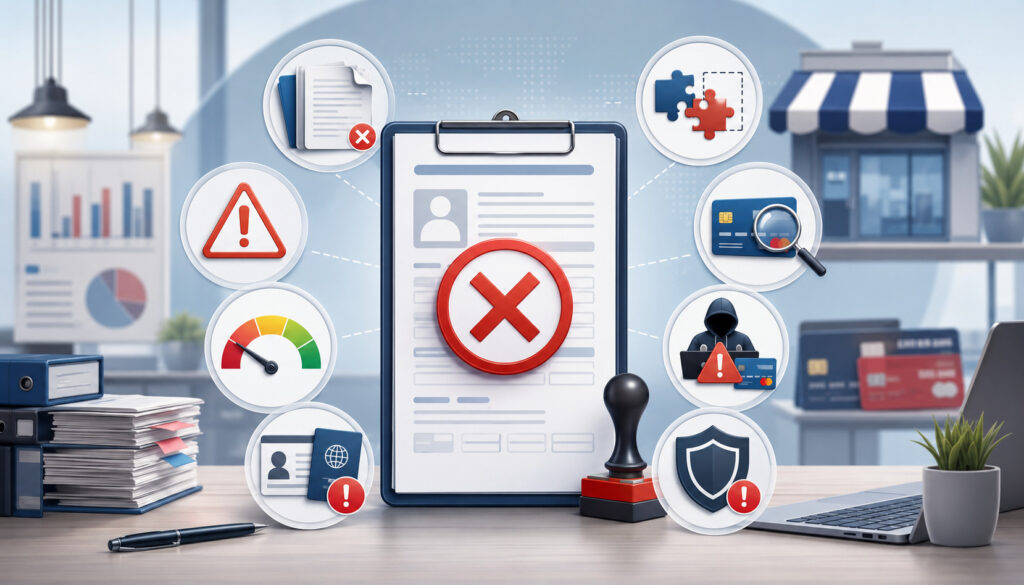
Merchant applications get declined for many reasons, but most denials come down to verification gaps, risk concerns, documentation problems, or poor fit.
A merchant services application denied result may happen because the underwriter cannot confirm who owns the business, what the business sells, how customers are billed, or whether the merchant can manage disputes.
Some denial reasons are simple. The application may be incomplete, the tax identification number may not match, or bank account verification may fail. Other issues are more serious, such as excessive chargebacks, prior account termination, fraud concerns, unsupported products, or financial instability.
Online sellers often face extra review because customers are not physically present when paying. Underwriters may review website compliance, fulfillment policies, refund terms, privacy policy, terms and conditions, pricing clarity, contact information, and secure checkout practices.
A declined merchant account can also result from unrealistic sales projections. If a startup claims very high monthly transaction volume without records, contracts, inventory, or bank statements to support the estimate, underwriting may question the projection.
The key lesson is that denial is usually not random. It usually reflects a specific concern that can be understood, corrected, or better documented before reapplying.
Incomplete or Incorrect Application Details
Incomplete or incorrect details are among the easiest mistakes to avoid, but they are still common. Missing fields, wrong addresses, inconsistent ownership percentages, outdated phone numbers, incorrect tax information, mismatched business names, or incomplete bank details can delay or derail the merchant account approval process.
Underwriters compare application answers with other records. If the business name on the application differs from the bank account, tax records, website, license, or formation documents, the reviewer may pause the file. If the DBA is used publicly but not disclosed on the application, the business may appear inconsistent.
Even small errors can become larger concerns when they affect business verification. A typo in a tax identification number may look like a verification failure. An old address may make it harder to confirm the business location. A website that shows a different product line than the application may raise questions about transparency.
Missing or Weak Business Documentation
Business documentation helps underwriters verify that the business is real, active, properly owned, and able to support its payment activity. Missing documents do not always cause denial immediately, but they often delay the file or weaken the application.
Common documents include business formation records, business license if applicable, government-issued identification, tax identification details, bank statements, voided check or bank letter, invoices, supplier records, ownership documents, financial statements, prior processing statements, and website policies.
A new business may not have processing history, but it can still prepare strong supporting records. Formation documents, bank verification, clear product descriptions, supplier invoices, fulfillment plans, and realistic volume estimates can help underwriters understand the business.
Weak documentation creates uncertainty. If underwriters cannot verify ownership, settlement account control, licensing, product sourcing, fulfillment ability, or financial stability, they may decline the application or request additional proof.
Unsupported or Restricted Business Type
Some business types receive more scrutiny because of regulation, chargeback exposure, reputation risk, product restrictions, fraud concerns, or card network rules. This does not mean every business in a higher-risk category is automatically unacceptable, but it does mean not every provider will support every model.
A provider may decline an application if the business sells prohibited products, operates in an unsupported category, lacks required licensing, uses a sales model outside the provider’s guidelines, or presents risk beyond the provider’s tolerance.
Industry risk can also be influenced by fulfillment timing. Businesses that collect payment long before delivery may create more exposure if customers later dispute transactions. Recurring billing, subscription offers, digital products, travel-related services, coaching programs, trial offers, and high-ticket services may receive extra review depending on the full context.
The best approach is transparency. Hiding product details or describing the business too vaguely can make the application look riskier, not safer.
High Chargeback or Refund Risk
Chargebacks and refunds matter because they show how often customers reverse or dispute payments. A business with frequent disputes, unclear billing, delayed fulfillment, confusing cancellation terms, or refund-heavy products may be viewed as higher risk.
A chargeback happens when a cardholder disputes a transaction through the issuing bank, and excessive chargebacks can make a merchant appear risky. Educational resources on chargebacks commonly explain that chargebacks reverse payments and can create financial and operational problems for merchants.
Underwriters may look at chargeback history, dispute reasons, refund ratios, subscription cancellation complaints, product dissatisfaction, billing descriptor confusion, customer service response times, and prior processing statements.
If the business has past chargebacks, it should be ready to explain what caused them and what has changed. Better order confirmation, clearer billing descriptors, faster customer support, delivery tracking, fraud screening, and visible cancellation terms can help show improvement.
Poor Credit or Financial Instability
Credit and financial health can influence merchant account underwriting because card payments create future liability. A customer may dispute a payment after funds have already been deposited. If the business cannot cover refunds, chargebacks, fees, or negative balances, the processor may carry risk.
Underwriters may review personal credit, business credit, bank statements, cash flow, unpaid debts, negative balances, overdrafts, tax issues, revenue stability, or financial statements. Credit is not always the only factor, and requirements vary, but weak financial signals may lead to conditional approval, reserves, lower limits, or denial.
Financial instability may be especially important for businesses with high average ticket sizes, delayed delivery, recurring billing, or high refund exposure. In those cases, underwriters want to know whether the business can handle future obligations.
A business with imperfect credit can still strengthen the file by organizing records, explaining past issues honestly, showing stable revenue, lowering chargeback risk, and submitting realistic processing estimates.
Website or Checkout Compliance Problems
Online businesses need clear, complete websites before applying. Underwriters often review the website because it shows what customers see before paying. A website that is unfinished, vague, inconsistent, or missing key policies can cause a merchant account application declined result.
Common website issues include missing refund policy, unclear product descriptions, hidden pricing, weak contact information, incomplete terms and conditions, missing privacy policy, unclear shipping or fulfillment details, confusing checkout pages, broken links, or unsupported product claims.
A website should help customers understand what they are buying, how much it costs, when they will receive it, how to contact support, how refunds work, and what terms apply.
Official consumer protection guidance also emphasizes truthful business practices, privacy, security, and advertising responsibilities, which are useful background areas for online merchants to understand.
Merchant Account Denial Reasons Table
The table below summarizes common denial reasons, what they mean, why they matter, and how a business can prepare or respond.
| Denial Reason | What It Means | Why It Matters | How to Prepare or Respond |
| Incomplete application | Required fields were missing or unclear | Underwriters cannot complete business verification | Review every field before submitting |
| Inconsistent information | Application details do not match records | Mismatches may create identity or fraud concerns | Match business name, address, tax details, website, and bank records |
| Missing documents | Required proof was not provided | Underwriters cannot verify claims | Prepare formation records, bank proof, licenses, ID, and statements |
| Unsupported industry | The business type does not fit provider guidelines | Some categories exceed risk tolerance | Apply with a provider familiar with the business model |
| Excessive chargebacks | Past disputes or refund issues appear high | Chargebacks create financial risk | Show dispute causes and corrective actions |
| Poor credit or weak finances | Credit or bank activity raises concerns | Refunds and disputes may create future liability | Organize bank statements and explain financial improvements |
| Website issues | Policies, products, pricing, or contact details are unclear | Customer confusion can lead to disputes | Publish refund, privacy, terms, shipping, and contact pages |
| Prior processing termination | A previous account had serious issues | Prior risk events may affect approval | Be transparent and provide context |
| Unrealistic projections | Sales estimates lack support | High volume without evidence may look risky | Use realistic estimates supported by records |
| Unclear fulfillment | Delivery timing or service completion is vague | Delayed delivery can increase dispute risk | Explain shipping, delivery, service timelines, and support steps |
What Underwriters Review Before Approval

For broader background on how underwriters evaluate applicants, this overview of merchant account underwriting explains why business operations, financial responsibility, documentation, and risk controls may be reviewed before a merchant account is approved.
Merchant services underwriting is designed to answer a basic question: can this business accept payments in a way that is verifiable, transparent, and manageable from a risk standpoint? To answer that, underwriters review many parts of the business file.
They may look at business identity, beneficial ownership, sales model, product or service type, website content, transaction volume, average ticket size, processing history, chargeback history, refund policy, fulfillment process, financial stability, credit profile, bank statements, licenses, and compliance documents.
For online businesses, website content is often a major part of the review. Underwriters want to see clear product descriptions, pricing, customer support information, privacy policy, terms and conditions, refund policy, cancellation terms, shipping details, and a secure checkout flow.
For existing businesses, prior merchant statements can be important. These statements may show processing volume, average ticket, refund levels, chargebacks, transaction counts, and processing patterns. A stable history can support approval, while unexplained spikes or disputes may trigger more review.
For high-risk merchant account applicants, underwriting may be more detailed. Underwriters may request financial statements, supplier invoices, fulfillment proof, business licenses, processing statements, fraud controls, or a chargeback prevention plan.
Business and Ownership Verification
Business and ownership verification confirms who owns the business, where it operates, and whether the information matches available records. This step may include verifying legal business name, DBA, entity type, business address, tax identification number, ownership percentages, authorized signer, and bank account relationship.
Beneficial ownership matters because payment processing can create financial obligations after transactions are approved. Refunds, chargebacks, fees, reserves, and negative balances may become the responsibility of the business and, depending on agreements, the authorized parties.
Underwriters may also check whether the person applying is authorized to open the account. If ownership records are unclear or multiple owners are involved, more documentation may be required.
A business should make sure that the owner name, business name, tax records, website identity, bank account name, and licensing information all support the same story. Consistency reduces confusion and speeds review.
Sales Model and Transaction Risk
Sales model affects risk because not all transactions carry the same exposure. Card-present sales usually involve a customer paying in person. Card-not-present sales happen online, by phone, invoice, virtual terminal, or recurring billing, and they may carry higher fraud and dispute risk.
eCommerce businesses may face questions about website compliance, fulfillment timing, shipping policies, fraud controls, and customer support. Subscription businesses may be reviewed for cancellation clarity, renewal notices, recurring authorization, and refund terms.
High-ticket transactions can also receive closer review because a single dispute can create a larger loss. Businesses that accept deposits, preorders, custom orders, or delayed delivery may need to explain how they fulfill orders and communicate timelines.
The goal is not to punish complex business models. The goal is to understand them well enough to decide whether the risk can be managed.
Processing History
Processing history helps underwriters understand how a business has performed with card payments in the past. Prior merchant statements may show transaction volume, average ticket size, monthly trends, chargeback ratios, refund activity, card-present or card-not-present mix, and seasonal patterns.
A strong processing history can support merchant account approval because it shows that the business has already handled payments responsibly. Low chargeback levels, consistent volume, clear refund practices, and stable ticket sizes may help underwriting feel more comfortable.
A weak or troubled processing history does not always mean automatic denial, but it should be explained. If chargebacks increased because of shipping delays, a product issue, or a billing problem, the business should show what changed.
Hiding prior issues is risky. Underwriters may discover them during merchant account risk review, and nondisclosure can damage trust.
How Credit and Financial History Affect Merchant Applications
Credit and financial history can affect merchant account approval because payment processing involves future exposure. When a card payment is approved, funds may settle to the merchant before the risk period is over. A customer may later dispute the transaction, request a refund, or report fraud.
Underwriters may review personal credit, business credit, unpaid obligations, bank statements, account balances, overdrafts, existing debts, tax concerns, business revenue, and financial stability. The level of review depends on the business type, sales channel, expected processing volume, ownership structure, and risk profile.
A business with strong financial records may appear more prepared to handle refunds, chargebacks, seasonal changes, and operational costs. A business with repeated overdrafts, negative balances, unpaid processor balances, or unstable revenue may receive additional scrutiny.
Credit is only one part of the merchant account approval process. A business with weaker credit may still improve its application by providing organized records, realistic processing estimates, clear policies, strong documentation, and a thoughtful explanation of risk controls.
For high-ticket, future-delivery, or higher-risk sales models, financial review may matter more. Underwriters may want to know whether the business can fulfill orders, manage disputes, and cover payment reversals if customer complaints arise.
High-Risk Businesses and Merchant Account Denials
Some higher-risk applicants may be approved with funding controls instead of being declined. For additional context, this guide on merchant account reserves explains why reserves may be used when a processor wants to reduce exposure from chargebacks, refunds, or delayed fulfillment.
A high-risk merchant account generally refers to an account for a business model that may create higher exposure for chargebacks, fraud claims, refunds, regulatory scrutiny, fulfillment delays, or reputational concerns. “High-risk” does not mean the business is bad. It means the payment activity needs closer review.
Risk may come from industry type, high average ticket size, recurring billing, online-only transactions, international sales, future delivery, trial offers, digital products, regulated goods, refund-heavy offers, or prior chargeback history.
Some businesses are considered higher risk because customers often dispute charges, delivery happens later, or compliance requirements are more complex.
A merchant account denial may happen when the provider does not support the business category, cannot verify required licenses, sees too much chargeback exposure, or determines that the sales model does not fit its risk tolerance.
High-risk businesses should prepare more carefully than low-risk applicants. They may need stronger documentation, clearer website policies, supplier proof, financial statements, prior processing statements, fraud controls, customer support details, and chargeback prevention procedures.
A high-risk classification does not guarantee denial. It often means underwriting will ask more questions before making a decision.
Why Some Industries Receive More Scrutiny
Some industries receive more scrutiny because they have higher dispute rates, complex compliance requirements, refund risk, fulfillment risk, customer dissatisfaction risk, or card-not-present fraud exposure. This can happen even when the business is legitimate and well-managed.
For example, a business that bills customers before delivery may create exposure if delivery is delayed. A subscription business may create disputes if cancellation terms are unclear.
A digital product seller may receive complaints if customers do not understand access instructions. A high-ticket service provider may create larger disputes if expectations are not documented clearly.
Underwriters want to know how the business reduces these risks. Strong customer communication, clear refund terms, transparent pricing, realistic delivery timelines, fraud screening, and accurate product descriptions can help.
The more questions a business model creates, the more important documentation becomes.
Conditional Approval and Reserves
Some high-risk applicants are not declined outright. Instead, they may receive conditional approval. This may include processing limits, transaction caps, rolling reserves, delayed funding, additional reporting, or periodic review.
A reserve is money held temporarily from processing deposits to help cover possible refunds, chargebacks, fees, or negative balances. Resources on merchant account reserves explain that reserves can be used as a risk-control tool when a business has higher exposure.
Conditional approval can feel restrictive, but it may allow the business to begin processing while building a track record. Over time, stable processing, low chargebacks, accurate volume estimates, and strong customer support may help support future review.
Businesses should read all reserve and limit terms carefully before accepting conditional approval.
Website Issues That Can Cause a Merchant Application Decline
Online merchants should also pay attention to customer-facing disclosures, advertising clarity, privacy, and security practices. The business guidance from the Federal Trade Commission offers educational resources on consumer protection topics that can help businesses understand why transparent policies matter.
Online businesses are often judged by what their website communicates to customers. A website does not need to be elaborate, but it should be complete, transparent, and consistent with the merchant application.
Underwriters may review product descriptions, pricing, checkout flow, refund policy, privacy policy, terms and conditions, shipping policy, contact details, customer support information, business identity, and secure checkout practices. If these details are missing, the business may appear unprepared or risky.
Website compliance problems can create customer confusion, and customer confusion often leads to refunds and chargebacks. If customers do not understand what they bought, when it will arrive, how billing works, or how to cancel, disputes become more likely.
A website should clearly answer these questions:
- What is being sold?
- Who is selling it?
- How much does it cost?
- When will the customer receive it?
- How can the customer contact support?
- What happens if the customer wants a refund?
- What terms apply to the purchase?
- How is customer information handled?
Missing Refund or Return Policy
A missing refund or return policy can cause underwriting concern because refund confusion often becomes dispute risk. Customers need to know whether refunds are available, how to request them, how long they may take, and whether any conditions apply.
A strong refund policy should be visible before purchase. It should explain time frames, eligible items, non-refundable items if applicable, partial refunds, cancellation rules, restocking fees if applicable, and support contact methods.
For service businesses, the policy should explain deposits, cancellations, missed appointments, completed work, project milestones, and refund limitations. For subscription businesses, it should explain renewal, cancellation, and billing terms.
Underwriters do not want vague refund language because vague terms can lead to customer complaints.
Unclear Product or Service Descriptions
Unclear product or service descriptions make it hard for underwriters to understand what the business sells. Vague descriptions such as “premium solutions,” “digital services,” or “custom packages” may not provide enough detail.
Product pages should explain what customers receive, how delivery works, what is included, what is not included, and when fulfillment occurs. Service pages should explain the scope of work, timeline, deliverables, scheduling process, and customer responsibilities.
If the application and website describe different things, underwriting may pause the file. The sales model must be consistent across the application, website, invoices, product pages, and customer communications.
Clear descriptions reduce both underwriting questions and customer disputes.
Weak Contact and Business Information
Weak contact and business information can make a business look less trustworthy. Customers should be able to identify who they are buying from and how to get help.
A website should include a business name, customer support email, phone number if available, contact form, business address or service area where appropriate, response expectations, and support instructions. The public-facing name should align with the application and billing descriptor where possible.
If the website has no contact information, no business identity, no support details, or only a generic form, underwriters may question whether customers can resolve issues before filing disputes.
Clear contact information supports both customer confidence and merchant account approval.
Chargebacks and Their Impact on Merchant Approval
Because chargebacks can affect approval decisions, merchants should understand how disputes work and how to reduce preventable claims. This educational guide on understanding chargebacks explains common dispute causes and practical prevention steps.
Chargebacks are one of the most important risk factors in merchant account underwriting. A chargeback occurs when a cardholder disputes a transaction through the issuing bank. The payment may be reversed while the dispute is reviewed, and the merchant may need to provide evidence to respond.
Chargebacks matter because they create financial exposure for the merchant, processor, and acquiring side. Excessive chargebacks can lead to fees, reserves, monitoring, account review, funding holds, or termination. Educational chargeback resources explain that chargebacks can drain revenue, create operational burden, and increase payment risk for businesses.
Underwriters may review dispute rates, customer complaints, fraud claims, delivery issues, unclear billing descriptors, subscription cancellations, refund delays, and previous processing history. A business with a high chargeback history may need to explain what happened and what corrective steps were taken.
Common chargeback triggers include:
- Product not received
- Service not delivered as expected
- Fraud claim
- Duplicate billing
- Unclear billing descriptor
- Subscription cancellation confusion
- Refund delay
- Poor customer support response
- Misleading product description
A strong chargeback prevention process can help applicants appear more prepared. This may include order confirmation, delivery tracking, clear refund rules, visible support channels, fraud screening, accurate descriptors, customer communication, and quick response to complaints.
Processing Volume, Average Ticket Size, and Sales Projections
Merchant account applications usually ask for projected monthly volume, average ticket size, and highest expected ticket. These numbers help underwriters understand the size and risk of the account.
Transaction volume shows how much the business expects to process. Average ticket size shows the typical sale amount. Highest ticket size shows the largest transaction that may occur. A small café with low average tickets has a different risk profile than a business selling expensive custom services or equipment.
Unrealistic projections can raise questions. A brand-new business projecting very high processing volume without contracts, invoices, inventory, financial records, or sales history may look risky. Underwriters may ask how the business expects to generate that volume and whether it can fulfill orders.
Sudden volume spikes can also create review issues. If a business is approved for modest volume but quickly processes far beyond expectations, the account may be reviewed again. That does not always mean wrongdoing, but unexplained growth can trigger risk controls.
Applicants should use realistic estimates supported by available records. Existing businesses can provide processing statements, bank statements, invoices, contracts, or sales reports. New businesses can provide business plans, supplier records, website analytics, signed agreements, or inventory proof when available.
Previous Merchant Account Problems
Prior merchant account problems can affect a new application. Underwriters may review previous processing activity if available, especially when the business already accepted card payments.
Past issues may include terminated accounts, excessive chargebacks, unpaid processor balances, suspicious activity, fraud concerns, reserve problems, high refund ratios, billing complaints, or unresolved negative balances. These issues do not always guarantee denial, but they usually require explanation.
A merchant account denial may occur if prior activity suggests that the business could create future losses. For example, if a previous account was closed due to excessive disputes and the business has not changed its billing, fulfillment, or customer support practices, underwriting may be cautious.
The worst response is to hide prior problems. Underwriters may discover them through application review, risk databases, processing history, or supporting documents. A transparent explanation is usually stronger than silence.
A business should be ready to show what happened, why it happened, what changed, and how future risk will be managed.
Terminated Merchant File or MATCH Review
Some prior account terminations may be reported and reviewed during underwriting. This is sometimes discussed in relation to the terminated merchant file or MATCH list. These reviews are used to identify certain prior processing issues that may affect approval.
A listing or prior termination can make approval more difficult, especially if it involved fraud concerns, excessive chargebacks, unpaid obligations, or serious policy violations. However, every situation depends on the facts, the reason for the prior termination, and the provider’s review standards.
Businesses should avoid making assumptions about the outcome. A prior issue should be handled carefully, honestly, and with documentation. This guide does not provide legal or financial advice, and no removal or approval outcome should be assumed.
If a business believes prior information is inaccurate, it should gather records, contact the appropriate parties, and seek qualified guidance where needed.
How to Respond to Prior Processing Issues
If prior processing issues exist, applicants should be transparent. Explain what happened, provide supporting records, and show corrective actions.
For example, if chargebacks increased due to shipping delays, explain the delay, provide updated fulfillment procedures, and show delivery tracking improvements. If subscription disputes occurred, provide updated cancellation terms, renewal notices, and customer service procedures. If a business changed products or ownership, provide documentation.
A good response focuses on facts, not blame. Underwriters want to understand whether the same issue is likely to happen again.
Corrective actions may include improved refund policies, clearer billing descriptors, fraud filters, better customer support, revised product pages, stronger fulfillment controls, and updated sales practices.
Documents Commonly Needed for a Merchant Application
Document requirements vary, but many applications request similar records. Preparing these in advance can reduce delays and improve the quality of the file.
Common documents may include:
| Document | Why It May Be Needed |
| Government-issued identification | Supports identity verification |
| Business formation documents | Confirms legal business existence |
| Tax identification details | Supports business verification |
| Business license, if applicable | Confirms authorization for regulated activities |
| Bank account verification | Confirms settlement account ownership |
| Voided check or bank letter | Verifies routing and account details |
| Recent bank statements | Shows financial activity and stability |
| Processing statements | Shows transaction volume, refunds, and chargebacks |
| Financial statements | Supports higher-volume or higher-risk applications |
| Website policies | Confirms refund, privacy, terms, and fulfillment details |
| Invoices or contracts | Supports sales model and transaction amounts |
| Supplier information | Supports product sourcing and fulfillment ability |
| Ownership documents | Confirms beneficial ownership |
| Fulfillment details | Explains delivery, shipping, service timelines, or access |
| Chargeback records | Helps explain dispute history and prevention steps |
Not every business needs every document. A new small retail store may need fewer records than a high-volume eCommerce business. A high-risk merchant account applicant may need more detailed documentation than a low-risk card-present merchant.
How to Improve Your Chances Before Applying
Improving your chances starts before the application is submitted. The goal is to make the business easy to verify, easy to understand, and easier to evaluate from a risk standpoint.
Complete the application carefully. Use the correct legal name, DBA, address, owner information, tax identification number, bank details, website URL, business description, processing volume, average ticket, and sales channel information.
Match business details across documents. The application, bank account, website, tax records, licenses, invoices, and formation documents should tell the same story. If something differs, explain it clearly.
Prepare website policies before applying. Online sellers should publish refund policy, privacy policy, terms and conditions, shipping or fulfillment policy, contact details, product descriptions, pricing, cancellation terms, and customer support information.
Review chargeback risk. If past disputes exist, identify the causes and document changes. Improve billing descriptors, order confirmations, delivery tracking, cancellation flows, and customer support response.
Estimate volume realistically. If you are new, use conservative projections and explain your basis. If you are established, use processing statements, bank statements, invoices, or sales records to support your numbers.
Review All Business Information for Consistency
Consistency is one of the simplest ways to strengthen a merchant application. Your business name, address, ownership details, website, bank account, tax information, license, invoices, and customer-facing materials should match.
If your business uses a DBA, make sure it is disclosed. If the bank account uses the legal entity name but the website uses the public brand name, explain the relationship. If your business recently moved, update records before applying.
Inconsistency does not always mean denial, but it creates questions. Underwriters may need to pause the file and request more proof.
A clean application makes the review easier and reduces the chance that a small mismatch becomes a bigger concern.
Prepare a Clear Risk Explanation
Businesses in higher-risk categories should prepare a clear explanation of how they manage risk. This may include fulfillment process, refund policy, customer support process, fraud controls, chargeback prevention steps, cancellation terms, shipping timelines, and delivery proof.
For example, a business selling custom products can explain order approval, production timelines, customer communication, and refund limitations. A subscription business can explain recurring authorization, renewal notice, cancellation process, and support response times.
This explanation should be factual and specific. Avoid vague statements such as “we have good customer service.” Instead, explain response times, support channels, order tracking, refund process, and dispute prevention practices.
Underwriters are more comfortable with risk that is understood and controlled.
Keep Financial Records Organized
Organized financial records help underwriters evaluate stability. Bank statements, processing statements, revenue records, expense documentation, invoices, contracts, and financial statements can support the application.
Existing businesses should keep recent processing statements available. These records show volume, average ticket, refunds, chargebacks, and transaction patterns. New businesses can prepare bank statements, supplier invoices, business plans, contracts, or inventory records.
Financial organization also helps the business owner answer underwriting questions quickly. Delayed responses can slow approval or make the file appear less prepared.
Good records do not guarantee merchant account approval, but they improve transparency.
What to Do If a Merchant Application Is Declined
If a merchant application is declined, start by asking for the reason. Some providers may give a general explanation, while others may provide more specific feedback. Even a general reason can help you decide what to fix before reapplying.
Review the application for errors. Check business name, tax identification number, owner details, address, website URL, bank information, transaction estimates, and product descriptions. Correct any inaccurate or outdated information.
Gather missing documents. If the file was declined because underwriting could not verify the business, prepare formation records, licenses, bank statements, ID, ownership proof, website policies, invoices, supplier records, and processing statements.
Improve your website. Add or update refund policy, privacy policy, terms and conditions, shipping policy, fulfillment details, contact information, product descriptions, pricing, and customer support pages.
Address chargeback issues. If disputes were a factor, document causes and fixes. Improve billing descriptors, cancellation terms, order tracking, fraud screening, and customer communication.
Do not reapply immediately without correcting the issue. Repeating the same application with the same problems may lead to another denial.
Ask for the Decline Reason
Asking for the decline reason helps you avoid repeating the same mistake. The reason may involve missing documents, unsupported industry type, poor credit, high chargebacks, website problems, prior processing history, or inconsistent information.
Some decline explanations are broad, but they can still guide the next step. For example, “unable to verify business” suggests documentation or consistency problems. “Risk profile not supported” suggests industry, sales model, chargeback, or financial concerns.
Keep the response professional and organized. Ask what information would be needed if the file is reconsidered, and document the answer for your records.
Correct Problems Before Reapplying
Reapplying too quickly can hurt the process if nothing has changed. Take time to fix the reason behind the denial.
If documents were missing, gather them. If the website was incomplete, update it. If chargebacks were high, create a prevention plan. If volume estimates were unrealistic, revise them with support. If credit or financial concerns were involved, prepare an explanation and updated records.
The goal is to submit a stronger file, not simply a new file.
A corrected application shows that the business takes underwriting seriously.
Consider the Right Processing Fit
Some businesses may need a provider experienced with their business model, risk level, sales channel, documentation needs, or transaction profile. A low-risk retail provider may not be the right fit for a high-risk merchant account applicant, subscription seller, digital product business, or high-ticket service provider.
Fit matters because each provider has different underwriting guidelines and risk tolerance. A merchant account rejection from one provider does not always mean every provider will decline the business.
However, fit does not remove the need for transparency. Even a suitable provider will still review documentation, chargeback risk, business verification, and financial stability.
Merchant Application Preparation Checklist
Use this checklist before submitting a merchant application or reapplying after a denial.
| Preparation Item | Completed? | Notes |
| Application fully completed | ☐ | No blank required fields |
| Legal name and DBA match records | ☐ | Confirm formation, tax, website, and bank details |
| Ownership information accurate | ☐ | Include beneficial ownership details where required |
| Tax identification details verified | ☐ | Avoid typos and outdated information |
| Bank account records ready | ☐ | Prepare voided check or bank letter |
| Government ID ready | ☐ | Use current identification |
| Business license ready if applicable | ☐ | Include regulated activity licenses |
| Website policies published | ☐ | Refund, privacy, terms, shipping, fulfillment |
| Product descriptions clear | ☐ | Explain what customers receive |
| Contact information visible | ☐ | Include support email, phone, or contact method |
| Realistic volume estimates prepared | ☐ | Support with records when available |
| Average ticket and high ticket reviewed | ☐ | Avoid unsupported estimates |
| Chargeback prevention plan ready | ☐ | Include customer support and fraud controls |
| Processing history organized | ☐ | Include recent merchant statements if available |
| Bank statements prepared | ☐ | Use recent, complete statements |
| Prior issues explained | ☐ | Prepare honest context and corrective actions |
Common Mistakes to Avoid During the Application Process
Many merchant account application mistakes are preventable. Avoid guessing, hiding details, or submitting an incomplete file.
Common mistakes include:
- Guessing monthly sales volume without support
- Hiding high-risk products or services
- Using inconsistent business names across records
- Submitting outdated bank statements
- Leaving website policy pages unfinished
- Applying before the website is ready
- Ignoring chargeback history
- Using unclear billing descriptors
- Failing to disclose prior processing issues
- Listing the wrong tax identification number
- Using a bank account that does not match the business
- Providing vague product descriptions
- Assuming merchant account approval is automatic
- Reapplying immediately after denial without fixing the issue
A business does not need to look perfect, but it should look organized, transparent, and ready to accept payments responsibly. Underwriters expect questions. What matters is whether the applicant can answer them clearly.
FAQs
Why do merchant applications get declined?
Merchant applications get declined when underwriting identifies a risk, verification issue, unsupported business type, missing documentation, inconsistent information, poor financial signals, excessive chargeback history, website problem, or prior processing concern. A denial usually means the provider could not approve the file under its guidelines.
The reason may be simple, such as a missing bank letter or incorrect tax identification number. It may also be more complex, such as high refund exposure, unclear fulfillment, prior account termination, or an unsupported sales model.
The best response is to ask for the reason, review the application carefully, correct errors, gather documents, and reapply only when the file is stronger.
What does a merchant account application declined mean?
Merchant account application declined means the payment provider or underwriting team decided not to approve the application as submitted. It does not always mean the business can never accept card payments.
A merchant account application declined result may happen because the file was incomplete, documents were missing, the website was not ready, business verification failed, the industry was unsupported, or the risk level was too high for that provider.
The next step is to understand the reason and correct what can be corrected. In some cases, the business may need a provider with underwriting experience for its sales model or risk category.
Can I reapply after a merchant account denial?
Yes, many businesses can reapply after a merchant account denial, but they should not rush. Reapplying without fixing the original problem may lead to another decline.
Start by asking for the decline reason. Then review your application, correct inconsistent details, prepare missing documents, update website policies, address chargeback issues, and revise unrealistic processing estimates.
If the denial was related to business type or risk tolerance, consider whether a different underwriting fit may be needed. Still, no provider should be treated as a guaranteed approval path.
What documents are needed for a merchant account application?
Common merchant account requirements may include government-issued identification, business formation documents, tax identification details, business license if applicable, bank account verification, voided check or bank letter, bank statements, processing statements, financial statements, website policies, invoices, supplier information, fulfillment details, and ownership documents.
Not every business needs every document. Requirements vary based on sales channel, risk profile, processing volume, industry type, and underwriting review.
Having documents ready before applying can reduce delays and make the business appear more organized.
Does bad credit affect merchant account approval?
Bad credit can affect merchant account approval, but it is usually only one factor in the full review. Underwriters may consider personal credit, business credit, bank balances, unpaid obligations, negative balances, overdrafts, revenue stability, and financial records.
Credit may matter more for businesses with high transaction amounts, delayed fulfillment, high refund exposure, or limited processing history. A business with weaker credit can still strengthen the file with clear documentation, realistic volume estimates, stable bank records, and strong chargeback controls.
No business should assume approval or denial based on credit alone.
Can chargebacks cause a merchant application to be denied?
Yes, chargebacks can cause a merchant application to be denied, especially if the business has a history of excessive disputes, unresolved complaints, fraud claims, unclear billing, delayed fulfillment, or subscription cancellation problems.
Underwriters may review chargeback ratios, dispute reasons, refunds, customer support practices, and prior processing statements. High chargebacks suggest future risk.
A business with past chargebacks should explain what caused them and what has changed. Better refund policies, delivery tracking, fraud screening, billing descriptors, and customer support can help show improvement.
Why do online businesses need website policies before approval?
Online businesses need website policies because underwriters review what customers see before making a purchase. Missing refund policies, privacy policy, terms and conditions, shipping details, fulfillment timelines, contact information, or cancellation terms can make the business look unclear or unprepared.
Website policies help reduce customer confusion. Customer confusion often leads to refunds, complaints, and chargebacks.
A complete website supports both customer trust and the underwriting review.
What is merchant account underwriting?
Merchant account underwriting is the risk review that happens before a business is approved to accept card payments. Underwriters evaluate whether the business is real, the owners can be verified, the products or services are understandable, and the payment activity appears manageable.
The review may include business documentation, website content, ownership verification, sales model, transaction volume, average ticket size, processing history, chargeback history, credit profile, financial stability, and compliance concerns.
Merchant account underwriting is not only about finding problems. It also helps determine whether approval should include conditions such as reserves or processing limits.
Are high-risk businesses always declined?
No, high-risk businesses are not always declined. However, they usually receive more detailed merchant account underwriting because they may have higher chargeback exposure, regulatory complexity, refund risk, fraud risk, future delivery risk, or higher transaction amounts.
A high-risk business may be approved, conditionally approved, asked for more documents, assigned reserves, given processing limits, or declined depending on the provider’s guidelines and the strength of the application.
Preparation matters. Clear documentation, transparent website policies, realistic processing estimates, and strong risk controls can improve the quality of the application.
What should I do after a merchant services application is denied?
After a merchant services application is denied, ask for the decline reason. Then review the application and identify what needs correction.
Check for incomplete fields, inconsistent business details, missing documents, website problems, chargeback issues, credit concerns, unrealistic projections, or prior processing problems. Gather stronger documentation before reapplying.
Do not submit the same application repeatedly without changes. A stronger, corrected file gives underwriting more useful information to review.
How can I improve my merchant account approval chances?
You can improve your chances by completing the application accurately, matching business information across records, preparing documents, publishing website policies, explaining products clearly, using realistic volume estimates, organizing bank statements, reviewing credit concerns, reducing chargeback risk, and being transparent about prior processing issues.
For higher-risk businesses, prepare a risk explanation that covers fulfillment, refunds, customer support, fraud controls, and dispute prevention.
Approval is never guaranteed, but a complete and well-documented application gives underwriters fewer reasons to pause or decline the file.
Conclusion
Merchant applications may be declined for many reasons, including incomplete information, missing documents, inconsistent business details, unsupported industries, high chargeback risk, poor credit, financial instability, website issues, unrealistic sales projections, prior processing problems, or concerns found during merchant account underwriting.
A merchant account denial is not always the end of the process. In many cases, it is a signal that the business needs to correct errors, improve documentation, strengthen website transparency, explain its risk profile, organize financial records, or apply with a better understanding of merchant account requirements.
The best preparation starts before the application is submitted. Review business information for consistency, publish clear customer policies, estimate volume realistically, gather supporting documents, address chargeback risks, and be transparent about previous processing history.
A payment processing application is more than a form. It is a review of how the business operates, how customers pay, how risk is managed, and whether the merchant is prepared to accept card payments responsibly. Businesses that understand the review process can avoid common mistakes and submit a stronger, more complete application.
Leave a Reply