
Customers may discover a product on social media, compare it on a phone, place an order on a website, pick it up at a store, and later request a return through customer service.
A service business may take a deposit through a payment link, collect the balance on a mobile device, and issue an electronic receipt from its office. Omnichannel payment processing is the framework that helps these interactions operate as parts of one connected payment experience rather than as unrelated transactions.
For a business, the goal is not simply to add more ways to pay. The goal is to connect payment acceptance, customer records, orders, inventory, refunds, subscriptions, reporting, and settlement information so employees and customers encounter consistent rules across channels.
That requires compatible technology, carefully designed workflows, secure data handling, and regular reconciliation.
What Omnichannel Payment Processing Means
Omnichannel payment processing is a coordinated approach to accepting and managing payments across physical stores, ecommerce sites, mobile devices, apps, virtual terminals, invoices, subscriptions, social commerce, delivery workflows, and other touchpoints.
A connected environment allows transaction information to move between customer-facing channels and back-office systems with fewer gaps.
In practical terms, a purchase made online may be visible to store employees, finance staff, customer support, inventory systems, and refund tools.
A payment token created during an app purchase may, with proper authorization and compatible systems, support a later purchase through another channel. A refund may be traced to the original order and returned through the appropriate payment method even when the customer contacts a different location.
The payment layer is only one part of the design. A useful omnichannel payment system also connects order identifiers, customer profiles, receipts, fulfillment status, tax information, discounts, loyalty activity, refunds, chargebacks, fees, deposits, and accounting entries.
This broader architecture is sometimes described as unified commerce because payment activity is coordinated with the rest of the customer and operational journey.
A strong foundation begins with scalable payment infrastructure that can support multiple channels, reliable reporting, secure integrations, and increasing transaction complexity.
Payment infrastructure includes the gateway, processor, merchant account, point-of-sale system, checkout, fraud controls, APIs, settlement reports, and internal procedures—not merely a terminal or checkout page.
More Than Accepting Payments in Several Places
A business can accept cards in a store, on a website, and over the telephone without having an omnichannel setup. If each channel uses separate customer records, refund rules, reports, tokens, and inventory data, the business has multichannel payment acceptance rather than a genuinely connected system.
The distinction becomes clear when something changes after the sale. Can a store employee locate an ecommerce order without switching systems? Can customer support see whether an invoice was paid through a link? Can finance match mobile transactions and store batches to the correct deposits? Can an authorized stored credential be used where the customer expects it, or is it trapped inside one application?
Omnichannel payments aim to make these workflows coordinated. That does not mean every system must be supplied by one provider or stored in one database. It means the systems exchange accurate information, follow defined rules, and give employees a reliable view of what happened across the customer journey.
Omnichannel vs Multichannel Payment Processing
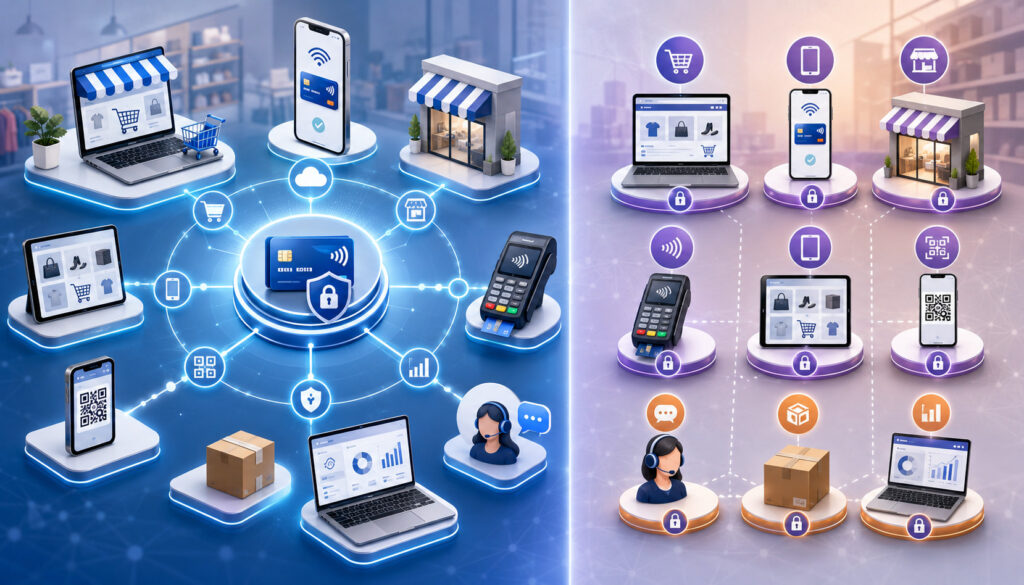
Multichannel payment processing allows customers to pay through several channels. An omnichannel approach goes further by coordinating those channels so transaction history, customer information, policies, tokens, orders, and reports can work together.
A multichannel setup may be faster to launch because each channel can be selected independently. A store might use one point-of-sale system, an ecommerce site another gateway, and the billing team a separate virtual terminal.
This flexibility can be useful, but it often creates duplicated records, inconsistent reporting, separate security administration, and manual reconciliation.
An omnichannel payment platform may reduce these gaps through shared identifiers, integrations, centralized reporting, common security controls, and standardized workflows.
However, integration introduces its own complexity. Data mappings must be correct, APIs must be monitored, staff need training, and a failure in a central component may affect several channels at once.
Omnichannel vs Multichannel Payment Processing
| Comparison factor | Omnichannel approach | Multichannel approach | Why the difference matters |
| System integration | Channels exchange payment, order, and customer data | Channels may operate independently | Integration affects visibility and manual work |
| Customer records | Profiles can be linked across touchpoints | Separate profiles are common | Duplicate records can weaken service and reporting |
| Reporting | Transactions can be viewed through coordinated dashboards or exports | Reports are gathered from each channel | Finance teams may spend more time combining data |
| Refunds | Original transactions may be located across channels | Refunds may need to be handled in the original system | Customers may experience different return options |
| Inventory | Sales and returns can update connected inventory records | Inventory may be maintained separately | Delays can cause overselling or incorrect availability |
| Payment tokens | Compatible tokens may support approved cross-channel use | Stored credentials may remain channel-specific | Portability affects repeat checkout and subscriptions |
| Customer experience | Policies, receipts, and service can be coordinated | Experiences may vary by channel | Inconsistency creates confusion and support work |
Neither model is automatically superior in every situation. A small business with limited cross-channel activity may reasonably operate separate systems if the workflows are documented and reconciliation remains manageable.
A growing retailer, subscription service, or multi-location operation may benefit more from unified payment processing when customers routinely move among channels.
The decision should be based on required customer journeys, transaction risk, internal capabilities, integration quality, data portability, total operating cost, and business continuity. The number of payment methods shown on a sales page is not a reliable measure of integration quality.
How Omnichannel Payments Work
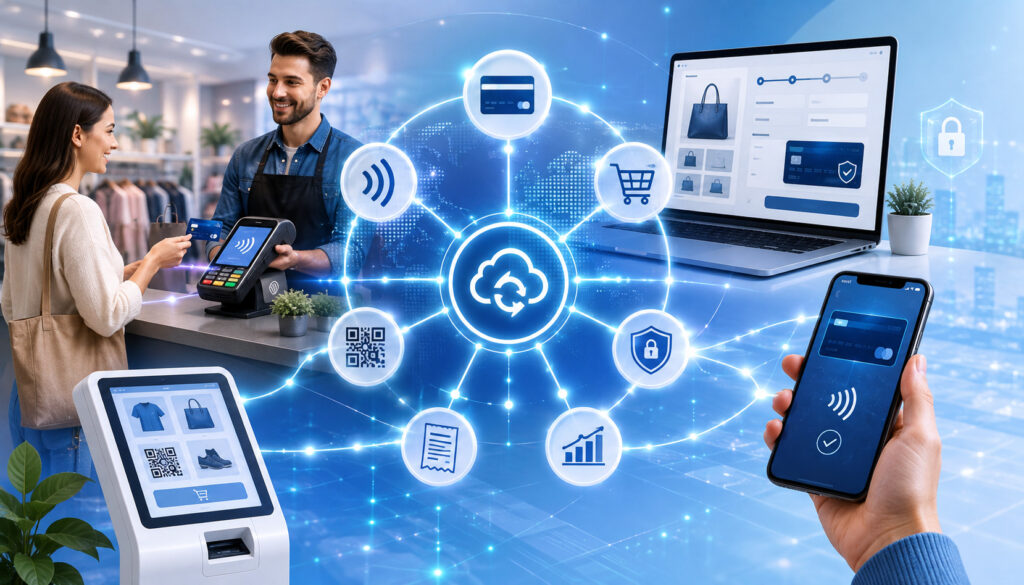
Although channels look different to customers, most card transactions follow a common lifecycle. The details vary by payment method, business model, capture policy, risk controls, and account arrangement, but the core stages are payment data capture, authentication and screening, authorization, approval or decline, capture, batching, clearing, settlement, funding, reporting, and possible post-transaction adjustments.
A connected payment environment attaches consistent identifiers to the transaction. These may include an order number, customer reference, channel, location, device, invoice, subscription, batch, authorization code, and settlement record. Good identifiers allow teams to trace a sale from checkout through deposit, refund, or dispute.
The Transaction Flow From Checkout to Funding
- Payment data capture: A terminal, checkout page, mobile reader, app, virtual terminal, invoice portal, or payment link collects the payment details and transaction amount. Secure designs limit where sensitive data enters the business environment.
- Authentication and fraud screening: The system may evaluate a chip or contactless interaction, security code, address information, customer login, device data, transaction history, velocity, or additional authentication. The controls should reflect the risk of the channel.
- Authorization: The gateway or point-of-sale environment sends an authorization request through the processor and network to the issuing institution. The issuer evaluates account status, available funds or credit, verification information, and risk indicators.
- Approval or decline: An approval permits the transaction to proceed, while a decline means the payment should not be completed with that method. A technical error is not the same as an issuer decline and should be handled according to documented retry rules.
- Capture and batching: Capture confirms that the business intends to finalize an approved amount. Captured card transactions may be grouped into a batch for clearing and settlement.
- Clearing and settlement: Transaction information is exchanged among the acquiring side, network, and issuing side. Amounts and obligations are calculated so funds can move through the payment ecosystem.
- Merchant funding: The business receives a deposit into its business bank account according to its funding arrangement. The deposit may be reduced by fees, refunds, disputes, reserves, or adjustments, or those items may be billed separately.
- Reporting and reconciliation: Sales records are matched with gateway reports, processor reports, batches, fees, deposits, bank activity, and accounting entries.
- Refunds or disputes: A settled sale may later be partially or fully refunded. A cardholder may also dispute a transaction, creating a separate chargeback workflow.
The distinction between approval and actual funding is essential. Payment authorization and settlement perform different jobs: authorization approves a payment attempt, while capture, clearing, settlement, and funding complete the financial process.
A detailed credit card transaction flow can help operations and finance teams understand why an approved sale may still be uncaptured, unsettled, or unmatched to a deposit. This shared understanding improves handoffs among customer support, operations, and finance.
The Parties and Systems Involved
The point-of-sale system records in-person sales and may manage products, taxes, receipts, employee permissions, tips, inventory, and batch closing. The ecommerce platform manages product pages, carts, order information, fulfillment status, and online checkout.
The payment gateway securely passes transaction information between the customer-facing environment and processing systems. The payment processor routes authorization, capture, settlement, and reporting messages. A merchant account supports card acceptance and funding, subject to underwriting, account terms, risk limits, and monitoring.
The issuing institution provides the customer’s card or account and decides whether to approve the authorization. The acquiring institution supports the merchant side of card acceptance. The card network routes messages and applies network rules. The business bank account ultimately receives merchant deposits.
In a well-designed omnichannel payment solution, these components do not need to expose every detail to every employee. Instead, the business assigns appropriate access, maintains reliable data mappings, and gives each team the information required for its role.
Major Omnichannel Payment Channels
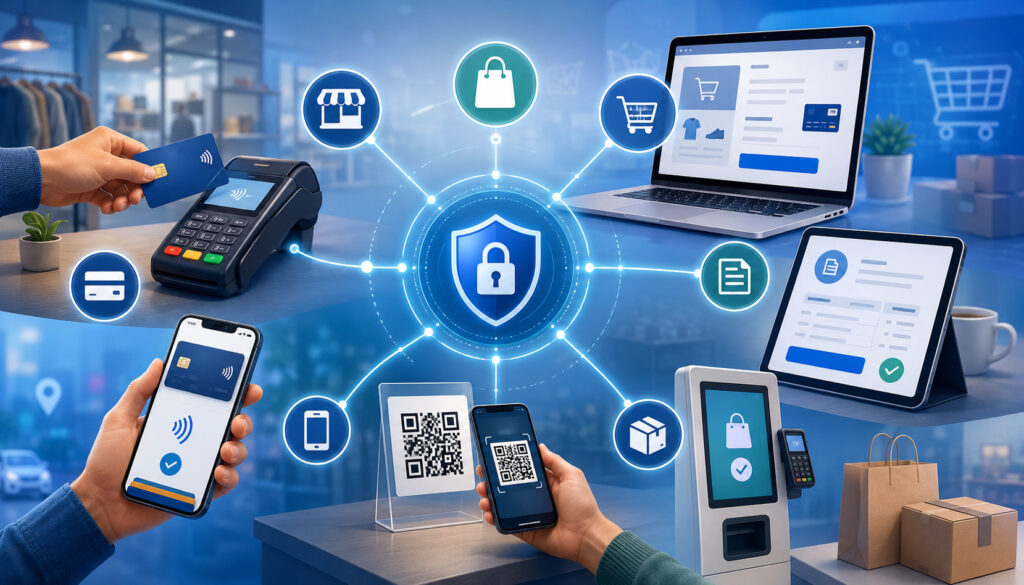
Businesses combine channels according to how customers discover, order, receive, and pay for goods or services. The right design is not the one with the greatest number of options. It is the one that supports real customer needs while keeping transaction records, security controls, refunds, reporting, and staff procedures manageable.
Physical point-of-sale terminals support card-present transactions at a counter, table, kiosk, or service desk. Mobile point-of-sale devices extend in-person acceptance to sales floors, events, curbside service, delivery, or field work.
Contactless cards and digital wallets can operate through compatible terminals, while an app may support checkout, stored credentials, order tracking, and loyalty activity.
Ecommerce checkout handles browser-based purchases. Virtual terminals allow authorized employees to key payment information into a secure interface for telephone orders or approved administrative workflows. Payment links and online invoices direct customers to hosted payment pages, reducing the need for employees to collect sensitive details directly.
Recurring billing and subscription payments use stored credentials or electronic bank authorizations according to agreed schedules. Social commerce may begin within a social channel but should still create reliable order and payment records.
Curbside pickup and delivery combine digital ordering with physical fulfillment, making order status, identity checks, inventory, and refund rules especially important.
Omnichannel Payment Channels Compared
| Payment channel | Typical use case | Customer experience | Main operational requirement | Key security consideration |
| In-store point of sale | Retail, dining, front-desk service | Tap, insert, or use a wallet at a terminal | Device management, staff permissions, batch review | Secure terminals and controlled physical access |
| Ecommerce | Website purchases | Cart and checkout on a browser | Gateway, order management, mobile usability | Fraud screening and secure checkout forms |
| Mobile payments | Field service, events, line-busting | Pay through a mobile reader or app | Reliable connectivity and device controls | Device security and authenticated staff access |
| Virtual terminal | Telephone or back-office payment | Customer provides approved details remotely | Restricted access and accurate order notes | Higher card-not-present exposure |
| Payment links | Deposits, remote service payments | Open a secure link and complete payment | Link tracking and customer communication | Verify link authenticity and prevent tampering |
| Online invoices | Business or service billing | Review invoice and pay remotely | Invoice matching and accounts-receivable updates | Secure portal and access controls |
| Recurring billing | Memberships and subscriptions | Automatic scheduled charges | Consent records, retry rules, cancellation handling | Tokenized credentials and account protection |
| Digital wallets | In-store, web, or app checkout | Authenticate through a supported device or account | Compatible terminals and checkout integration | Secure provisioning and authentication |
| ACH payments | Invoices, recurring debits, account-to-account payments | Authorize an electronic bank payment | Authorization records and return handling | Account validation, access control, and fraud monitoring |
Electronic bank payments have a different operational flow from card transactions. Businesses should understand authorization, file or message handling, returns, settlement, and reconciliation before treating them as interchangeable with card payments. This overview of how ACH payments work provides useful background on credit and debit flows.
Creating Connected Customer Experiences and Unified Data
Customers usually do not think in terms of payment gateways, merchant accounts, or data mappings. They expect the business to recognize an order, honor a disclosed policy, issue an accurate receipt, and explain what happens next. Connected payment experiences support these expectations by carrying reliable information across the systems employees use.
A customer may buy online and return an item in a store, begin checkout on one device and finish on another, pay an invoice remotely, update a subscription through a portal, or contact support about an app purchase.
These journeys work only when the business can locate the correct order and transaction, confirm eligibility, protect the customer’s account, and apply consistent policies.
Consistency does not mean every channel must look identical. A terminal, mobile app, invoice portal, and telephone workflow naturally differ. The important elements are transparent pricing, accurate product and order information, accessible checkout, clear consent, recognizable receipts, dependable status messages, and refund policies that employees can apply.
Customer Records, Privacy, and Data Quality
A unified customer view may combine purchases, payment preferences, subscriptions, refunds, loyalty activity, service interactions, and support history. This can help employees solve problems without asking customers to repeat information, but it also increases responsibility.
Duplicate profiles are a common issue. The same customer may use different email addresses, phone numbers, names, guest checkouts, or store accounts. Automated matching can help, but incorrect merging can expose another person’s information or attach transactions to the wrong profile. Businesses need controlled merge procedures, audit trails, and a way to correct errors.
Data collection should be limited to what the business genuinely needs. Access should be based on job responsibilities, and sensitive exports should be restricted.
Loyalty and personalization should remain proportionate. Purchase history may help staff recognize preferences or resolve a return, but businesses should avoid intrusive profiling, unexpected data sharing, or assumptions about customers based on sensitive or unrelated behavior.
Tokenization and Stored Payment Credentials
Tokenization replaces a sensitive account number with a substitute value called a token. The business can use an authorized token for supported functions—such as repeat purchases, refunds, subscriptions, or account updates—without placing the original account number into every connected system.
Tokenization can reduce exposure, but it is not a complete security solution. The token vault, de-tokenization process, access controls, integration, and point of initial capture still require protection. Official tokenization guidance explains that tokenization may reduce the number of systems handling card data, but it does not remove security and compliance responsibilities.
Cross-channel use also depends on compatibility. A token created by one gateway or application may not be portable to another.
Before implementation, businesses should ask who controls the token vault, which channels can use the token, how customer authorization is recorded, whether credentials can be migrated, how account updates work, and what happens if the commercial relationship ends.
Stored credentials require clear customer consent and accurate records. Customers should understand when a method will be saved, how it may be used, how to update it, and how to revoke permission. Employees should never copy raw payment details into notes, email, chat, or general customer relationship systems.
Card-Present, Card-Not-Present, Security, and Fraud Prevention
Card-present transactions occur when a card or digital wallet interacts with a compatible physical terminal. Card-not-present transactions include ecommerce, telephone orders, virtual terminals, payment links, invoices, subscriptions, and many in-app payments.
Both follow authorization and settlement processes, but their evidence, verification options, fraud exposure, chargeback patterns, and customer experience can differ.
Card-present transactions can use chip or contactless data that shows the payment credential interacted with a terminal. Card-not-present transactions rely more heavily on customer-entered information, account history, device signals, security codes, address checks, authentication, and fraud screening.
Keyed entry at a physical location is still generally treated as card-not-present because the terminal did not securely read the card.
Processing costs may differ by channel because risk, data quality, card type, transaction method, and account terms differ. Businesses should compare their own statements rather than assume a universal rate difference.
They should also separate card-present and card-not-present activity when reviewing declines, fraud, chargebacks, refunds, and operational errors.
A Layered Security Program
No omnichannel payment system is completely secure or fraud-proof. Security depends on technology, configuration, employee behavior, vendor controls, monitoring, and incident response. The objective is to reduce exposure, detect suspicious activity, limit access, and respond effectively.
Important controls include the measures below. Each control should have a documented owner, review schedule, and escalation path:
- Encryption for sensitive data in transit and, where applicable, at rest
- Tokenization to reduce the spread of account numbers
- Secure customer authentication and protected account recovery
- PCI DSS responsibilities matched to the actual payment environment
- Approved, maintained devices and protected network connections
- Strong passwords, multifactor authentication, and unique user accounts
- Role-based permissions for refunds, exports, reports, and configuration
- Timely software and firmware updates
- Fraud screening, transaction monitoring, and review queues
- Secure customer portals and payment pages
- Logging, alerting, backups, and tested incident-response procedures
Payment security standards establish technical and operational requirements for organizations that store, process, or transmit cardholder data. The relevant payment security standards include protections for stored data, encrypted transmission, secure systems, access control, and monitoring.
Multifactor authentication adds another verification factor beyond a password and is particularly important for administrative portals, remote access, refund tools, reporting dashboards, and systems containing customer or payment data. Practical multifactor authentication guidance explains why passwords alone provide insufficient protection for sensitive business systems.
Fraud Controls Should Match the Channel
Fraud patterns are not identical across in-store, ecommerce, telephone, mobile, subscription, and invoice payments. A single rule set applied everywhere may be too weak for one channel and unnecessarily restrictive for another.
Ecommerce screening may consider device information, billing and shipping differences, rapid attempts, account age, order value, delivery risk, and customer history.
Telephone and virtual-terminal payments need restricted employee access, strong order notes, and procedures that prevent staff from bypassing verification. Subscription systems should watch for account takeover, unusual credential changes, repeated failures, and disputes linked to unclear billing.
Velocity controls can identify repeated attempts by card, account, device, address, customer, or employee. Risk-based authentication can request stronger verification when behavior is unusual while keeping routine purchases convenient.
Manual review is useful when the system cannot confidently approve or reject an order, but reviewers need documented criteria and escalation procedures.
Employee training is part of fraud prevention. Staff should recognize suspicious refund requests, requests to bypass controls, social engineering, account takeover indicators, unusual pickup changes, and attempts to collect payment outside approved channels.
Cross-Channel Refunds, Returns, and Recurring Payments
A cross-channel return occurs when the customer asks for a refund or exchange somewhere other than the original purchase channel. For example, an online order may be returned at a store, or an app purchase may be handled by a customer-service agent.
The process works only when employees can find the original order, confirm the transaction status, apply the return policy, and send funds through the appropriate payment path.
The first step is reliable transaction lookup. Employees may search by order number, receipt, customer account, payment token, date, amount, or location, depending on privacy and access rules. The system should distinguish a completed payment from an authorization, void, prior refund, or disputed transaction.
Refunds should normally return to the original payment method when required by policy, network rules, or risk controls. Partial refunds need clear calculations and records. If the original credential is no longer available, staff should follow an approved exception procedure rather than improvising cash, gift credit, or a different card.
Customer communication matters because refund posting is not always immediate. Staff should provide a refund receipt, amount, date, reference, and a careful explanation of what the business has completed. They should avoid promising an exact posting time controlled by another institution.
Return fraud remains a risk. Connected order histories can help identify duplicate returns, altered receipts, repeated no-receipt claims, or attempts to refund more than the remaining transaction balance. Controls should be proportionate and should not prevent legitimate customers from using published policies.
Recurring and Subscription Workflows
Recurring billing adds customer consent, stored credentials, scheduled charges, plan changes, retries, cancellations, and billing notices to the omnichannel environment.
A customer might enroll in a store, update a payment method in an app, pause through a portal, and contact support to cancel. Each action should update the same subscription record.
Consent records should show what the customer authorized, the amount or calculation method, frequency, trial or introductory terms, cancellation process, and communication preferences. Billing descriptors and receipts should help customers recognize charges.
Failed-payment handling should include sensible retry rules, notices, secure payment-update options, and clear service consequences. Endless retries can create fees and complaints, while immediate cancellation may be unnecessarily disruptive. Expired credentials and account changes should be managed through approved update tools where available.
Reporting, Reconciliation, Inventory, and Loyalty
Centralized reporting is one of the most practical benefits of omnichannel payment processing, but a dashboard is not the same as reconciliation. Reporting shows activity. Reconciliation proves that transactions, fees, adjustments, and deposits agree across systems.
Finance teams may need to compare store sales, ecommerce orders, mobile transactions, payment links, invoice payments, processor reports, processing fees, refunds, chargebacks, net deposits, bank statements, and accounting records.
Differences can result from batch cutoffs, delayed capture, partial refunds, tips, reserves, disputes, separate fee billing, or integration errors.
A useful routine has several layers. The exact timing may vary, but unresolved exceptions should not be carried forward without an owner:
- Daily: Confirm channel totals, failed captures, batch closure, refunds, unusual declines, and expected deposits.
- Weekly: Review unmatched transactions, fee exceptions, chargebacks, stale authorizations, refund trends, and integration failures.
- Monthly: Reconcile merchant statements, bank activity, accounting balances, channel totals, fees, reserves, and outstanding exceptions.
Detailed guidance on payment settlement cycles helps explain why transaction dates, batch dates, settlement records, and bank deposits may not align one-for-one. A periodic merchant statement audit can also reveal unexpected fees, reporting gaps, and changes in transaction mix.
Connected inventory and order systems can reduce overselling, duplicate orders, and fulfillment mistakes, but synchronization is rarely instantaneous in every environment. A store sale, online reservation, return, damaged item, canceled order, or transfer between locations must update available quantities according to defined rules.
Businesses should monitor synchronization delays, incorrect product identifiers, bundle logic, duplicate webhooks, failed imports, and returns placed in the wrong inventory status. A correction procedure should identify the system of record, preserve an audit trail, and prevent the same mismatch from recurring.
Loyalty programs and customer support can use connected payment records to locate purchases, apply rewards, and understand service history. Access should remain role-based, and loyalty data should not become an excuse to collect unnecessary information or make inappropriate assumptions about customers.
Omnichannel Payment Costs and Technology Choices
The cost of an omnichannel payment system extends beyond a quoted transaction rate. Potential expenses include interchange, network fees, processor markup, gateway services, hardware, software subscriptions, integrations, tokenization, fraud tools, chargebacks, support, implementation, maintenance, training, and internal staff time.
Different channels can create different cost patterns. Card-present, card-not-present, recurring, invoice, wallet, and ACH transactions may carry different pricing, verification, return, and dispute considerations.
Hardware may be inexpensive but require a long contract; software may appear simple but require costly custom integration; a low rate may be offset by gateway, statement, support, or account fees.
Businesses should calculate total operating cost using realistic transaction volume, average ticket, payment-method mix, location count, refund activity, chargeback exposure, support needs, and expected growth. Costs and funding schedules vary, so proposals should be compared line by line rather than reduced to one advertised number.
Centralized Systems vs Separate Channel Systems
A centralized environment can improve data consistency, shared tokens, reporting, refunds, and security administration. It may also simplify support because fewer integrations sit between the business and its transaction records.
The tradeoffs include implementation complexity, dependence on central components, migration difficulty, and vendor concentration. If the core gateway or platform has an outage, several channels may be affected. Data portability can also become important if tokens, customer records, or transaction histories cannot be transferred easily.
Separate systems can provide flexibility and isolation. A problem in one channel may not stop another, and teams can select specialized tools. However, separate systems often increase manual reconciliation, duplicated customer profiles, inconsistent permissions, and policy drift.
The best architecture may be a controlled combination: shared identifiers and reporting where they add value, with redundancy and channel separation where business continuity requires it. The design should make dependencies visible rather than hiding them behind a single dashboard.
Core Technology and Integration Requirements
An omnichannel technology stack may include point-of-sale hardware, ecommerce software, gateways, processors, merchant accounts, mobile apps, virtual terminals, customer relationship systems, inventory platforms, order management, accounting software, reporting dashboards, APIs, and integration tools. Each component should have a clear operational purpose and defined data responsibilities.
An API is a defined way for software systems to request information or actions from one another. For example, an order system may use an API to create a payment request, retrieve a transaction status, issue a refund, or download settlement records.
Compatibility is more than having an available connector. Teams should examine field mappings, update frequency, error handling, duplicate prevention, rate limits, access controls, logging, test environments, and support responsibilities. Every automated connection needs an owner and a procedure for exceptions.
Implementation Challenges and a Step-by-Step Strategy
Implementation problems often come from legacy systems, incomplete data migration, incompatible tokens, duplicate customer profiles, inconsistent refund policies, staff resistance, security gaps, and unclear ownership.
Inventory synchronization may be inaccurate, integrations may fail silently, and custom workflows may increase dependence on one technology provider.
The safest approach is phased and evidence-based. The following sequence keeps customer needs, financial controls, and technical dependencies visible:
- Map current sales and payment channels. Include stores, websites, apps, invoices, subscriptions, telephone orders, social commerce, pickup, and delivery.
- Document the customer journey. Trace discovery, checkout, fulfillment, service, returns, and repeat purchases.
- Identify disconnected systems and data. Record duplicate entry, missing identifiers, separate reports, and manual work.
- Review payment preferences. Use actual transaction and support data rather than assumptions.
- Define required cross-channel experiences. Specify which returns, saved methods, receipts, profiles, and subscription actions must work across channels.
- Evaluate payment methods and risks. Match verification and fraud controls to each channel.
- Review integrations. Confirm APIs, data mappings, token compatibility, update frequency, and error handling.
- Compare total costs and terms. Include implementation, training, support, hardware, software, fees, and exit requirements.
- Establish security and privacy controls. Define access, retention, monitoring, incident response, and compliance responsibilities.
- Standardize refunds and communication. Align policies, receipts, status messages, and employee scripts.
- Train employees. Provide role-specific practice for checkout, declines, refunds, fraud alerts, and outages.
- Test every workflow. Include successful transactions, failures, exceptions, and accounting results.
- Launch in phases. Start with controlled locations, channels, or customer groups and correct defects before expanding.
- Monitor and refine. Review performance, complaints, exceptions, security events, and reconciliation findings.
Data migration should preserve transaction history, consent, refund eligibility, and audit records without importing unnecessary sensitive data. Before launch, confirm which system is the source of truth for customers, orders, inventory, subscriptions, and financial records.
Testing, Performance, Common Mistakes, and Downtime
Testing should follow money and data from the customer action to the accounting entry. Test approved and declined transactions, in-store and online purchases, mobile checkout, digital wallets, refunds, partial refunds, cross-channel returns, recurring billing, customer profiles, inventory changes, receipts, settlement, fees, bank deposits, accounting exports, permissions, and outage procedures.
Use test cases for duplicate clicks, timeouts, expired credentials, failed webhooks, incorrect amounts, canceled orders, partial fulfillment, and employees attempting actions outside their role. Confirm that alerts reach the correct team and that logs contain enough information to diagnose problems without exposing sensitive data.
Performance measures may include approval rates, declines, checkout abandonment, processing cost, refunds, chargebacks, cross-channel return completion, reconciliation discrepancies, downtime, deposit timing, complaints, mobile performance, and channel volume.
Appropriate results vary by business model, customer base, channel, and configuration; trends and root causes are more useful than universal benchmarks.
Common mistakes include treating separate channels as omnichannel, adding methods without demand, ignoring mobile usability, applying identical fraud rules everywhere, collecting excessive data, using inconsistent refund policies, skipping integration tests, neglecting reconciliation, storing payment details improperly, and relying entirely on one provider.
Regular operational reviews should turn each of these risks into a specific control, owner, and test.
Downtime planning should cover internet loss, gateway disruption, terminal failure, software errors, power loss, and integration problems. Define secure backup methods, employee authority, customer messages, emergency contacts, data recovery, and post-outage reconciliation.
Never record sensitive payment details in unsecured notes for later entry. After service returns, compare every temporary record with completed, declined, duplicated, and missing transactions.
Frequently Asked Questions
What is omnichannel payment processing?
It is a connected approach to accepting and managing payments across stores, websites, apps, mobile devices, invoices, subscriptions, and other touchpoints. The defining feature is coordination among transaction records, customers, orders, refunds, reporting, and business systems—not merely the availability of several payment channels.
How is it different from multichannel payments?
Multichannel acceptance provides several ways to pay, but the systems may remain separate. Omnichannel payment acceptance aims to link those channels through shared identifiers, integrations, policies, reporting, and customer records so purchases and service actions can continue across touchpoints.
Which channels can be connected?
Common channels include point-of-sale terminals, ecommerce checkout, mobile readers, apps, wallets, contactless payments, virtual terminals, telephone payments, payment links, invoices, social commerce, subscriptions, ACH payments, curbside pickup, and delivery. The useful combination depends on actual customer journeys.
Can customers use the same payment method across channels?
Sometimes, when the customer has authorized storage and the token, gateway, account, and connected applications support the intended use. Token portability is not automatic. Businesses should confirm consent, compatibility, security, account-update behavior, and what happens during a system change.
How do cross-channel refunds work?
The receiving channel locates the original order and payment, verifies return eligibility, confirms the remaining refundable amount, and sends the credit through the approved method. Strong controls prevent duplicate refunds, incorrect tender changes, and refunds against unsettled or already disputed transactions.
Are omnichannel payments harder to secure?
They can increase the number of devices, users, integrations, and data flows that require protection. Centralized controls may improve consistency, but a central weakness can affect several channels.
Security therefore requires restricted access, tokenization, encryption, authentication, monitoring, updates, training, and tested incident response.
How are omnichannel transactions reconciled?
Teams match orders and channel sales to authorizations, captures, batches, settlement reports, fees, refunds, chargebacks, deposits, bank records, and accounting entries. Shared transaction and order identifiers make this easier, but automated matching still needs exception review.
Can the system connect with inventory and accounting software?
Yes, when compatible APIs or integration tools are available and correctly configured. Teams should verify data mappings, update timing, duplicate prevention, tax and fee treatment, refund entries, inventory rules, error alerts, and the system of record for each data type.
What are the main implementation challenges?
Typical challenges include legacy systems, migration, token portability, duplicate profiles, inconsistent policies, training, downtime, security gaps, synchronization delays, unexpected costs, provider dependence, and changing internal processes. Phased rollout and documented ownership reduce these risks.
Conclusion
Omnichannel payment processing connects payment acceptance, customer experiences, refunds, reporting, and business systems across multiple channels. Its value comes from coordinated workflows: an order can be located, a transaction can be traced, a return can follow the original payment, and a deposit can be matched to the activity that created it.
Successful implementation requires more than adding terminals, wallets, links, or checkout options. Businesses need compatible technology, secure data handling, reliable integrations, standardized refund and subscription procedures, employee training, clear customer communication, realistic downtime plans, and regular reconciliation.
The best strategy starts with required customer journeys and operational needs. It then selects payment methods, integrations, security controls, reporting, and support processes that fit those requirements. Careful testing and phased rollout help reveal gaps before they affect every channel.
An omnichannel payment system will not automatically increase sales, eliminate fraud, or solve every operational problem. When designed responsibly, however, it can give customers more consistent ways to pay and give business teams a clearer, more dependable way to manage transactions from initiation through funding, service, and financial reporting.
Ongoing review is essential because customer behavior, transaction risk, integrations, and operating processes change over time. The system should therefore be treated as a managed business capability rather than a one-time technology installation.
Leave a Reply