
Digital information passes through many systems before reaching its destination. A private message may travel through a device, local network, internet service, routing infrastructure, application servers, notification services, and the recipient’s network.
Payment information, business documents, support conversations, and account records may follow similarly complicated paths.
End-to-end encryption is designed to protect the content throughout that journey. When properly implemented, readable information is encrypted at the sender’s endpoint and remains unreadable until an authorized recipient’s endpoint decrypts it.
The systems carrying or temporarily storing the information should generally see encrypted data rather than the original content.
This protection is valuable, but it is not absolute. End-to-end encryption does not secure an unlocked device, stop a recipient from copying information, prevent phishing, hide every type of metadata, or correct weak access controls.
Its effectiveness depends on the cryptographic protocol, device security, identity verification, key management, backups, account recovery, software implementation, and user behavior.
Understanding these distinctions helps businesses and individuals evaluate encrypted communications accurately instead of relying on a lock symbol or an unsupported claim that a system is “fully secure.”
What End-to-End Encryption Means
The end-to-end encryption meaning can be summarized as follows: information is converted into an unreadable form at its source and is normally restored to a readable form only at an authorized destination.
The sender and recipient are the “ends” in this model. An endpoint might be a phone, computer, payment device, secure hardware component, connected sensor, or another authorized system. The exact endpoint depends on the design of the service.
A properly designed E2EE system should prevent an intermediary from obtaining the keys required to read protected content. Servers may still route messages, store encrypted files, synchronize devices, deliver notifications, or manage accounts, but they should generally handle ciphertext rather than readable message content.
What Counts as an Endpoint?
An endpoint is the place where protected information becomes readable for an authorized user or process. In a private conversation, the endpoints are usually the participants’ devices. In a secure document workflow, they could be approved computers holding the necessary decryption keys.
The service’s central server is not automatically an endpoint merely because data passes through it. If the server can decrypt the content as part of normal operation, the arrangement may provide transport encryption, server-side encryption, or another security model rather than strict E2EE.
Endpoints may change when a person adds a new device, signs in through a browser, restores a backup, or allows an administrator to access content. These events can expand the set of systems able to decrypt information.
A useful evaluation question is: At which exact locations can this information appear in a readable form? The answer reveals the real encryption boundary more accurately than a general statement that data is “encrypted.”
Plaintext, Ciphertext, and Encryption Keys
Plaintext is the original readable information. A note saying “Approve the supplier invoice” is plaintext before encryption.
Ciphertext is the scrambled output created by an encryption algorithm. It may look like a meaningless sequence of characters and cannot normally be understood without the correct key.
An encryption key is a value used by a cryptographic algorithm to encrypt information, decrypt it, or perform a related security function. A strong encryption system does not depend on keeping its general algorithm secret. Instead, security depends heavily on protecting the keys and using the algorithm correctly.
A simplified example looks like this:
- A sender enters “Approve the supplier invoice.”
- The sender’s device combines that plaintext with an encryption algorithm and key.
- The result becomes unreadable ciphertext.
- The ciphertext travels through networks and servers.
- The recipient’s device uses the correct key to decrypt it.
- The original sentence becomes readable again.
Real cryptographic protocols are more complex. They may also include authentication checks, digital signatures, temporary session keys, message counters, integrity protections, and safeguards against replay or impersonation.
How End-to-End Encryption Works

E2EE is not a single algorithm. It is a system design that combines encryption, key exchange, authentication, device management, and message-handling rules.
The cryptographic process often begins when users establish accounts or register devices. Each endpoint may create cryptographic key material locally. Depending on the protocol, some public information may be uploaded to a server so other users can establish protected sessions, while private keys remain on authorized devices.
When a sender communicates with a recipient, the endpoints establish or derive keys that can protect the content. Efficient symmetric encryption may secure the actual message, while asymmetric cryptography helps authenticate participants or establish shared secrets.
Servers can then store or transport the encrypted information without possessing the content-decryption keys. After the recipient receives the ciphertext, the recipient’s device verifies it, decrypts it, and displays the original information.
The Encryption Process Step by Step
The following sequence provides an E2EE explained overview:
- The sender creates information. This may be a message, voice packet, file, image, payment instruction, or business record.
- The sender’s device prepares the data. The application may add message identifiers, integrity information, recipient details, or protocol data.
- Encryption happens at the source. The device transforms the readable content into ciphertext using approved cryptographic methods.
- The encrypted data is transmitted. Networks, routers, servers, and storage systems handle the ciphertext.
- The recipient receives the protected data. The destination device checks that the message is valid and intended for that endpoint.
- The correct key is applied. The recipient’s device decrypts the ciphertext.
- The original content is displayed. The recipient sees or processes the readable information.
Encryption protects confidentiality, but a well-designed protocol should also address integrity and authentication. Otherwise, an attacker might be unable to read a message but could attempt to replace it, alter it, redirect it, or impersonate a participant.
Key Exchange, Authentication, and Decryption
Two endpoints need a secure method for establishing encryption keys. Simply sending a secret key as readable data would expose it to anyone monitoring the exchange.
Public-key cryptography helps solve this problem. A device may create a public key that can be shared and a private key that remains protected. The public information can help another device encrypt data, verify a signature, or establish a shared secret without receiving the private key.
Authentication is equally important. Encryption with the wrong person still protects data from outsiders, but it does not protect the sender from an impersonator. Authenticated key exchange helps the endpoints establish keys while confirming the expected identities.
Some systems allow users to compare verification codes or public-key fingerprints through a separate communication channel. Digital signatures may also prove that a message or key announcement came from a device holding a particular private key.
After authentication and key establishment, the recipient’s device performs decryption. If the ciphertext was altered, the authentication check should fail rather than producing trusted content.
Symmetric and Asymmetric Encryption
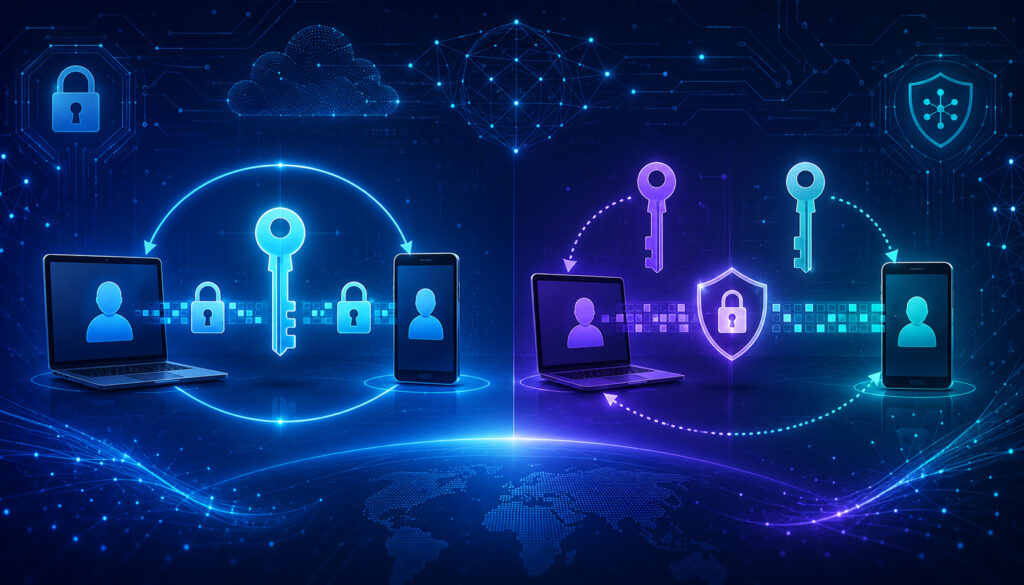
Modern E2EE systems often combine symmetric and asymmetric encryption. The two approaches solve different problems and are more effective together than when treated as competing methods.
Symmetric encryption is generally efficient enough to protect large messages, files, calls, and continuous data streams. Asymmetric encryption is useful for public-key distribution, identity verification, digital signatures, and secure key establishment.
A hybrid protocol may use asymmetric techniques when a protected session begins. The endpoints then derive temporary symmetric keys and use those faster keys to encrypt the actual content.
Symmetric Encryption
Symmetric encryption uses the same secret key, or closely related secret key material, for encryption and decryption. Anyone who possesses the secret may be able to read the protected data, so distributing and storing that key safely is essential.
Imagine two authorized devices that already share a secret. One device encrypts a file with that secret, and the other uses the same secret to decrypt it. An intermediary without the key sees only ciphertext.
Symmetric encryption is efficient and well suited to large amounts of data. It is commonly used after two endpoints have completed an authenticated key exchange.
Its central challenge is key distribution. If the shared secret is sent through an insecure channel, copied into an exposed configuration file, or stored on a compromised device, the encryption may no longer provide the expected protection.
The number of keys can also become difficult to manage when many people, devices, or groups need different access rights.
Asymmetric Encryption and Hybrid Systems
Asymmetric encryption uses a pair of mathematically related keys. A public key can be distributed, while the corresponding private key must remain protected.
Depending on the algorithm and protocol, information encrypted for a public key can be decrypted only with the related private key. A private key can also create a digital signature that others verify using the public key.
Asymmetric operations usually require more computing resources than symmetric encryption. For that reason, real systems commonly use a hybrid process:
- The endpoints use public-key techniques to authenticate one another or establish a shared secret.
- The protocol derives one or more temporary symmetric keys.
- Symmetric encryption protects the conversation or file transfer.
- New keys may be derived as the session continues.
- Old key material may be deleted when it is no longer needed.
This combination provides efficient content encryption while reducing the difficulty of transmitting secret keys securely. Official cryptographic key-management guidance recognizes symmetric, asymmetric, and hybrid key-establishment techniques.
End-to-End Encryption Compared With Other Security Methods
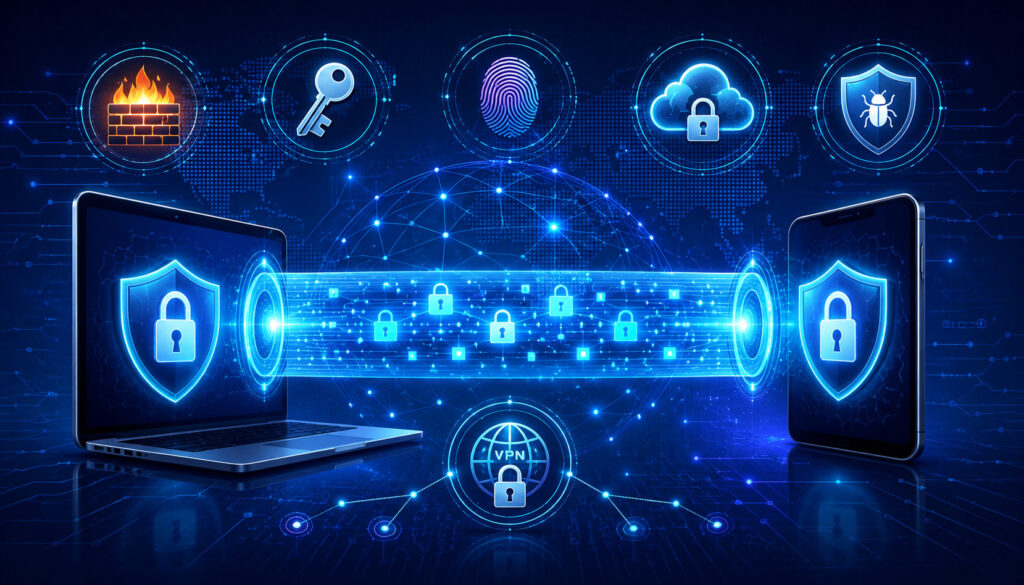
The word “encryption” can describe several different protections. Data may be encrypted while traveling to a server, while stored on a disk, between a payment terminal and a decryption environment, or directly between user-controlled endpoints.
These methods are not interchangeable. Each protects a different segment of the data lifecycle, and more than one may be used in the same system.
End-to-End Encryption vs Transport Encryption
Transport encryption protects a connection between two systems, such as a browser and a web server. HTTPS normally uses TLS to encrypt data while it travels across that connection.
This protection helps prevent someone monitoring the network from easily reading or modifying the traffic. It is essential for secure websites, account logins, online checkout, application programming interfaces, and many other internet services.
However, TLS usually ends at the receiving server. The server decrypts the traffic so it can process the request. The organization operating that server may therefore be technically capable of reading, scanning, storing, or forwarding the content.
In E2EE, the service transporting the information should generally lack the keys needed to decrypt the protected content. TLS may still protect the encrypted message while it travels, but it is an additional layer rather than the defining E2EE layer.
HTTPS therefore does not automatically mean that information is end-to-end encrypted. It confirms that the connection to the server is protected when correctly configured; it does not prove that the server cannot access the submitted data.
E2EE vs Point-to-Point Encryption
Point-to-point encryption protects data between two defined points. In payment processing, that frequently means encryption begins when account data is captured by a payment device and ends in a secure decryption environment.
The payment-security definition of P2PE states that account data is protected from the point where a merchant accepts the card to the secure point of decryption.
This can substantially reduce exposure within a merchant environment, but the secure decryption environment is intentionally able to recover the payment data. That design is not always identical to E2EE in private communications, where the service operator generally should not possess the keys required to read message content.
The terms should therefore be qualified:
- Communications E2EE: The intended communicating endpoints normally control content access.
- Payment P2PE: Data is encrypted from an approved capture point to a controlled decryption point.
- Generic point-to-point encryption: The protected points depend on the system architecture.
A payment vendor may use “end-to-end” descriptively even when a standards-based P2PE design is more technically precise. Businesses should ask where encryption begins, where decryption occurs, and who controls the keys.
E2EE vs Tokenization and Hashing
Tokenization replaces sensitive information with a substitute value called a token. The token may preserve a useful reference to the original record without exposing the record itself.
For example, a payment system may replace a card number with a token. The merchant can use the token for an approved recurring payment or refund workflow without storing the original card number locally.
Encryption is different. It mathematically transforms information into ciphertext and is designed to be reversible with the correct key. Tokenization often depends on a secure mapping or token service that connects a token to its original value.
Hashing is another distinct process. A cryptographic hash converts input into a fixed-length output and is generally intended to be one-way. Proper password-verification systems store a protected password-derived hash rather than a reversibly encrypted copy of the password.
Encryption is suitable when authorized users must recover the original content. Hashing is suitable when a system needs to verify a value without recovering the original. Tokenization is useful when business processes need a substitute reference instead of the sensitive value.
End-to-End Encryption Compared With Other Security Methods
| Security method | What it does | Who may access readable data | Common use | Important limitation |
| End-to-end encryption | Encrypts content at a source endpoint for decryption at an authorized destination | Intended endpoints holding valid keys | Messages, calls, files, protected collaboration | Does not secure compromised endpoints or necessarily hide metadata |
| Transport encryption | Protects a connection between systems | Users, the receiving server, and other authorized systems after termination | HTTPS, APIs, online checkout and account access | The server normally decrypts the information |
| Data-at-rest encryption | Protects stored files, databases, disks, or backups | Systems or administrators with storage keys and permissions | Laptops, servers, databases and archives | Data may be readable while an authorized system is operating |
| Point-to-point encryption | Encrypts data between two defined processing points | The source when captured and the approved destination after decryption | Payment devices and secure decryption environments | Not automatically equivalent to communications E2EE |
| Tokenization | Replaces sensitive data with a substitute reference | The secure token service or authorized system resolving the token | Stored payment references and recurring transactions | Does not itself encrypt every surrounding data field |
| Hashing | Produces a one-way digest for verification | The original value is not normally recovered | Password verification and integrity checks | Unsuitable when the original content must be restored |
Common Uses of End-to-End Encryption
Secure messaging is the best-known E2EE example, but the model can protect many types of communication and stored content.
Private messages, group discussions, voice calls, video calls, shared documents, and file transfers may be protected between authorized endpoints. Email can also use end-to-end data encryption, although setup, key discovery, device synchronization, and recipient compatibility may be more complex.
Cloud storage may provide E2EE when files are encrypted before upload and the storage operator lacks the decryption keys. Other storage services use server-side encryption instead, meaning the platform controls the keys and can process readable content when authorized.
The label must be evaluated for each feature. A service may encrypt messages end to end while storing address books, previews, search indexes, or backups under a different model.
Communication, Files, and Collaboration
End-to-end encrypted communication can protect confidential conversations from unnecessary access by network operators, hosting infrastructure, and service administrators. Common applications include:
- Private individual and group messages
- Voice and video conversations
- Sensitive file transfers
- Internal business discussions
- Legal, financial, or personnel documents
- Remote-work collaboration
- Customer-support exchanges containing restricted information
- Communications between field employees and central teams
Group communication requires additional controls because membership can change. A secure protocol should handle participant additions, removals, linked devices, key updates, and historical access consistently.
Business collaboration also raises questions about retention and authorized oversight. An organization may need to preserve certain records, investigate misconduct, recover information after an employee leaves, or respond to a valid legal request. These needs must be considered before adopting a system in which only individual endpoints possess keys.
Healthcare, Finance, Support, and Connected Devices
Encrypted communications can help protect appointment details, care coordination, financial information, customer records, vendor documents, and operational instructions. The security value depends on what is encrypted and what remains visible elsewhere in the workflow.
A customer-support conversation may be E2EE during a live session but later copied into a ticketing database under server-controlled encryption. A financial document may be protected during transfer but downloaded to an unmanaged computer. A connected device may encrypt sensor data while still revealing device identifiers and communication patterns.
Organizations should not assume that every service in healthcare, finance, cloud storage, collaboration, or connected-device categories provides true E2EE. Some systems must access readable information to search it, classify it, process transactions, perform safety monitoring, generate analytics, or integrate with other platforms.
The practical question is not merely whether encryption exists. It is whether the encryption boundary matches the sensitivity of the information and the organization’s operational requirements.
End-to-End Encryption in Payment Security
Payment environments use several security layers because payment card information may pass through terminals, browsers, mobile devices, gateways, processors, financial networks, storage systems, and fraud controls.
Encryption can protect payment data when it is captured and transmitted. Tokenization can reduce the need to store card numbers. Access controls restrict administrative functions. Authentication helps verify customers or devices. Monitoring identifies unusual activity, while PCI DSS defines security responsibilities for entities that store, process, or transmit payment account data.
An overview of secure payment infrastructure helps illustrate how gateways, terminals, processors, fraud tools, access controls, tokenization, and reporting work together. The card transaction flow also shows why secure capture is only one stage of payment processing.
Card-Present Transactions
In a card-present environment, payment information may be captured by a terminal or point-of-interaction device. A secure design can encrypt the account data immediately within approved hardware before it enters the merchant’s broader network.
The ciphertext then travels through connected systems to a secure decryption environment. Employees, local systems, and intermediate infrastructure may be able to route the transaction without seeing the underlying card number.
This approach can reduce the exposure of readable payment data inside the merchant environment. It does not eliminate every risk. Attackers may still target the terminal, replace hardware, steal credentials, manipulate transaction amounts, compromise administrative accounts, or exploit systems after decryption.
Payment-security guidance describes P2PE as protecting account data from the point of acceptance to a secure decryption environment. It also notes that use of a listed solution does not remove the need for appropriate evaluation and due diligence.
Businesses should distinguish a validated payment-security design from a general vendor statement that a terminal “uses encryption.”
Ecommerce, Mobile Payments, and Stored Credentials
An ecommerce checkout commonly uses TLS to protect information between the customer’s browser and the payment server. Hosted payment fields, secure checkout pages, and gateway-controlled forms may keep raw payment card information away from the merchant’s application.
The roles of a payment gateway and merchant account provide useful context. A gateway can support secure transmission, tokenization, authentication, fraud checks, and authorization routing, while the acquiring and settlement environment handles other financial functions.
In mobile payments, protection may begin in a secure device component, application, reader, or wallet environment. The precise encryption boundary depends on the implementation.
Stored credentials should generally be minimized. Tokenization can allow recurring billing, refunds, account updates, or repeat purchases without requiring a merchant to store the original card number. Encryption may still protect the token, transaction data, or supporting records.
Businesses should also review gateway fees and security capabilities together. This payment-processing cost guide explains that gateway services may include encryption, tokenization, fraud screening, reporting, and authorization controls.
Benefits, Limitations, Metadata, and Endpoint Risk
The benefits of end-to-end encryption come primarily from reducing the number of systems and people able to read protected content.
Intermediaries can route or store encrypted information without receiving content access. A breach of a message server may expose ciphertext rather than readable conversation history, assuming keys and endpoints remain secure. Confidential business communications can be protected from unnecessary internal or external access.
E2EE can also support secure remote work by protecting information across networks employees do not control. It may strengthen customer confidence when the protection is explained accurately and when other security controls support it.
These benefits do not make encrypted data unexposable. Attackers frequently target accounts, people, devices, backups, integrations, and recovery mechanisms instead of attempting to defeat the underlying mathematics.
What End-to-End Encryption Can Protect
A correctly implemented system may help:
- Prevent network intermediaries from reading protected content
- Reduce exposure while data travels through external infrastructure
- Limit readable information stored on central servers
- Protect confidential employee, customer, and vendor communications
- Reduce unnecessary administrator access
- Limit the consequences of some server-side data breaches
- Protect files shared across remote or untrusted networks
- Detect certain unauthorized modifications
- Authenticate devices or participants through cryptographic methods
The protection applies only within the defined encryption boundary. If a message is exported, copied into another application, printed, captured in a screenshot, or stored in an unprotected backup, that new copy may no longer receive the original protection.
Similarly, a message may be encrypted while its notification preview appears on a locked screen. A file may be protected during transfer but remain readable in a temporary folder. Good security requires reviewing these secondary copies and surrounding workflows.
What End-to-End Encryption Does Not Protect
E2EE does not automatically protect against:
- Malware operating on an endpoint
- Stolen or reused passwords
- Phishing and social engineering
- Unlocked, shared, or stolen devices
- Screen captures, photographs, forwarding, or copying
- A malicious or careless recipient
- Unprotected exports and backups
- Software vulnerabilities
- Weak account-recovery procedures
- Improperly generated or stored keys
- Excessive administrative permissions
- Incorrect implementation
- Lost decryption keys
- Every category of metadata
A recipient who is authorized to read content can generally reproduce or disclose it. Encryption cannot force a trusted recipient to remain trustworthy.
An attacker who controls a device may also read content before encryption or after decryption. The attacker does not need to break the encryption if malware can capture keystrokes, copy files, record the screen, or access an unlocked application.
E2EE is therefore one layer within a wider cybersecurity strategy, not a replacement for endpoint protection, authentication, access management, monitoring, employee training, secure development, and incident response.
Metadata and Device Security
Metadata is information about communication rather than necessarily its content. Depending on the system, visible metadata may include account identifiers, participating devices, communication times, message size, network addresses, delivery status, group membership, or frequency of contact.
Some systems minimize or encrypt portions of metadata, while others retain more for routing, abuse prevention, billing, synchronization, diagnostics, or legal obligations. It is inaccurate to claim that E2EE always hides all metadata.
Endpoint security is equally important. Businesses and individuals should use:
- Device encryption
- Strong screen locks
- Unique account passwords
- Multifactor authentication
- Prompt security updates
- Malware protection appropriate to the device
- Limited administrator privileges
- Remote-lock or removal procedures
- Automatic locking after inactivity
- Controlled application installation
A device should be removed from trusted access when it is lost, replaced, reassigned, or no longer required. Organizations should also review whether linked devices remain authorized indefinitely.
Key Management, Identity Verification, Forward Secrecy, and Backups
Cryptographic keys determine who can encrypt, decrypt, authenticate, or sign information. Weak key management can undermine an otherwise strong algorithm.
The key lifecycle may include generation, registration, distribution, agreement, storage, use, rotation, backup, recovery, revocation, archival, and destruction. Each stage introduces different risks.
Keys should be generated with suitable randomness and protected according to their purpose. Private keys should not be placed in public repositories, sent through ordinary messages, or copied broadly across systems. Organizations should document who or what can use each key and what happens if it is exposed.
Practical key-management guidance recommends documented procedures for key generation, distribution, storage, backup, compromise recovery, and destruction.
Identity Verification and Authenticated Key Exchange
Encryption proves little about identity unless the system authenticates the parties involved. An attacker who substitutes a public key could attempt to position themselves between two users and establish separate encrypted sessions with each.
Authenticated key exchange is designed to combine secure key establishment with identity assurance. The protocol may use digital signatures, trusted device records, certificates, account credentials, previously verified keys, or another trust mechanism.
Users may also be given a public-key fingerprint, security code, or scannable verification value. Comparing that value through a separate trusted channel can help confirm that both participants see the same keys.
Organizations should understand what happens when:
- A participant adds a new device
- A device key changes unexpectedly
- An employee leaves
- An administrator resets an account
- A group participant is added or removed
- A trusted device is lost
- An account is recovered
- An identity-verification warning is ignored
A secure protocol should make important identity or key changes visible rather than silently accepting them.
Forward Secrecy
Forward secrecy limits the effect of a future key compromise. Instead of protecting all historical communications with one permanent key, the protocol derives temporary session or message keys and deletes old key material when it is no longer needed.
If a long-term identity key is later stolen, an attacker should not automatically gain the ability to decrypt every previously captured conversation. The amount of protected history depends on the protocol, key-deletion behavior, endpoint state, and backups.
Forward secrecy is a valuable property, but it is not universal. Some encrypted systems reuse keys for long periods, preserve session keys in backups, or allow historical content to be recovered through other mechanisms.
Businesses should ask whether forward secrecy is supported, which data it covers, how group conversations are handled, and whether restored devices can decrypt earlier content.
Forward secrecy also does not protect past messages that were previously copied, exported, screenshotted, or stored in readable form.
Encrypted Backups and Recovery
Backups can create a weaker path to otherwise protected information. A conversation may be E2EE during transmission but copied into a cloud backup encrypted with keys controlled by the service or recoverable through an account reset.
A genuinely end-to-end encrypted backup should normally be protected by key material unavailable to the storage operator. This improves privacy but can make recovery difficult. If the user loses the recovery key and every trusted device, the content may be permanently inaccessible.
Recovery designs may use passwords, recovery codes, trusted contacts, hardware keys, additional devices, or encrypted key escrow. Each method creates a different balance among privacy, availability, support burden, and account recovery.
Businesses should document:
- Who controls backup keys
- Whether administrators can restore employee data
- How devices migrate encrypted content
- How recovery codes are stored
- Whether backups include metadata
- What happens when an employee leaves
- Whether deleted content remains in archives
- How recovery events are logged and reviewed
Business Evaluation, Compliance, Tradeoffs, and Best Practices
Organizations should evaluate encrypted systems according to their actual workflows rather than assuming that the most restrictive model is always the best fit.
Internal collaboration may benefit from strong confidentiality, but the organization may also need retention, discovery, supervision, continuity, and employee-offboarding controls.
Customer support may require secure communication while still allowing authorized agents to access previous cases. Payment operations require encryption but also need fraud review, settlement, reconciliation, and regulated processing.
The organization should classify information before choosing a system. Public information, routine internal material, confidential business records, payment information, health-related communications, employee records, and authentication secrets may require different controls.
Security, Privacy, and Compliance
Encryption may help support privacy and security objectives, but it does not automatically satisfy every law, contract, security framework, or industry standard.
Compliance may also require documented policies, access controls, vulnerability management, monitoring, employee training, vendor oversight, retention rules, incident response, and evidence that controls operate effectively.
For payment card information, PCI DSS responsibilities depend on whether an organization stores, processes, or transmits cardholder data and how its payment environment is designed. Encryption can reduce exposure, while validated P2PE and tokenization may affect the systems within scope. They do not eliminate the need to determine applicable responsibilities.
Businesses should seek qualified legal, compliance, and cybersecurity advice for their specific circumstances. General educational guidance cannot determine whether a particular product, architecture, contract, or workflow meets every obligation.
Common Misconceptions
Several misunderstandings lead to poor security decisions:
- “Encryption makes a device impossible to hack:” Encryption protects data under defined conditions; it does not remove software vulnerabilities.
- “Encrypted data can never be exposed:” Keys, endpoints, backups, recipients, or implementations may be compromised.
- “E2EE hides all metadata:” Metadata handling varies by system.
- “Encryption and hashing are the same:” Encryption is reversible with a key; hashing is generally designed to be one-way.
- “HTTPS means true E2EE:” HTTPS protects a connection to a server, which normally decrypts the request.
- “Tokenization is another name for encryption:” Tokenization substitutes a reference; encryption transforms data mathematically.
- “A strong algorithm guarantees security:” Implementation, keys, authentication, and endpoint protection remain critical.
- “Every encrypted backup is end-to-end encrypted:” The backup operator may control the decryption keys.
- “E2EE eliminates access controls:” Unauthorized users must still be prevented from accessing endpoints and accounts.
Potential Drawbacks and Tradeoffs
E2EE can create operational challenges:
- Account recovery may become more difficult.
- Lost keys can cause permanent data loss.
- Server-side search, filtering, analysis, or content processing may be limited.
- Backup and migration procedures may become more complex.
- Integrations may require special designs.
- Record-retention and discovery obligations may be harder to satisfy.
- Employee misuse may be less visible to administrators.
- Device inventory and access removal become more important.
- Older or low-powered devices may experience performance constraints.
- Users may bypass difficult workflows and create insecure copies.
These tradeoffs do not prove that E2EE is good or bad for every use case. They show why security architecture must balance confidentiality, availability, usability, governance, and operational requirements.
How Businesses Can Evaluate an Encrypted System
Use the following checklist during security and vendor reviews:
- Where does encryption begin?
- At which point is data decrypted?
- Who creates, stores, and controls the keys?
- Can the service operator decrypt content?
- How are users and devices authenticated?
- How can participants verify one another?
- What happens when a device or key changes?
- Are backups protected to the same standard?
- What metadata is collected or retained?
- Is forward secrecy supported?
- How are lost keys and account recovery handled?
- Can administrators read, export, retain, or delete information?
- How are departing employees and lost devices removed?
- What independent security documentation is available?
- How are vulnerabilities reported and corrected?
- What happens during outages?
- Can data be exported securely?
- How is deletion handled in backups and archives?
- Does the design meet retention and compliance requirements?
- Are employees trained to use it correctly?
A security claim should be supported by architecture documentation, key-management details, independent assessments, clear limitations, and accurate descriptions of administrator access.
Best Practices for Using E2EE
Organizations and individual users should:
- Keep operating systems, browsers, applications, and device firmware updated.
- Use strong, unique passwords and a controlled password-management process.
- Enable multifactor authentication where available.
- Protect recovery keys, codes, and hardware authenticators.
- Verify recipients before sharing highly sensitive information.
- Review linked devices and active sessions regularly.
- Apply role-based permissions and remove unnecessary access.
- Review backup settings and test recovery procedures.
- Train employees to identify phishing, impersonation, and social engineering.
- Maintain incident-response and lost-device procedures.
- Avoid exporting sensitive content into unprotected files.
- Confirm how each system defines “end-to-end encrypted.”
- Separate payment card capture from general communication tools.
- Document retention, deletion, and employee-offboarding procedures.
- Reassess encryption boundaries when integrations or workflows change.
Frequently Asked Questions
What Does End-to-End Encryption Mean?
End-to-end encryption means that content is encrypted at its source endpoint and is normally decryptable only by an authorized destination endpoint. Intermediaries transporting or storing the information should generally handle ciphertext rather than readable content.
The precise endpoints matter. A phone-to-phone conversation may be E2EE if only those authorized devices hold the keys. A browser-to-server connection is usually transport encrypted because the server decrypts and processes the information.
A service may provide E2EE for one feature but not another. Messages may be protected while backups, notification previews, exported files, or account information use different security models.
The most reliable way to evaluate the claim is to determine where readable data exists, who controls the decryption keys, how new devices are authorized, and whether the operator can recover the content.
How Does E2EE Work?
The sender’s device converts readable content into ciphertext using cryptographic keys. The ciphertext travels through networks and servers, and the recipient’s device uses authorized key material to restore the original content.
Most real systems use several cryptographic techniques. Public-key methods may authenticate devices or establish shared secrets, while symmetric encryption protects the actual messages efficiently.
The protocol should also verify integrity so altered data is rejected. Authentication is needed to reduce the risk of communicating with an impersonator.
Servers may still manage accounts, route messages, store encrypted content, and deliver notifications. What distinguishes a properly implemented E2EE design is that these intermediaries generally do not possess the keys required to decrypt protected content during normal operation.
Is End-to-End Encryption Completely Secure?
No security control provides complete protection against every threat. E2EE can provide strong content confidentiality, but it depends on the protocol, implementation, key management, authentication, device security, and user behavior.
Malware can capture content before it is encrypted or after it is decrypted. An unlocked device can reveal messages. A recipient can copy or forward information. A weak backup may expose content protected during transmission.
Attackers may also steal passwords, abuse account recovery, impersonate trusted users, or exploit software vulnerabilities.
E2EE should be combined with software updates, device encryption, multifactor authentication, access controls, phishing awareness, secure backups, monitoring, incident response, and responsible data handling. Its purpose is to reduce particular categories of exposure, not eliminate every cybersecurity or fraud risk.
Can a Service Provider Read End-to-End Encrypted Data?
In a correctly implemented E2EE design, the provider should generally lack the keys required to read protected content. The provider may route, store, synchronize, or deliver the ciphertext without decrypting it.
However, the answer depends on system design. A provider may be unable to read messages but able to access unencrypted backups, notification content, support exports, or metadata. It may also distribute software updates, manage account recovery, or authorize additional devices.
A business should review whether administrators have exceptional access, whether recovery services can restore keys, and whether browser sessions or server-side integrations become endpoints.
Claims such as “encrypted” or “secure” are not enough. Technical documentation should explain key ownership, endpoint authorization, backup protection, metadata handling, and the circumstances under which readable content can be accessed.
Is HTTPS the Same as End-to-End Encryption?
No. HTTPS normally uses TLS to protect communication between a user’s browser and a web server. It helps prevent network observers from reading or altering traffic while it travels across that connection.
The receiving server usually decrypts the request so it can display a page, process a login, submit a form, complete a checkout, or store information. The organization controlling the server may therefore be capable of accessing the readable content.
With E2EE, the intermediary service should generally lack the content-decryption keys. The intended recipient’s endpoint performs the decryption.
HTTPS remains essential even when E2EE is used. It can protect encrypted messages, metadata, authentication data, and protocol traffic while they move between a device and a server. The two protections may operate together at different layers.
What Is the Difference Between Encryption and Tokenization?
Encryption transforms readable data into ciphertext through a mathematical algorithm and key. An authorized system can reverse the transformation using the correct decryption key.
Tokenization replaces sensitive information with a substitute value. A payment card number, for example, may be replaced with a token used for recurring billing or refunds. The merchant can use the reference without storing the original number.
A secure token service may maintain the relationship between the token and original value, or the token may function within a controlled payment environment. Possessing a token does not necessarily reveal the original information.
Payment systems frequently use both methods. Encryption protects data during capture, transmission, or storage, while tokenization reduces the number of systems that need the original card information.
Does E2EE Protect Metadata?
Not necessarily. End-to-end encryption primarily protects content, while some metadata may remain available for routing, account operation, synchronization, abuse prevention, diagnostics, or billing.
Visible metadata may include account identifiers, device information, communication times, message size, delivery status, group membership, or network data. The exact information varies by system.
Some protocols take additional measures to minimize, obscure, or encrypt portions of metadata. Others retain more information because their operating model depends on it.
Users should avoid universal assumptions. A service should explain which data fields are end-to-end encrypted, which are transport encrypted, which are stored separately, how long metadata is retained, and who can access it. For highly sensitive communication, metadata exposure should be considered during risk assessment.
What Happens If an Encryption Key Is Lost?
If no valid copy of a required decryption key exists, the protected data may be permanently inaccessible. This is a security benefit and an availability risk.
Some systems provide recovery codes, trusted devices, recovery contacts, encrypted key backups, or administrator-controlled recovery. These features can make restoration possible but may also introduce additional paths to the protected key material.
Businesses should determine whether confidentiality or recoverability has priority for each type of information. Irreplaceable records may require carefully controlled backup keys, while highly sensitive temporary communications may intentionally avoid recoverable archives.
Recovery procedures should be documented, tested, monitored, and protected with strong authentication. Recovery keys should not be stored beside the encrypted data without additional safeguards. The organization must also define who is allowed to initiate recovery and how that action is audited.
Conclusion
End-to-end encryption protects content by encrypting it at a source endpoint and allowing it to be decrypted at an authorized destination when the system is correctly designed and operated. Intermediaries can transport or store ciphertext without ordinarily receiving access to the readable information.
Its value depends on more than the strength of an encryption algorithm. Endpoint security, authenticated key exchange, identity verification, key management, backup protection, access controls, recovery procedures, and software implementation all affect the result.
E2EE also solves only part of the security problem. It does not prevent phishing, malware, device theft, unauthorized screenshots, malicious recipients, weak passwords, exposed backups, or every form of metadata collection.
Businesses should evaluate the exact encryption boundary, identify who controls the keys, understand how devices and identities are verified, and test what happens during recovery, employee departure, device loss, and system failure.
Used alongside secure devices, strong authentication, responsible key management, employee training, protected backups, role-based access, and clear security procedures, end-to-end encryption can provide an important layer of privacy protection and secure digital communication.
Leave a Reply