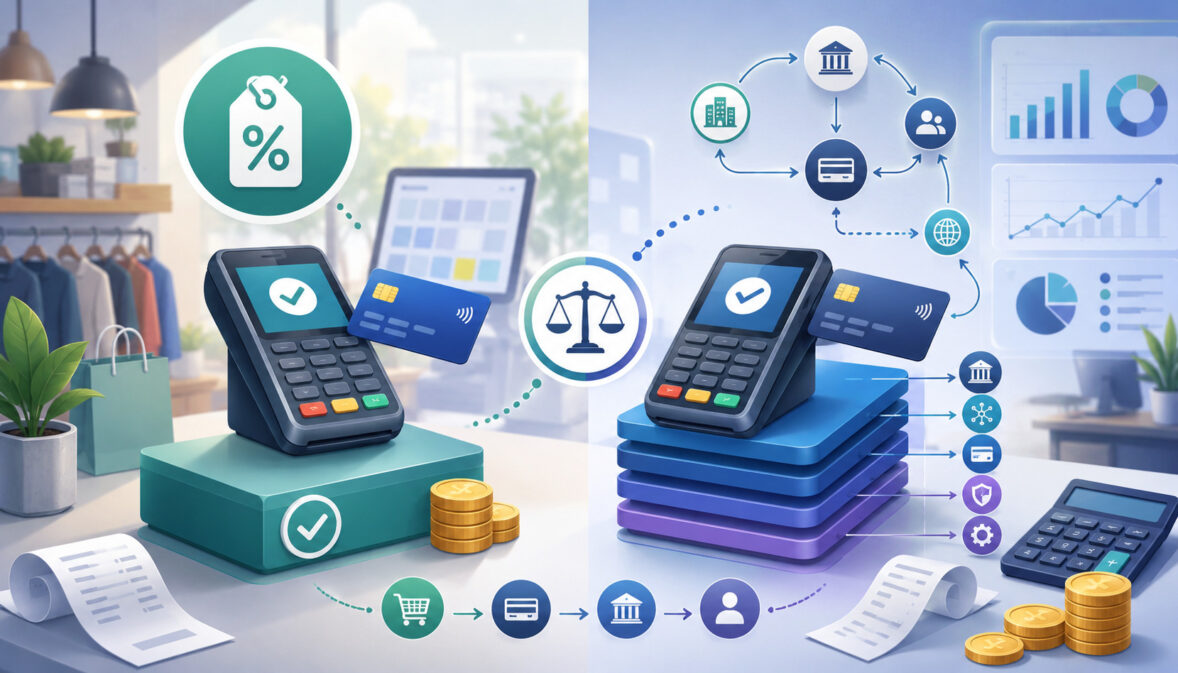
Understanding flat-rate pricing vs interchange pricing is important for any business that accepts card payments. Payment processing fees affect profit margins, cash flow, pricing decisions, monthly operating costs, and the way finance teams reconcile sales.
Even a small difference in card processing fees can matter when a business processes hundreds or thousands of transactions each month.
Many business owners only look at the advertised rate, but credit card processing pricing is rarely just one number. A merchant may pay percentage fees, per-transaction fees, monthly fees, gateway fees, chargeback fees, and other merchant service fees depending on how the account is structured.
That is why comparing payment processing pricing models requires more than checking which quote looks lower at first glance.
Flat-rate pricing is often easier to understand because many costs are bundled into one simple rate. Interchange pricing, especially interchange-plus pricing, may show more detail because it separates base card network and issuing-bank costs from processor markup. Both models can make sense in different situations.
This guide explains how flat-rate payment processing compares with interchange pricing, how interchange-plus fees work, how merchant statement details may appear, and how businesses can perform a responsible payment cost comparison.
The goal is not to declare one pricing model best for everyone, but to help merchants understand what they are paying for and how to evaluate pricing based on real transaction data.
What Flat-Rate Pricing Means
Flat-rate pricing is a payment processing pricing model where many payment processing costs are bundled into a simple fee structure. A merchant may pay one percentage, one fixed transaction fee, or a combination of both. For example, a flat-rate structure may apply the same advertised percentage and transaction fee across many common card payments.
The main appeal of flat-rate pricing is simplicity. A business does not need to review every interchange category, assessment fee, or processor markup line to estimate basic processing costs.
This can be helpful for first-time payment processing users, small retailers, mobile businesses, service providers, and low-volume merchants that want a straightforward billing structure.
Flat-rate payment processing may also make monthly cost planning feel easier. If a merchant knows that most transactions will be charged at one clear rate, estimating payment processing costs becomes less complicated. This can help with budgeting, especially when card volume is still low or unpredictable.
However, flat-rate pricing does not mean every transaction costs the same behind the scenes. The actual cost of accepting a card can vary depending on card type, card-present transactions, card-not-present transactions, rewards cards, commercial cards, debit cards, credit cards, risk level, and transaction data quality. Under flat-rate pricing, those differences are usually blended into one simplified structure.
That blending can be convenient, but it can also reduce pricing transparency. A merchant may not easily see how much went to interchange fees, assessment fees, processor markup, or other card processing fees. This matters when a business grows and wants to understand the true total cost of acceptance.
How Flat-Rate Payment Processing Works
Flat-rate payment processing usually works by applying a single advertised rate to many transactions. The provider behind the payment account still has to account for underlying costs such as interchange fees, assessment fees, risk exposure, authorization costs, settlement costs, and technology costs. Instead of showing each cost separately, the provider blends those costs into one simplified pricing structure.
For example, a debit card used in person may carry a different underlying cost than a rewards credit card used through an online checkout. A keyed transaction may carry different risk characteristics than a chip or tap transaction. A commercial card used for a large invoice payment may cost more than a standard consumer debit card purchase.
Under flat-rate pricing, the merchant may still pay the same advertised rate across many of those transactions. This does not mean the transactions cost the provider the same amount. It means the pricing model averages costs across many card types and transaction categories.
This approach can make statements easier to read, but it may hide important details. A business may not know whether it is paying more because of rewards cards, commercial cards, online payments, keyed transactions, gateway fees, or chargebacks.
Why Some Businesses Like Flat-Rate Pricing
Some businesses like flat-rate pricing because it is easy to understand and easy to estimate. Newer merchants often prefer a simple structure because they may not yet have enough transaction history to compare multiple merchant pricing models. A predictable rate can make the first stage of card acceptance less intimidating.
Flat-rate pricing may also appeal to businesses with low monthly volume. If a merchant only processes a modest amount of card sales, the simplicity of flat-rate processing fees may matter more than line-by-line pricing optimization. A small service business, pop-up seller, seasonal merchant, or new online shop may prefer a structure that is easier to start with.
Another reason merchants like flat-rate pricing is that billing may feel less technical. Instead of sorting through interchange categories, basis points, assessment fees, and processor markup, the business can focus on the total amount charged per sale.
This can be useful for owners who handle their own bookkeeping. When statements are short and easy to scan, payment reconciliation may take less time. Still, convenience should be balanced against the need to understand total payment processing costs as sales volume grows.
Possible Drawbacks of Flat-Rate Pricing
The biggest drawback of flat-rate pricing is limited transparency. Because many costs are bundled, a merchant may not know how much of the fee is tied to interchange rates, assessment fees, processor markup, gateway fees, or risk-related costs. This can make payment cost comparison harder.
Flat-rate pricing may also cost more for some transaction mixes. If a business accepts many lower-cost debit cards or card-present transactions, a blended rate may not fully reflect those lower underlying costs. In that case, the merchant may pay the same flat rate even when certain transactions cost less to process behind the scenes.
Another limitation is that flat-rate pricing may not scale well for every business. As transaction volume increases, a merchant may want more detailed reporting, clearer markup visibility, and better insight into how card type affects cost. A simple pricing structure that worked for a startup may become less useful for a growing business.
Flat-rate pricing can also make it harder to identify cost drivers. If fees rise, the merchant may not know whether the cause is higher card-not-present volume, more rewards cards, larger refunds, added gateway fees, chargebacks, or a shift in average ticket size.
What Interchange Pricing Means
Interchange pricing is a pricing approach that connects merchant costs more directly to interchange fees. Interchange is a base card transaction cost category tied to the card payment system.
In general, interchange is paid through the acquiring side of the transaction and received by the issuing side. It helps support card issuing, authorization, fraud risk, settlement, and card acceptance infrastructure.
Interchange pricing generally passes through interchange costs and then adds processor markup, depending on the merchant account pricing structure. The most common version is interchange-plus pricing, where the merchant pays the applicable interchange category plus a stated markup. That markup may include a percentage, a per-transaction fee, or both.
Unlike flat-rate pricing, interchange pricing may show more detail on a merchant statement. A business may see interchange categories, card network assessment fees, processor markup, transaction fees, and other service charges. This added detail can help finance teams understand why certain transactions cost more than others.
However, interchange pricing can also be more complex. Statements may include many line items, abbreviations, category names, and fee codes. A beginner may need time to understand how card-present transactions, card-not-present transactions, debit card processing fees, credit card processing fees, rewards cards, and commercial cards affect total costs.
Interchange pricing is often valued by businesses that want pricing transparency. It can be especially useful for merchants with higher transaction volume, mixed card types, multiple sales channels, or accounting teams that want to separate base costs from processor markup.
Interchange Fees Explained
Interchange fees are one part of the total cost of accepting card payments. They are connected to the transaction relationship between the acquiring side and the issuing side of the card payment process. In a typical card transaction, the merchant, payment processor, acquiring bank, issuing bank, and card network all play roles in authorization and settlement.
Interchange fees are not the same as the full merchant service fee. A merchant may also pay assessment fees, processor markup, gateway fees, monthly fees, batch fees, chargeback fees, statement fees, and other service costs. This is why a quote that mentions interchange alone does not tell the full story.
Interchange fees can vary by card type and transaction method. A standard debit card transaction may have a different cost category than a rewards credit card transaction. An in-person POS payment may have a different risk profile than a keyed transaction or online checkout.
For merchants, the key point is that interchange is usually a base cost category rather than the full amount charged by the provider. A responsible comparison should separate interchange fees from markup and service fees whenever possible.
How Interchange Rates Can Vary
Interchange rates can vary for several reasons. The card type is one factor. Debit cards, credit cards, rewards cards, and commercial cards may fall into different cost categories. A business that accepts many commercial cards may see a different cost pattern than a business that mostly accepts standard debit cards.
The transaction method also matters. Card-present transactions, such as chip, tap, swipe, and contactless payments, may carry different risk characteristics than card-not-present transactions. Card-not-present payments include eCommerce payments, keyed transactions, invoice payments, phone orders, recurring billing, and stored card payments.
Business category can also influence interchange categories. Different business types may have different risk levels, average ticket sizes, return patterns, and fraud exposure. Data quality can matter too. Some transactions may qualify for better categories when required transaction data is submitted correctly and settlement occurs on time.
Interchange rates are also affected by processing environment. A secure in-person transaction with strong card verification may be viewed differently than a remote transaction with limited verification. That is why payment security, authorization quality, settlement timing, and transaction data can all influence cost outcomes.
Why Interchange Pricing Can Be More Detailed
Interchange pricing can be more detailed because it may show how different transaction categories contribute to total card processing fees. Instead of one blended rate, a merchant may see multiple line items tied to interchange fees, assessment fees, processor markup, and transaction fees.
This detail can help a business identify cost patterns. For example, if online checkout volume increases, card-not-present costs may become more noticeable. If a business starts accepting more commercial cards, interchange categories may shift. If average ticket size changes, percentage fees and per-transaction fees may affect the effective rate differently.
For finance and accounting teams, this detail can support better payment reconciliation. It may also help with budgeting, margin review, and pricing decisions. A merchant can compare payment processing costs by location, sales channel, card type, or transaction method.
The trade-off is that more detail requires more review. A merchant statement may become longer and more technical. Businesses using interchange pricing should be prepared to calculate effective rate, review fee categories, and ask questions about unclear charges.
What Interchange-Plus Pricing Means
Interchange-plus pricing is a common version of interchange pricing. Under this model, a merchant pays the actual interchange category for each transaction plus a processor markup.
The markup may be shown as a percentage, a per-transaction fee, or both. This makes interchange-plus pricing different from blended pricing, where many costs are combined into a single rate.
For example, a merchant may pay the applicable interchange cost, card network assessment fees, and a stated processor markup.
The exact cost of each transaction can vary because the interchange portion changes based on card type, transaction method, risk level, and qualification category. The processor markup should remain easier to identify if the statement is structured clearly.
Interchange-plus pricing is often considered more transparent than flat-rate pricing because it separates base costs from markup. This can help businesses see which costs are tied to card networks and issuing banks and which costs are tied to the payment processor or service provider.
However, transparency does not automatically mean simplicity. Interchange-plus statements may include many line items. A merchant may need to understand basis points, percentage fees, per-transaction fees, assessment fees, gateway fees, monthly fees, and other service charges.
This model can be helpful for businesses that want to compare payment processing pricing models carefully. It may also support better long-term cost management because the merchant can review how transaction mix affects payment processing fees.
Interchange-Plus Fee Structure
An interchange-plus fee structure usually includes several components. The first component is interchange. This is the base transaction cost category connected to card acceptance. It can vary by card type, transaction method, business category, and risk level.
The second component is assessment fees. These are card-network-related fees that may apply alongside interchange. They are typically smaller than interchange but still contribute to total payment processing costs.
The third component is processor markup. This is the provider’s added fee for processing services, account support, technology, reporting, risk tools, settlement support, and other account functions. Processor markup may appear as a percentage, a per-transaction amount, or both.
A merchant may also see other costs depending on setup. These can include payment gateway fees, monthly fees, statement fees, batch fees, chargeback fees, refund fees, PCI-related fees, and account maintenance fees. The full cost is not always captured in the interchange-plus percentage alone.
Why Statement Review Matters
Statement review matters because interchange-plus pricing can be detailed. A merchant may have a fair markup but still pay more than expected because of gateway fees, monthly minimums, chargebacks, refunds, batch fees, or other service charges. Looking only at the quoted markup can create an incomplete picture.
A good review starts with total card volume and total fees. From there, the merchant can calculate the effective rate. This helps compare flat-rate pricing, interchange-plus pricing, blended pricing, and tiered pricing using one simple metric.
Businesses should also review transaction patterns. If card-not-present volume increased, fees may rise. If more customers used rewards cards or commercial cards, interchange categories may change. If staff keyed more transactions manually, risk-related costs may be higher.
Statement review helps merchants separate controllable costs from base costs. Interchange and assessments may be less negotiable, while processor markup and certain service fees may be more open to review.
Flat-Rate Pricing vs Interchange Pricing: Key Differences
The main difference between flat-rate pricing and interchange pricing is how costs are presented. Flat-rate pricing bundles many costs into a simpler structure. Interchange pricing separates more of the underlying card processing fees, especially when structured as interchange-plus pricing.
Flat-rate pricing is easier for many beginners because the merchant may see one simple rate for many transactions. This can help with cost predictability and basic budgeting. A small business owner may be able to estimate processing costs without reviewing complex fee categories.
Interchange pricing provides more visibility. A merchant may see how interchange fees, assessment fees, and processor markup affect total cost. This is useful when transaction mix matters. Businesses with different sales channels, card types, average ticket sizes, or transaction volumes may benefit from more detailed cost reporting.
Cost predictability also differs. Flat-rate pricing may feel more predictable because the same rate applies to many payments. Interchange pricing may vary more month to month because the actual interchange categories can change based on customer card mix and transaction methods.
Statement complexity is another difference. Flat-rate statements may be shorter and easier to scan. Interchange pricing statements may be longer but more informative. This can be helpful for finance teams that need to understand payment processing costs in detail.
Volume sensitivity also matters. A low-volume merchant may value simplicity. A growing merchant may value transparency and markup visibility. A business with high ticket sizes may need to study percentage fees carefully, while a low-ticket business should watch per-transaction fees.
Flat-Rate vs Interchange Pricing Comparison Table
| Factor | Flat-Rate Pricing | Interchange Pricing |
| Pricing structure | Many costs are bundled into one simple rate or rate-plus-transaction-fee structure | Interchange costs are passed through with separate markup and possible additional fees |
| Transparency | Lower visibility into base costs and markup | Higher visibility into interchange, assessments, and processor markup |
| Statement complexity | Usually easier to read | Often more detailed and technical |
| Cost predictability | More predictable for basic budgeting | More variable because transaction categories differ |
| Best fit | Newer, low-volume, simple, or seasonal businesses that value simplicity | Growing, higher-volume, multi-channel, or finance-led businesses that want detail |
| Main drawback | May hide underlying cost differences | Requires more statement review |
| Transaction mix impact | Card type differences may be blended | Card type differences are more visible |
| Average ticket impact | Percentage and per-transaction fees still matter, but may be less obvious | Easier to analyze effect of ticket size and card mix |
| Review requirement | Lower review effort, but effective rate should still be checked | Higher review effort, especially for interchange categories and markup |
| Cost comparison method | Compare total fees divided by total card sales | Compare total fees, markup, assessments, and effective rate |
This table shows why the difference between flat-rate and interchange pricing is not only about price. It is also about visibility, control, simplicity, and reporting needs. A merchant that wants easy billing may prefer a bundled model, while a merchant that wants deeper insight may prefer detailed pricing.
How Payment Processing Fees Are Built

Payment processing fees are built from several layers. The headline rate is only one part of the total cost. To compare merchant pricing models responsibly, businesses should understand the major fee categories that may appear on a merchant statement.
The largest base cost is often interchange. This varies by card type, transaction method, business category, risk level, and data quality. Interchange fees are connected to the card payment system and are not the same as processor markup.
Assessment fees are another layer. These are card-network-related fees that may apply to transaction volume or certain transaction types. They are usually smaller than interchange but still affect the total cost of acceptance.
Processor markup is the provider’s portion. This may pay for payment processing services, technology, reporting, support, settlement tools, risk monitoring, and account servicing. Processor markup is one of the most important items to review when comparing interchange-plus fees.
Other fees can also apply. These may include gateway fees, monthly fees, chargeback fees, refund fees, batch fees, PCI-related fees, statement fees, account fees, and per-transaction fees. Some may be included in a bundled model, while others may appear separately.
Interchange Fees
Interchange fees are base transaction cost categories connected to card payment acceptance. They are tied to the transaction process between the acquiring side and the issuing side of a card payment. For merchants, interchange usually appears as part of the total cost of accepting debit cards and credit cards.
Interchange is affected by factors such as card type, sales channel, risk level, and transaction method. A card-present POS payment may be categorized differently from an online checkout transaction. A debit card may carry different costs than a rewards card or commercial card.
Interchange fees matter because they often represent a major portion of credit card processing fees and debit card processing fees. However, merchants should remember that interchange is not the only cost. Assessment fees, processor markup, and other service fees can also affect the final bill.
In an interchange-plus model, interchange may be shown more directly on the statement. In flat-rate pricing, interchange is usually blended into the advertised rate.
Assessment Fees
Assessment fees are card-network-related fees that may apply alongside interchange. They are usually based on card transaction activity and may appear as separate line items on detailed merchant statements.
Although assessment fees are often smaller than interchange, they still matter. A business with higher transaction volume may see these fees add up over time. Assessment fees can also make the total cost higher than the quoted markup alone.
In flat-rate pricing, assessment fees may be bundled into the flat rate. In interchange pricing, they may be shown separately. This is one reason two pricing models can be hard to compare by quote alone.
Merchants reviewing their statements should look for assessment-related charges and understand whether they are included in the quoted structure or listed separately.
Processor Markup
Processor markup is the portion added by the provider for payment services. It may cover processing technology, authorization routing, settlement support, reporting tools, customer support, risk management, chargeback handling, account servicing, and other operational functions.
Processor markup can be structured in several ways. It may be a percentage, a per-transaction fee, a monthly fee, or a combination of these. In interchange-plus pricing, markup should be easier to identify because it is added on top of interchange and assessments.
Processor markup is important because it may be more controllable than base interchange and assessment costs. When merchants compare pricing, they should ask what markup applies to card-present transactions, card-not-present transactions, keyed transactions, online checkout, recurring billing, and payment gateway activity.
A low processor markup may look attractive, but merchants should also review additional service fees. A quote may show a low percentage but include other monthly or transaction-based charges.
Additional Service Fees
Additional service fees can affect total payment processing costs. These may include gateway fees, monthly fees, statement fees, batch fees, chargeback fees, refund fees, PCI-related fees, account update fees, and reporting fees.
Gateway fees may apply when a business accepts eCommerce payments, invoice payments, recurring billing, or online checkout transactions. Chargeback fees may apply when customers dispute transactions. Batch fees may apply when transactions are closed and submitted for settlement.
Refund fees can also matter. Some pricing structures may charge fees on refunds, while others may not return certain transaction costs. Merchants with frequent returns should review how refund activity affects total cost.
These extra costs are why the full merchant cost may be higher than the headline rate. A responsible payment cost comparison should include every recurring and transaction-based fee.
How Transaction Type Affects Pricing

Transaction type can have a major effect on credit card processing pricing. Payments are not all treated the same behind the scenes. The way a card is accepted, verified, authorized, and settled can influence risk level and cost category.
Card-present transactions generally happen in person through a POS terminal, countertop device, mobile reader, or contactless payment method. These transactions often include stronger verification signals because the card or payment device is physically present.
Card-not-present transactions happen when the physical card is not presented at checkout. These include eCommerce payments, keyed transactions, invoice payments, phone orders, recurring billing, and card-on-file payments. Because these transactions may carry higher fraud risk, they can have different cost categories.
Transaction data quality can also affect pricing. If required data is missing, if a transaction is keyed instead of inserted or tapped, or if settlement is delayed, costs may change. Businesses should train staff to use proper payment methods whenever possible.
A business that processes mostly in-person POS payments may have a different cost profile from a business that accepts mostly online checkout or invoice payments. This is why transaction mix is critical when comparing flat-rate pricing vs interchange pricing.
Card-Present Transactions
Card-present transactions occur when the customer pays in person and presents a card or contactless payment method. Common examples include chip, tap, swipe, and mobile wallet payments at a POS terminal.
These transactions often have different risk characteristics than remote transactions. Because the card or payment credential is present, the transaction may include stronger verification signals. This can affect the underlying interchange category and overall payment processing costs.
Retail stores, restaurants, salons, repair shops, grocery businesses, and mobile vendors often process a high share of card-present transactions. For these businesses, transaction speed, terminal setup, batch settlement, and staff training can all affect payment operations.
Even with flat-rate pricing, card-present transactions still have underlying cost differences. The merchant may not see those differences clearly, but they still exist behind the bundled rate.
Card-Not-Present Transactions
Card-not-present transactions happen when the customer’s physical card is not presented at checkout. These include eCommerce payments, keyed transactions, invoice payments, phone payments, recurring billing, payment links, and stored card transactions.
These payments often require extra attention because fraud risk and verification needs can be higher. Businesses may use address checks, security codes, fraud filters, payment gateway rules, tokenization, and customer authentication tools to reduce risk.
Card-not-present transactions may cost more than comparable in-person payments. This can affect eCommerce sellers, subscription businesses, professional service firms, contractors, wholesalers, and businesses that accept invoices by card.
Merchants should review whether online, keyed, and recurring transactions are priced differently. In flat-rate pricing, some of these differences may be bundled. In interchange pricing, they may be visible as separate categories.
Debit, Credit, Rewards, and Commercial Cards
Different card types can create different underlying costs. Debit cards, credit cards, rewards cards, and commercial cards may each fall into different interchange categories. This matters even if the merchant pays one flat rate.
A business that accepts mostly debit cards may have a different cost profile than a business that accepts many rewards credit cards. A B2B merchant that accepts commercial cards may see higher underlying costs than a local shop that mainly accepts consumer debit cards.
Rewards cards and commercial cards may involve different economics because they may support benefits, purchasing features, or business card programs. These differences can show up in interchange categories under detailed pricing.
Flat-rate pricing may hide these differences by blending them. Interchange pricing may show them more clearly, which can help merchants understand why certain transactions cost more.
Why Average Ticket Size and Transaction Volume Matter
Average ticket size and transaction volume can strongly influence payment processing costs. A pricing model that works for a low-ticket business may not work the same way for a high-ticket business. A pricing structure that is affordable at low volume may become costly as volume grows.
Percentage fees and per-transaction fees behave differently. A percentage fee grows as the sale amount increases. A per-transaction fee has a larger impact on small-ticket sales because the fixed fee represents a bigger share of each sale.
For example, a fixed per-transaction fee matters more on a small purchase than on a large invoice. A percentage-based markup matters more as transaction size increases. This is why merchants should review both percentage fees and transaction fees.
Monthly transaction volume also matters. A low-volume business may prioritize easy setup and predictable billing. A higher-volume business may benefit from deeper statement review and more detailed pricing. Growing businesses should not assume the pricing model they started with is still the right fit.
The effective rate can help compare options. By dividing total processing fees by total card sales, merchants can see the real percentage cost of accepting cards over a given period.
Low-Ticket Businesses
Low-ticket businesses should pay close attention to per-transaction fees. When the average sale amount is small, even a modest fixed fee can become a significant share of the transaction.
For example, a small café, quick-service food business, convenience shop, or low-price retail store may process many transactions with small ticket sizes. In that environment, transaction fees can add up quickly.
Flat-rate pricing may be easy to understand, but the combination of percentage fees and fixed fees still matters. Interchange pricing may show more detail, but merchants must still evaluate whether per-transaction markup affects margins.
Low-ticket businesses should calculate effective rate often. They should also review whether minimum charges, batch fees, or monthly fees are increasing the real cost of acceptance.
High-Ticket Businesses
High-ticket businesses should pay close attention to percentage fees. As transaction amounts increase, even a small percentage difference can create a meaningful dollar impact.
Service businesses, contractors, medical offices, specialty retailers, equipment sellers, wholesalers, and B2B merchants may process larger transactions. For these businesses, a bundled flat-rate percentage may become expensive if the underlying transaction mix includes lower-cost categories.
Interchange-plus pricing may offer more visibility into whether high-ticket transactions are being priced efficiently. However, merchants should still review all fees, including gateway charges, chargeback fees, refund policies, and monthly account costs.
High-ticket merchants should also consider risk. Large transactions may attract additional review, dispute exposure, or reserve requirements depending on business type and processing history.
Growing Transaction Volume
Growing transaction volume can change the pricing conversation. A business may begin with flat-rate pricing because it is simple, then later need more detailed reporting as card sales increase.
As volume grows, small differences in processor markup can become more important. A difference that seemed minor at low volume may become meaningful when monthly card sales rise. More volume also creates more data for comparing pricing models accurately.
Growth can also change transaction mix. A retailer may add eCommerce payments. A service business may add recurring billing. A restaurant may add online ordering. Each change can affect payment processing fees.
Businesses should review pricing whenever volume, average ticket size, sales channel, or card type mix changes significantly. Payment pricing should support the business as it evolves.
Cost Predictability vs Cost Transparency
One of the biggest trade-offs in flat-rate pricing vs interchange pricing is cost predictability versus cost transparency. Flat-rate pricing may feel more predictable because many costs are bundled into one simple structure. Interchange pricing may feel less predictable because the total cost can change based on card type, transaction method, and interchange category.
Flat-rate pricing can make budgeting easier for businesses that want fewer variables. A merchant may know the rate before each sale and may find it easier to estimate monthly fees. This can be useful for newer businesses and owners who prefer a simplified statement.
Interchange pricing provides more detail. Instead of hiding cost differences inside a blended rate, it may show interchange fees, assessment fees, processor markup, and other charges separately. This can help businesses understand the total cost of acceptance more clearly.
The better option depends on business needs. A merchant that values simplicity may prefer cost predictability. A merchant that values fee analysis may prefer transparency. Finance teams, accounting teams, and growing businesses often want more detail because it helps with reconciliation and cost management.
Still, transparency only helps if the business reviews the statement. A detailed statement that no one reads may not improve decision-making. On the other hand, a simple statement that hides important cost drivers may limit a merchant’s ability to manage expenses.
Effective Rate: A Simple Way to Compare Pricing Models
Effective rate is one of the most useful ways to compare payment processing pricing models. It shows total processing fees as a percentage of total card sales. This helps merchants compare flat-rate pricing, interchange-plus pricing, tiered pricing, blended pricing, and other merchant account pricing structures.
The effective rate is helpful because it includes more than the advertised rate. It can reflect percentage fees, per-transaction fees, monthly fees, gateway fees, chargeback fees, batch fees, and other merchant service fees. This gives a more complete picture of payment processing costs.
For example, two businesses may both be quoted similar percentages, but one may pay more because of monthly fees, gateway fees, small-ticket transactions, or card-not-present activity. Effective rate helps reveal the real cost after all fees are included.
Effective rate should be calculated using a consistent period, such as one full monthly statement. It is best to compare similar months, especially if the business has seasonal sales patterns. Comparing a holiday-heavy month with a slow month may produce misleading results.
How to Calculate Effective Rate
The formula is simple:
Effective rate = Total processing fees ÷ Total card sales × 100
For example, if a business processed a full month of card sales and paid processing fees during that same period, the business can divide total fees by total card sales. The result shows the overall processing cost as a percentage.
This calculation should include all payment-related fees from the statement. Do not include only discount fees or transaction fees if the statement also includes gateway fees, monthly fees, batch fees, statement fees, or chargeback fees.
Effective rate is useful because it converts a complicated statement into one comparison number. It helps merchants see whether their real cost matches expectations.
What Effective Rate Can and Cannot Tell You
Effective rate can tell you the overall cost of payment acceptance for a specific period. It is useful for comparing flat-rate processing fees, interchange-plus fees, and other credit card processing pricing models.
However, effective rate does not explain everything by itself. A higher effective rate may be caused by small-ticket transactions, card-not-present payments, chargebacks, refunds, monthly fees, rewards cards, commercial cards, or a change in transaction volume.
Effective rate also does not show whether a specific fee is reasonable. It gives a starting point, not a complete diagnosis. Merchants should use it with statement review, transaction analysis, and fee category review.
A business should calculate effective rate regularly and compare it to previous months. Sudden changes may indicate a shift in transaction mix, added fees, more disputes, or changes in card usage.
Flat-Rate Pricing Benefits and Limitations

Flat-rate pricing offers several benefits. The biggest benefit is simplicity. A merchant can often understand the basic pricing structure quickly because many fees are bundled into one rate or one rate-plus-transaction-fee format. This can be helpful for businesses that are new to card acceptance.
Another benefit is cost predictability. If many transactions are charged at the same advertised rate, estimating monthly payment processing costs can be easier. This helps with cash flow planning and basic budgeting.
Flat-rate pricing may also make setup easier for some businesses. A simple pricing structure can reduce the learning curve for owners who do not want to study interchange categories, assessment fees, basis points, processor markup, and statement codes from the beginning.
The limitations are important too. Flat-rate pricing may be less transparent because it blends different costs. A merchant may not see whether a transaction was expensive because of card type, risk level, online checkout, keyed entry, or commercial card usage.
Flat-rate pricing can also be less customizable. Businesses with strong transaction history, higher volume, or lower-risk card-present sales may want more detailed pricing that reflects their actual mix.
Another limitation is that flat-rate pricing can make cost analysis harder. If all costs are bundled, the merchant may not know what portion is base cost and what portion is markup. This can make pricing negotiation and payment cost comparison more difficult.
Interchange Pricing Benefits and Limitations
Interchange pricing offers stronger cost visibility. Because interchange fees, assessment fees, and processor markup may be shown separately, merchants can better understand how payment processing fees are built. This is helpful for businesses that want detailed reporting and cost analysis.
Interchange-plus pricing can also make processor markup easier to evaluate. Instead of guessing how much markup is built into a flat rate, the merchant may see a stated percentage and per-transaction markup. This can support more responsible pricing comparison.
Another benefit is that interchange pricing may better reflect transaction mix. If a merchant accepts many lower-cost card-present or debit transactions, those differences may be more visible. If the merchant accepts higher-cost rewards or commercial cards, those costs may also be easier to identify.
The main limitation is complexity. Interchange pricing statements can be harder to read. A merchant may need to review several line items, fee categories, and transaction classifications to understand total cost.
Interchange pricing can also produce more variable monthly fees. Since card mix and transaction methods change, monthly processing costs may fluctuate. This can make budgeting less predictable than flat-rate pricing.
Additional service fees can still apply. A merchant should not assume interchange pricing is automatically cheaper. The final cost depends on markup, monthly fees, gateway fees, transaction volume, average ticket size, card type mix, and sales channel.
Which Pricing Model May Fit Different Business Types?
Different business types may prefer different payment processing pricing models based on transaction volume, average ticket size, sales channel, reporting needs, and card mix. There is no single best model for every merchant.
A small business with low volume may value simplicity more than detailed fee reporting. A growing business with higher volume may value transparency and markup visibility. An eCommerce seller may need to review gateway fees and card-not-present costs, while a retail store may focus on card-present transaction costs.
Restaurants may need to consider tips, adjustments, daily batches, and small-ticket transactions. Service businesses may need to review invoices, deposits, and card-on-file payments. B2B merchants may need to study commercial cards and enhanced data.
Subscription businesses should pay attention to recurring billing, stored credentials, failed payments, retries, and churn. Mobile businesses should consider card reader use, keyed fallback transactions, connectivity, and batch timing.
The best way to evaluate fit is to use real processing data. Merchants should review total monthly volume, average ticket size, transaction count, debit card mix, credit card mix, sales channel, refunds, chargebacks, and effective rate.
Retail Stores
Retail stores often process many card-present transactions through POS systems. Customers may insert, tap, or swipe cards at checkout. This can create a different cost profile than businesses that mostly accept online or keyed payments.
Average ticket size matters. A store with many small purchases should watch per-transaction fees. A store with larger purchases should watch percentage fees. Debit card mix can also affect the comparison because debit and credit transactions may carry different underlying costs.
Flat-rate pricing may appeal to smaller retail stores that want simple billing. Interchange pricing may appeal to stores with higher volume or finance teams that want to see how card type and transaction method affect costs.
Retailers should also review refunds, batch settlement, terminal fees, and payment reconciliation. A pricing model should support both checkout operations and back-office accounting.
Restaurants and Food Businesses
Restaurants and food businesses have unique payment patterns. They may process many transactions during busy periods, handle tips, adjust authorizations, close daily batches, and manage small-ticket sales.
Per-transaction fees can matter for quick-service businesses and cafés. Percentage fees can matter for higher-ticket dining, catering, or large group orders. Tip adjustments and settlement timing can also affect statement review.
Flat-rate pricing may be attractive because it keeps billing easier to understand. Interchange pricing may be useful when the business has enough volume to justify deeper review.
Restaurants should pay attention to batch fees, chargebacks, refund policies, online ordering fees, and card-not-present transactions. A business that adds delivery, catering deposits, or online checkout may see its transaction mix change.
eCommerce Businesses
eCommerce businesses usually process card-not-present transactions. These payments may involve online checkout, payment gateways, fraud filters, refunds, chargebacks, and shipping-related disputes.
Because remote payments can carry different risk characteristics, eCommerce payment processing costs may differ from in-person POS payments. Merchants should review gateway fees, authorization fees, card testing risks, fraud tools, and chargeback activity.
Flat-rate pricing may be useful for new online sellers that want a simple way to start accepting payments. Interchange pricing may be more useful for growing eCommerce businesses that need detailed reporting and cost visibility.
Online merchants should also review approval rates, failed payments, refund activity, and fraud prevention settings. Payment pricing is only one part of the cost. Poor fraud controls and high disputes can increase total payment costs.
Service Businesses
Service businesses may accept invoice payments, deposits, card-on-file payments, mobile payments, and occasional keyed transactions. Average ticket size may be higher than retail, which makes percentage fees especially important.
Flat-rate pricing may work for small service providers that process limited card volume and want simple statements. Interchange pricing may be worth reviewing when transaction volume grows or when the business accepts larger invoices.
Service businesses should also watch keyed transactions. Manually entered cards may carry different costs and risk characteristics than card-present payments. Encouraging secure payment links, card readers, or proper invoice payment workflows may help reduce unnecessary risk.
Refunds, deposits, and chargebacks should also be reviewed. A clear service agreement and refund policy can support better payment cost management.
B2B Merchants
B2B merchants may process larger tickets, commercial cards, invoice payments, and card-not-present transactions. These factors can affect interchange cost categories and total payment processing fees.
Commercial cards may carry different underlying costs than consumer cards. Some B2B transactions may benefit from submitting enhanced transaction data when supported by the payment setup. This can make statement review especially important.
Flat-rate pricing may be simple, but it may not show how commercial cards and large invoices affect costs. Interchange pricing may provide more useful detail for finance teams that need to analyze card type, transaction size, and processor markup.
B2B merchants should review average ticket size, card mix, invoice payment methods, gateway fees, refund activity, and chargeback risk. They should also compare total cost rather than focusing only on one quoted rate.
Subscription Businesses
Subscription businesses rely on recurring billing, stored credentials, retries, account updates, failed payment recovery, and customer retention workflows. These payment patterns can affect both costs and revenue continuity.
Card-not-present pricing is especially relevant for subscription payments. Recurring billing may involve gateway fees, transaction fees, retry costs, account update services, and failed payment management tools.
Flat-rate pricing may help early subscription businesses keep billing simple. Interchange pricing may become more useful when recurring volume grows and the business needs detailed cost visibility.
Subscription businesses should also review churn, failed payments, chargebacks, refunds, and customer communication. Payment cost management should be connected to retention strategy and revenue recovery.
How to Read a Merchant Statement When Comparing Pricing Models
Reading a merchant statement is one of the best ways to compare flat-rate pricing and interchange pricing. The statement shows actual processing activity, not just quoted pricing. It can reveal total card volume, total fees, effective rate, transaction count, refunds, chargebacks, and service charges.
Start with total card volume. This is the amount of card sales processed during the statement period. Then identify total fees. Include discount fees, transaction fees, monthly fees, gateway fees, batch fees, chargeback fees, statement fees, and any other payment-related charges.
Next, calculate effective rate. This gives a quick view of total processing cost as a percentage of sales. If the effective rate is higher than expected, review transaction mix and extra fees.
For interchange-plus pricing, separate base costs from markup. Interchange and assessment fees are different from processor markup. Understanding the difference can help identify which costs are less controllable and which may be open to review.
Finally, review transaction patterns. Look at card-present percentage, card-not-present percentage, average ticket size, debit card mix, rewards card mix, commercial card volume, keyed transactions, refunds, and chargebacks.
Identify Total Volume and Total Fees
Total volume and total fees are the starting point for comparing pricing models. Total volume tells you how much card revenue was processed. Total fees tell you how much the business paid to accept those payments.
A merchant should include all payment-related fees in the review. This means not only the main processing rate, but also transaction fees, gateway fees, monthly fees, statement fees, batch fees, chargeback fees, and refund-related charges.
Once total volume and total fees are identified, the merchant can calculate effective rate. This helps compare different payment processing pricing models using actual data.
If total fees are rising faster than sales volume, the business should investigate. The cause may be card mix, higher online volume, more refunds, more chargebacks, added fees, or changes in transaction behavior.
Separate Base Costs From Markup
Separating base costs from markup helps merchants understand what they can and cannot control. Interchange fees and assessment fees are base cost categories tied to card acceptance. Processor markup is the provider’s added cost for processing services.
In interchange-plus pricing, this separation may be visible on the statement. In flat-rate pricing, it may not be visible because costs are bundled. This is one of the main differences between flat-rate pricing and interchange pricing.
Understanding markup helps merchants compare quotes more responsibly. A business should ask what markup applies to card-present, card-not-present, keyed, online, recurring, and invoice transactions.
Merchants should also review whether extra fees are included in markup or charged separately. A low markup with many add-on fees may not produce a low total cost.
Review Transaction Patterns
Transaction patterns explain why processing costs change. A business may pay more because customers used more rewards cards, more commercial cards, or more card-not-present payments. Costs may also rise if staff keyed transactions manually instead of using a secure card reader.
Average ticket size can also change the effective rate. Small-ticket businesses may be affected more by per-transaction fees. High-ticket businesses may be affected more by percentage fees.
Refunds and chargebacks should also be reviewed. They can increase costs and create operational work. If disputes are rising, the business may need clearer policies, better receipts, stronger customer communication, or improved fraud controls.
Reviewing transaction patterns turns the merchant statement into a management tool. It helps businesses make better decisions about payment workflows and cost control.
Common Mistakes When Comparing Flat-Rate and Interchange Pricing
One common mistake is focusing only on the advertised rate. A headline percentage does not show the full cost of acceptance. Merchants should include per-transaction fees, monthly fees, gateway fees, chargeback fees, batch fees, and statement fees.
Another mistake is ignoring average ticket size. A fixed transaction fee affects small-ticket businesses more than high-ticket businesses. A percentage fee can create a larger dollar impact on high-ticket transactions.
Some merchants fail to calculate effective rate. Without effective rate, it is hard to compare flat-rate pricing, interchange-plus pricing, tiered pricing, and blended pricing fairly. Total fees divided by total card sales gives a clearer comparison point.
Another mistake is assuming flat-rate pricing is always cheaper. It may be convenient, but the blended rate may cost more for some transaction mixes. At the same time, it is also a mistake to assume interchange pricing is always better. Detailed pricing can still include markup and add-on fees.
Businesses may also overlook card-not-present costs. Online checkout, keyed transactions, invoice payments, and recurring billing can affect pricing. A merchant that adds eCommerce payments should review how that change affects total fees.
Refunds and chargebacks are often ignored during pricing comparisons. These activities can add costs and distort the effective rate. Businesses with frequent disputes should review policies and fraud controls.
Payment Pricing Model Checklist
| Review Item | Why It Matters |
| Monthly processing volume | Helps determine whether simple or detailed pricing may fit better |
| Average ticket size | Shows whether percentage fees or transaction fees have greater impact |
| Transaction count | Helps measure the effect of per-transaction fees |
| Card-present percentage | Important for retail, restaurant, and in-person service businesses |
| Card-not-present percentage | Important for eCommerce, invoice, phone, and recurring payments |
| Debit card mix | May affect underlying cost comparison |
| Credit card mix | Helps identify how credit transactions affect total fees |
| Rewards card volume | Can influence interchange categories |
| Commercial card volume | Especially important for B2B merchants |
| Keyed transaction volume | May signal higher risk or avoidable manual entry |
| Refund activity | Can affect fees and reconciliation |
| Chargeback activity | Adds direct and indirect costs |
| Gateway fees | Important for online checkout and invoice payments |
| Monthly fees | Can raise effective rate, especially at low volume |
| Batch fees | May affect daily settlement cost |
| Processor markup | Key comparison point in interchange-plus pricing |
| Effective rate | Shows total processing fees as a share of card sales |
| Statement transparency | Helps determine how easily costs can be reviewed |
| Sales channel mix | POS, online, mobile, invoice, and recurring payments may price differently |
| Settlement timing | Late or irregular settlement may affect operations and cost review |
This checklist can help merchants compare payment processing pricing models without relying only on rate quotes. It also helps identify whether a current pricing model still fits the business.
Questions to Ask Before Choosing a Pricing Model
Before choosing a pricing model, merchants should ask detailed questions. A quote should explain what is included, what is separate, and how different transaction types are handled. Clear answers can prevent confusion later.
Useful questions include:
- What is included in the quoted rate?
- Are interchange and assessments shown separately?
- What is the processor markup?
- Is the markup a percentage, a per-transaction fee, or both?
- Are monthly fees charged separately?
- Are gateway fees included or separate?
- Are keyed transactions priced differently?
- Are online checkout transactions priced differently?
- Are card-present and card-not-present transactions billed differently?
- Are refunds charged separately?
- Are chargeback fees charged separately?
- Are batch fees or statement fees charged?
- How is the effective rate calculated?
- Can the statement show interchange, assessments, and markup clearly?
- How often should statements be reviewed?
- What happens if transaction volume increases?
- Are commercial cards or rewards cards handled differently?
- Are recurring billing or card-on-file payments priced differently?
These questions help merchants avoid comparing incomplete quotes. They also encourage a fuller review of payment processing costs, not just the visible rate.
Best Practices for Managing Payment Processing Costs
Managing payment processing costs starts with regular statement review. Businesses should check total card volume, total fees, effective rate, transaction count, refunds, chargebacks, monthly fees, gateway fees, and processor markup. A monthly review can reveal changes before they become larger problems.
Businesses should also reduce unnecessary keyed transactions. When a card can be inserted, tapped, or securely collected through an approved online method, manual entry may be avoidable. Staff training can help reduce mistakes and improve transaction quality.
Settling batches on time is another useful practice. Delayed settlement can create reconciliation issues and may affect transaction handling. Businesses should have a consistent batch closing process, especially in restaurants and retail environments.
Chargebacks should be monitored closely. Clear receipts, accurate descriptors, documented policies, responsive customer service, and fraud controls can help reduce disputes. Fewer disputes can protect both revenue and processing stability.
Refund policies should be clear and easy for customers to understand. Confusing policies can lead to disputes and customer frustration. A clear refund workflow also supports accounting and payment reconciliation.
Businesses should compare total cost, not only the rate. The best review includes transaction data, sales channel mix, card type mix, average ticket size, monthly volume, and effective rate.
Finally, businesses should choose a pricing model based on real operating needs. A simple model may be enough for a small operation. A detailed model may be better for a growing business with higher volume and more complex reporting needs.
FAQs
What is the difference between flat-rate pricing and interchange pricing?
The main difference is how fees are structured and displayed. Flat-rate pricing bundles many payment processing fees into one simple rate or rate-plus-transaction-fee structure. Interchange pricing separates the underlying interchange cost from processor markup and other fee categories.
Flat-rate pricing may be easier to understand because the merchant sees fewer line items. Interchange pricing may provide more transparency because the merchant can see how interchange fees, assessment fees, and processor markup contribute to total cost.
The better option depends on transaction volume, average ticket size, sales channel, card type mix, reporting needs, and willingness to review statements.
What is flat-rate payment processing?
Flat-rate payment processing is a pricing model where many card processing fees are combined into a simple advertised rate. A merchant may pay the same rate for many transaction types, even though the underlying cost of each transaction may vary.
This model can be helpful for new, low-volume, or simple businesses that want predictable billing. It can also make statements easier to read.
The limitation is that flat-rate pricing may not show the true cost differences between debit cards, credit cards, rewards cards, commercial cards, card-present transactions, and card-not-present transactions.
What is interchange-plus pricing?
Interchange-plus pricing is a model where the merchant pays the applicable interchange cost plus a processor markup. The markup may be a percentage, a fixed transaction fee, or both.
This model is often considered more transparent because it separates base costs from markup. A merchant may be able to see interchange fees, assessment fees, processor markup, and other service charges more clearly.
However, interchange-plus pricing requires more statement review. Merchants should calculate effective rate and review all added fees, not just the quoted markup.
Is flat-rate pricing easier to understand?
Yes, flat-rate pricing is often easier to understand because many costs are bundled into one simple structure. This can make budgeting and basic reconciliation easier for some businesses.
However, easier does not always mean lower cost. A bundled rate may hide how different transaction types affect total payment processing fees.
Businesses using flat-rate pricing should still review effective rate, monthly fees, refund costs, chargeback fees, and transaction volume.
Is interchange pricing always cheaper?
No, interchange pricing is not always cheaper. It can provide more transparency, but the final cost depends on processor markup, assessment fees, transaction mix, monthly fees, gateway fees, and other service charges.
A merchant with low volume may not benefit from a more detailed pricing structure if monthly fees are high. A merchant with high card-not-present volume may still pay more because remote payments can carry different risk and cost categories.
The best way to compare is to use real statement data and calculate effective rate.
Why do interchange rates vary?
Interchange rates can vary because card payments are categorized by card type, transaction method, business category, risk level, data quality, and settlement timing. Debit cards, credit cards, rewards cards, and commercial cards may have different cost categories.
Card-present transactions and card-not-present transactions may also be treated differently. Online checkout, keyed transactions, invoice payments, and recurring billing can have different risk characteristics from in-person POS payments.
This variation is one reason interchange pricing statements can be more detailed than flat-rate statements.
What is processor markup?
Processor markup is the portion added by the payment provider for processing services. It may cover technology, authorization, settlement support, reporting, risk tools, customer support, and account servicing.
In interchange-plus pricing, markup may be shown as a percentage, a per-transaction fee, or both. In flat-rate pricing, markup is usually blended into the advertised rate.
Processor markup is important because it is one of the main areas merchants can review when comparing pricing models.
How do I calculate my effective rate?
To calculate effective rate, divide total processing fees by total card sales, then multiply by one hundred.
The formula is:
Effective rate = Total processing fees ÷ Total card sales × 100
Include all payment-related fees in the calculation. This means processing fees, transaction fees, monthly fees, gateway fees, batch fees, chargeback fees, statement fees, and other service charges.
Which pricing model is better for small businesses?
There is no single best pricing model for every small business. Flat-rate pricing may fit businesses that want simplicity, predictable billing, and easier setup. Interchange pricing may fit businesses that want more transparency and have enough transaction volume to justify detailed review.
A small business should consider monthly volume, average ticket size, transaction count, sales channel, card type mix, refunds, chargebacks, and reporting needs.
The best choice is the model that supports responsible cost management without creating unnecessary complexity.
How does average ticket size affect payment processing costs?
Average ticket size affects how percentage fees and per-transaction fees impact total cost. A fixed transaction fee has a larger impact on small-ticket sales because it represents a bigger share of each sale.
For high-ticket businesses, percentage fees can create a larger dollar impact. Even a small percentage difference can matter when transaction amounts are large.
That is why merchants should review average ticket size before choosing between flat-rate pricing and interchange pricing.
What should I review on my merchant statement?
Start with total card volume, total fees, transaction count, and effective rate. Then review interchange categories, assessment fees, processor markup, gateway fees, monthly fees, chargeback fees, refund activity, batch fees, and statement fees.
Also review transaction patterns. Look at card-present volume, card-not-present volume, keyed transactions, average ticket size, debit card mix, credit card mix, rewards cards, commercial cards, refunds, and disputes.
A merchant statement can show whether your pricing model still fits your business or needs closer review.
Conclusion
Flat-rate pricing and interchange pricing each have advantages and limitations. Flat-rate pricing can be easier to understand because many costs are bundled into a simple structure. It may work well for newer, lower-volume, seasonal, or simple businesses that value cost predictability and easy-to-read statements.
Interchange pricing, especially interchange-plus pricing, can provide more transparency. It may help merchants see interchange fees, assessment fees, processor markup, and other card processing fees more clearly.
This can be useful for growing businesses, higher-volume merchants, multi-channel sellers, B2B merchants, and finance teams that want deeper cost visibility.
The best choice depends on transaction volume, average ticket size, card mix, sales channel, reporting needs, risk level, and comfort with statement review. A business that mostly accepts card-present transactions may have different needs than one that relies on eCommerce payments, invoice payments, or recurring billing.
Merchants should compare total payment processing costs rather than focusing only on the advertised rate. Calculating effective rate, reviewing merchant statements, identifying transaction patterns, and separating base costs from markup can make pricing comparisons more responsible.
In the end, flat-rate pricing vs interchange pricing is not about choosing the most popular model. It is about choosing a structure that supports clear reporting, manageable costs, cash flow stability, and long-term payment cost management.
Leave a Reply