
Payment processing can feel simple on the customer side: a buyer taps, swipes, inserts, or enters card details, and the sale is approved in seconds.
Behind that fast checkout experience, however, is a layered system of banks, card networks, processors, gateways, software platforms, risk tools, security rules, and settlement workflows. Each participant has a role, and several of them earn revenue from the transaction.
For merchants, the important question is not only “What am I paying?” but “Who is getting paid, why, and where is the processor’s margin built in?” Understanding how payment processors make money helps business owners compare quotes, read merchant statements, negotiate more effectively, and avoid focusing only on the advertised rate.
A processor’s revenue may come from transaction fees, processor markup, monthly account fees, payment gateway fees, chargeback fees, equipment costs, PCI compliance fees, software revenue sharing, or a combination of these.
Some costs are passed through to other parties, while others become payment processing revenue for the processor, merchant services provider, ISO agent, or software platform involved in the account.
This guide breaks down the payment processor revenue model in a practical way, with examples and review tips for merchants that accept credit card payments, debit card payments, online payments, in-person payments, recurring billing, invoicing, mobile payments, or embedded payments.
This article is for general educational purposes. Payment processing fees and contract terms can vary by provider, business profile, transaction type, sales volume, industry risk, chargeback history, technology setup, and payment method.
What Payment Processors Do
A payment processor is the company or platform that helps move card transaction data between the merchant, the acquiring bank, the issuing bank, and the card networks. The processor’s job is to help authorize, clear, and settle payments so a business can accept debit card payments, credit card payments, and other electronic transactions.
When a customer pays, the payment processor helps transmit the transaction request for authorization. The issuing bank checks whether the card is valid, whether funds or credit are available, and whether the transaction appears legitimate.
The approval or decline message travels back through the system to the merchant’s point-of-sale system, ecommerce checkout, payment gateway, mobile reader, or virtual terminal.
After authorization, the transaction still needs to be settled. Settlement is the process that moves money from the customer’s side of the transaction to the merchant account, minus applicable merchant processing fees.
In many cases, the merchant receives a batch deposit that combines multiple card transactions, while the various payment processing fees are deducted daily, monthly, or through a blended structure.
A processor may also provide or connect to other services, such as:
- Merchant account setup
- Payment gateway access
- Virtual terminal tools
- In-person terminal connectivity
- Recurring billing support
- Fraud detection tools
- Tokenization and security features
- Chargeback management workflows
- Reporting and merchant statement access
- PCI compliance support
- Risk management and underwriting
The processor is not always the same as the acquiring bank, payment gateway, or merchant services provider. In some relationships, one provider packages all of these services together. In others, the merchant may work with a gateway, processor, acquiring bank, software vendor, and ISO agent through a connected arrangement.
The Key Parties in a Card Transaction
A typical card transaction involves several parties, and each has a different role in the payment processing business model.
The merchant is the business accepting payment. The customer is the cardholder. The issuing bank is the financial institution that issued the customer’s card. The acquiring bank is the financial institution that sponsors the merchant account and helps receive funds on behalf of the merchant.
The card networks set many operating rules and network fees. The payment processor moves transaction data and manages processing connectivity. The payment gateway securely transmits online or keyed transaction data. A merchant services provider may bundle sales, onboarding, support, equipment, gateway access, and account management.
The distinction matters because not every fee on a merchant statement goes to the processor. Interchange fees usually go to issuing banks. Assessment fees generally go to card networks. Processor markup, certain monthly account fees, some gateway fees, batch fees, and other service charges may create processor margin or revenue for the merchant services provider.
Authorization, Settlement, and Funding
Payment processors support several stages of a card transaction. During authorization, the transaction is checked for approval. During clearing, transaction details are prepared for exchange among the parties. During settlement, funds are moved and the merchant is paid.
For example, a restaurant may close out its terminal at the end of the day, creating a batch of card transactions. An ecommerce seller may have transactions submitted automatically through a payment gateway. A service business using a virtual terminal may key in invoices and settle payments through the same merchant account.
Processors may earn revenue from the transaction itself, from technology used to submit the transaction, or from account-level services that support funding, reporting, compliance, and risk monitoring. That is why two businesses with the same monthly sales volume may pay very different merchant services fees.
Why Understanding Payment Processor Revenue Matters
Understanding how payment processors make money is not just an accounting exercise. It can directly affect profit margins, pricing decisions, cash flow, and vendor selection. For many merchants, payment processing costs are one of the most consistent operating expenses because they apply every time customers pay electronically.
A merchant may see an advertised rate such as a percentage plus a per-transaction fee. That number may look simple, but the actual cost can include interchange fees, assessment fees, processor markup, payment gateway fees, statement fees, batch fees, PCI compliance fees, chargeback fees, equipment lease costs, monthly account fees, and other merchant services fees. Some fees are unavoidable pass-through costs. Others are negotiable or tied to the provider’s pricing strategy.
This is why comparing processors only by headline rate can be misleading. A lower advertised rate may come with higher monthly minimum fees, gateway costs, PCI fees, or non-qualified transaction rates. A higher visible markup may be fair if it replaces hidden charges and comes with better support, reporting, fraud tools, or transparent interchange-plus pricing.
For business owners, decision-makers, retailers, SaaS companies, ecommerce sellers, and service providers, processor revenue affects:
- The effective cost of each transaction
- The difference between card-present and card-not-present transactions
- Whether high-ticket or low-ticket sales are more expensive to process
- How chargebacks affect profitability
- Whether recurring payments need extra gateway or software fees
- How payment costs scale as sales volume grows
- Whether embedded payments create software-related revenue sharing
- How easy it is to compare quotes from different providers
Payment processing costs can vary because card type, transaction environment, business category, risk profile, average ticket size, sales volume, fraud exposure, and contract terms all influence the final cost.
Debit card payments, basic credit card payments, rewards cards, commercial cards, keyed transactions, ecommerce payments, and subscription payments can all price differently.
The Federal Reserve’s debit interchange information is one useful reference for understanding why debit interchange is treated differently in certain regulated situations. Merchants do not need to become payments experts, but they should know enough to separate unavoidable network-driven costs from provider-controlled fees.
Revenue Awareness Helps You Compare Quotes
Payment processing quotes often use different formats. One provider may quote flat-rate pricing. Another may offer interchange-plus pricing. Another may use tiered pricing or subscription pricing. Without understanding the payment processor revenue model, it can be difficult to compare these options fairly.
For example, a flat-rate model may bundle interchange, assessment fees, processor markup, risk costs, and gateway access into one simple rate. That can be convenient, but the processor may earn more margin on lower-cost debit transactions.
Interchange-plus pricing may show pass-through interchange separately and then list the processor markup as basis points and a per-transaction fee. This can be more transparent, but the statement may be more detailed.
Revenue awareness helps you ask better questions. Instead of asking only, “What is your rate?” you can ask, “Which fees are pass-through, which are markup, and which account fees are added monthly?” That shift often leads to a clearer comparison.
Revenue Awareness Helps You Control Costs
A processor’s revenue is not automatically unfair. Payment processing requires infrastructure, risk management, underwriting, support, security, reporting, and compliance. Processors should be paid for the value they provide. The issue is whether the cost is clear, competitive, and appropriate for the merchant’s needs.
A business that processes mostly in-person debit card payments may care most about low transaction costs. A SaaS company may care more about recurring billing, API access, account updater tools, and payment gateway reliability.
A high-risk merchant may need stronger fraud tools and reserve management. A multi-location retailer may need reporting, hardware support, and integrations.
When you understand how processor margin is earned, you can decide whether you are paying for value or simply absorbing avoidable fees.
The Main Ways Payment Processors Make Money

The main ways payment processors make money are through transaction-based markup, account-level fees, technology fees, risk-related fees, equipment-related fees, and revenue-sharing arrangements. The mix depends on the payment processing business model, the pricing plan, and the type of merchant.
At the transaction level, processors may earn a percentage markup, a per-transaction fee, or both. For example, a processor might charge a small number of basis points above interchange, plus a few cents per authorization.
On a flat-rate plan, the processor may earn the difference between the flat rate charged to the merchant and the underlying wholesale costs for that transaction.
At the account level, processors may earn revenue from monthly account fees, statement fees, PCI compliance fees, monthly minimum fees, batch fees, chargeback fees, gateway fees, virtual terminal fees, equipment leases, software fees, reporting tools, or support packages. Some of these charges may cover real services. Others may be more about packaging or pricing strategy.
Processors may also earn through indirect channels. In an ISO and agent model, sales agents or independent organizations may receive a portion of the ongoing processor markup. In embedded payments, a software platform may share in payment processing revenue when merchants accept payments inside the software.
In payment facilitation, a platform may onboard sub-merchants and earn revenue from payment volume, often while taking on more operational and risk responsibility.
Here is a practical comparison of common revenue sources.
| Revenue Source | What It Means | Who Pays It | What Merchants Should Check |
| Interchange fees | Fees associated with the issuing bank side of card transactions | Merchant, through processing costs | Whether they are passed through transparently or bundled into a rate |
| Assessment fees | Card network fees connected to network use | Merchant, through processing costs | Whether assessments are listed separately or hidden in blended pricing |
| Processor markup | The processor’s added margin above pass-through costs | Merchant | Basis points, per-transaction fee, and extra markups |
| Payment gateway fees | Charges for online transaction routing, security, and gateway tools | Merchant | Monthly gateway fee, per-transaction gateway fee, and batch fee |
| Monthly account fees | Recurring fees for account maintenance, support, reporting, or service | Merchant | Whether the fee replaces or adds to other charges |
| PCI compliance fee | Fee related to compliance support, validation tools, or account administration | Merchant | Whether it includes useful support or is just a recurring line item |
| Chargeback fees | Administrative fee when a customer disputes a transaction | Merchant | Fee amount, dispute tools, alert costs, and prevention support |
| Equipment fees | Terminal purchase, rental, lease, or software-connected device cost | Merchant | Ownership terms, cancellation terms, and total lease cost |
| Revenue sharing | Split of processing revenue with ISOs, agents, or software platforms | Merchant indirectly | Whether pricing is inflated to support commissions or software payouts |
Passed-Through Costs Versus Processor Revenue
A key concept in payment processing is the difference between passed-through costs and processor revenue. Passed-through costs are amounts collected from the merchant and paid to other parties, such as issuing banks or card networks. Processor revenue is the portion retained by the processor or merchant services provider.
Interchange fees and assessment fees are often described as wholesale or pass-through costs, especially in interchange-plus pricing. Processor markup is the added margin that compensates the processor. However, in flat-rate pricing or tiered pricing, the line between pass-through cost and processor revenue can be harder to see because multiple cost components are bundled.
This is why merchant statement review matters. If your statement clearly separates interchange, assessment fees, and processor markup, you can see what portion is going where. If everything is blended into broad categories, you may need to calculate your effective rate and ask for a fee breakdown.
Why Processor Revenue Varies by Merchant
Processor revenue is not identical across every merchant because risk and operating costs differ. A low-risk in-person retailer with consistent volume may qualify for lower markup than a newly launched ecommerce seller with card-not-present transactions and limited processing history.
Factors that can influence payment processor fees include:
- Average ticket size
- Monthly card volume
- Industry category
- Card-present versus card-not-present mix
- Debit versus credit card mix
- Rewards and commercial card usage
- Chargeback history
- Refund patterns
- Fraud exposure
- Funding speed
- Gateway and software requirements
- Contract terms
- Support expectations
For example, a business with many small-ticket transactions may be more affected by per-transaction fees. A business with high-ticket transactions may be more sensitive to percentage markup. A subscription business may need stronger recurring billing and account updater tools, which can add technology fees.
How Transaction Fees Generate Payment Processing Revenue
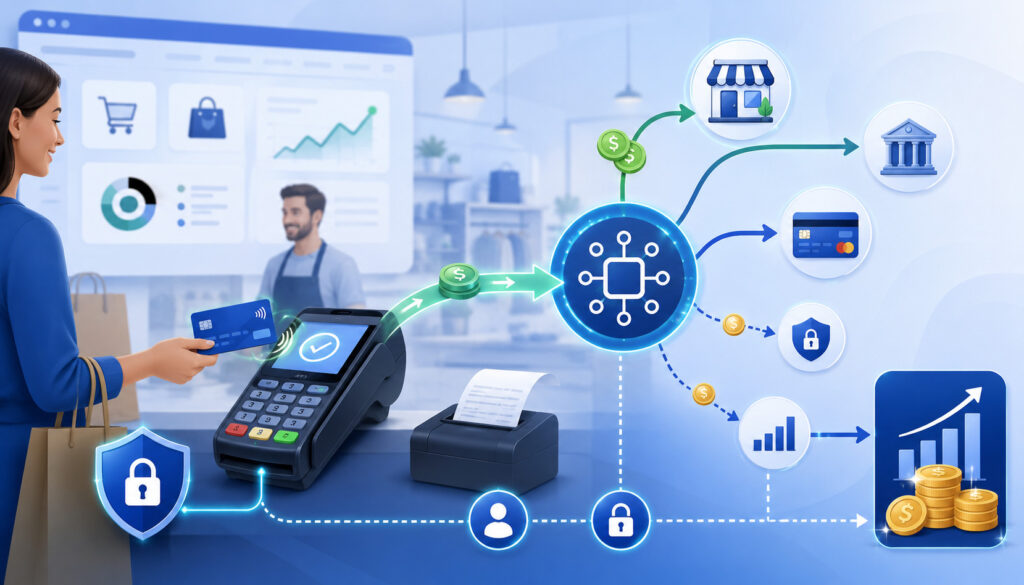
Transaction fees are one of the most visible sources of payment processing revenue. Each time a merchant accepts a card transaction, the total cost may include a percentage of the sale, a per-transaction fee, or both. The processor’s revenue may be built into these transaction fees, depending on the pricing model.
A typical card processing cost has three broad components: interchange fees, assessment fees, and processor markup. Interchange usually represents the largest portion of the cost. Assessment fees are generally smaller network fees. Processor markup is the portion added by the processor or merchant services provider.
For example, a merchant might pay a total cost on a transaction that includes:
- Interchange charged based on card type and transaction category
- Assessment fees connected to the card network
- Processor markup of several basis points
- A per-transaction fee
- Gateway transaction fee if processed online
- Additional fees for special services, if applicable
A transaction fee may look small, but it adds up quickly. A few basis points on high monthly volume can represent meaningful revenue. A few cents per transaction can be significant for high-volume, low-ticket businesses such as convenience stores, quick-service restaurants, vending businesses, and ecommerce stores with low average order values.
Transaction-based revenue also scales with merchant growth. As the business processes more card transactions, the processor earns more revenue, assuming the pricing structure stays the same. This is one reason processors compete for merchants with strong volume and stable risk profiles.
For merchants, the practical goal is not to eliminate transaction fees. Card acceptance has real costs and often supports customer convenience, higher sales conversion, faster collections, and better payment tracking. The goal is to understand what is being charged and whether the structure fits the business.
Interchange Fees
Interchange fees are paid to the issuing bank, not usually kept by the payment processor. The issuing bank is the financial institution that issued the customer’s card. Interchange compensates the issuer for its role in the transaction, including funding, cardholder services, fraud risk, and credit risk.
Interchange rates vary based on many factors, including card type, card network, transaction method, business category, data quality, debit versus credit, rewards card status, and whether the transaction is card-present or card-not-present.
Online payments and keyed transactions often cost more than in-person chip or contactless transactions because card-not-present transactions typically carry higher fraud and dispute risk.
For merchants, interchange is important because it is often the largest component of credit card processing fees. However, merchants generally cannot negotiate interchange directly with the processor. What they can negotiate is the processor markup above interchange and the account-level fees attached to the service.
Some pricing models pass interchange through transparently. Others bundle interchange into a flat rate or tiered category. When interchange is bundled, the merchant may not know whether a lower-cost debit card transaction is producing a higher processor margin than a higher-cost rewards credit card transaction.
Assessment Fees
Assessment fees are card network fees. These fees are separate from interchange and are generally paid to the networks that operate card rails and set many transaction rules. Assessment fees are usually smaller than interchange fees, but they still contribute to the total merchant processing fees.
Assessment fees may appear as separate line items on detailed statements or may be bundled into the total rate. They can vary by network, transaction type, cross-border activity, authorization characteristics, and other factors.
Like interchange, assessment fees are generally treated as pass-through costs in transparent pricing models. Merchants usually cannot negotiate assessment fees directly. However, they can ask whether network fees are being passed through at cost or marked up through vague statement categories.
Assessment fees matter because a merchant looking only at processor markup may underestimate total payment processing costs. A quote that says “interchange plus markup” should also clarify how assessment fees are handled.
Processor Markup
Processor markup is where payment processors most directly earn margin on transactions. It may be expressed as a percentage, basis points, a per-transaction fee, a monthly charge, or a combination of these.
For example, a processor might charge interchange plus a fixed markup and a per-transaction fee. In that case, the processor markup is easier to identify.
In flat-rate pricing, the processor markup is the difference between what the merchant pays and the underlying interchange, assessment, and operating costs. In tiered pricing, processor markup may be hidden inside qualified, mid-qualified, and non-qualified categories.
Processor markup is not automatically unreasonable. It pays for processing infrastructure, underwriting, support, software connectivity, risk monitoring, reporting, compliance administration, and customer service. The issue is whether the markup is transparent and aligned with the value delivered.
Merchants should ask whether processor markup applies to all transactions, whether it varies by payment method, whether it includes gateway access, and whether extra account fees are charged separately.
Processor Markup: Where Payment Processors Earn Their Margin
Processor markup is one of the most important concepts for merchants to understand because it represents the portion of payment processor fees most likely to be negotiable.
While interchange fees and assessment fees are largely set outside the processor’s control, markup is determined by the processor, merchant services provider, ISO, software platform, or sales channel.
Markup can be visible or hidden. In an interchange-plus pricing model, markup may be listed as a percentage plus a per-transaction fee.
For example, a statement may show interchange costs separately, assessment fees separately, and a processor margin as a clear add-on. In flat-rate pricing, the markup is blended into the rate. In tiered pricing, markup may be embedded inside broad pricing buckets.
Processor markup can include:
- Basis points above interchange
- Per-transaction fees
- Authorization fees
- Settlement or batch fees
- Monthly service fees
- Gateway markup
- Risk surcharges
- Non-qualified transaction markup
- Card-not-present markup
- Cross-border or special handling markup
Basis points are commonly used in merchant services pricing. One basis point equals one one-hundredth of a percent. So, a markup of 30 basis points equals 0.30%. On a high-volume account, small differences in basis points can have a noticeable effect.
Per-transaction fees also matter. A merchant processing 100 transactions per month may not worry much about a few cents. A merchant processing 50,000 transactions per month should care very much. That small fee becomes a recurring revenue stream for the processor.
Processor markup may also reflect risk. A business with higher chargeback exposure, delayed fulfillment, subscription billing, high average ticket sizes, or regulated products may pay more because the processor and acquiring bank face greater financial exposure.
Basis Points and Per-Transaction Fees
Basis points and per-transaction fees are two common ways processors earn transaction-level revenue. A basis-point markup is percentage-based, while a per-transaction fee is fixed.
A percentage markup affects larger transactions more. For example, a 0.30% markup on a $1,000 transaction is much larger in dollars than the same markup on a $10 transaction. A per-transaction fee affects small transactions more heavily because the fee does not shrink with the sale amount.
Consider two simplified examples:
- A $10 sale with a $0.10 processor transaction fee means the fixed fee alone equals 1% of the sale.
- A $1,000 sale with the same $0.10 fee means the fixed fee equals only 0.01% of the sale.
This is why merchants should evaluate pricing based on average ticket size. A coffee shop, ecommerce accessory seller, professional services firm, and B2B supplier may all need different pricing priorities.
A fair comparison should include both the percentage markup and the per-transaction fee. Looking at only one side of the formula can lead to the wrong conclusion.
Markup in Flat-Rate Pricing
In flat-rate pricing, the merchant pays a single bundled rate, such as a percentage plus a per-transaction fee. That rate typically includes interchange, assessment fees, processor markup, risk assumptions, and sometimes gateway access or platform tools.
Flat-rate pricing can be attractive because it is easy to understand and simple to forecast. A startup, low-volume merchant, mobile seller, or small ecommerce business may prefer the simplicity. However, the processor earns money when the bundled rate exceeds the actual cost of processing the transaction.
For example, if a debit transaction has a relatively low underlying cost, but the merchant pays the same flat rate as a higher-cost credit card transaction, the processor may earn a larger margin on that debit sale. On the other hand, the processor may earn less margin or take more risk on expensive card types.
Flat-rate pricing is not necessarily bad. It can be convenient and predictable. Merchants should simply understand that simplicity often comes with blended economics.
Markup in Tiered Pricing
Tiered pricing groups transactions into categories, often called qualified, mid-qualified, and non-qualified. Each tier has a different rate. The challenge is that merchants may not always know why a transaction falls into one tier instead of another.
A rewards card, keyed transaction, business card, card-not-present payment, missing data field, or certain settlement issue may push a transaction into a more expensive tier. That higher tier may include additional processor margin.
Tiered pricing can make payment processing fees harder to audit because the true interchange cost is not always visible. A merchant might see that many transactions are priced as non-qualified without understanding the underlying reason.
Merchants using tiered pricing should ask for a breakdown of transactions by tier, the criteria for each tier, and whether interchange-plus pricing is available as an alternative.
Monthly Fees, Account Fees, and Service Charges
Payment processors also make money from monthly fees, account fees, and service charges. These charges may not depend directly on transaction volume, which means they can have a bigger impact on smaller or seasonal businesses.
A merchant that processes a large monthly volume may barely notice a modest monthly fee. A low-volume business may find that the same fee significantly increases its effective rate.
Common monthly and account-level fees include:
- Monthly account fee
- Statement fee
- Monthly minimum fee
- PCI compliance fee
- PCI non-compliance fee
- Customer support fee
- Reporting fee
- Account maintenance fee
- Batch fee
- Funding fee
- Annual fee
- Regulatory or administrative fee
Some account fees cover legitimate services. A processor may maintain reporting portals, customer support, risk monitoring, account updates, tax documentation, underwriting reviews, and compliance tools. Other fees may be more difficult to evaluate because they are labeled broadly or described as administrative.
A monthly minimum fee is especially important to understand. This fee means the merchant must generate a minimum amount of processing fees each month.
If the account does not generate enough fees, the processor charges the difference. This can affect seasonal businesses, new businesses, consultants, event vendors, or merchants with inconsistent card volume.
Statement fees may be charged for providing monthly reporting or account documentation. In modern processing environments, merchants should ask whether the statement fee is required, optional, or waived with electronic statements.
Batch fees may be charged when a group of transactions is submitted for settlement. For example, a terminal may batch out at the end of the business day. The fee may be small, but daily batch fees can add up over time.
Monthly Account Fees
A monthly account fee is a recurring charge for keeping the merchant account active. It may cover access to support, reporting, account administration, risk monitoring, and back-office maintenance.
For higher-volume merchants, a monthly account fee may be reasonable if transaction pricing is competitive. For lower-volume merchants, the same fee can raise the total cost significantly. For example, a $25 monthly fee on $1,000 in monthly card sales adds 2.5 percentage points to the effective cost before transaction fees are even counted.
Merchants should ask what the monthly account fee includes. Does it include customer support? Does it include access to statements and reporting? Does it include PCI tools? Does it include gateway access? Or is the gateway billed separately?
The more clearly a provider explains the fee, the easier it is to decide whether the fee is justified.
Monthly Minimum Fees
A monthly minimum fee is different from a monthly account fee. It is not simply a charge for having the account. It is a minimum revenue requirement for the processor.
For example, if the monthly minimum is $25 and the merchant generates only $12 in qualified processing fees, the processor may charge an additional $13. This ensures the processor earns a minimum amount from the account even when transaction volume is low.
Monthly minimum fees can be reasonable for some account types, but they should be disclosed clearly. They are especially important for new merchants, seasonal businesses, event-based sellers, and merchants that use card payments only occasionally.
A merchant should ask which fees count toward the minimum. Not all charges may qualify. Interchange may not count because it is passed through. Only the processor’s revenue portion may count.
Statement Fees and Administrative Fees
Statement fees and administrative fees are common line items on merchant statements. A statement fee may be tied to monthly reporting, while administrative fees may be described more broadly.
These fees are not always large, but they can make the pricing model less transparent. A processor may advertise a low markup and then add several account-level fees. That does not always mean the overall pricing is unfair, but the merchant should include those charges in the total cost comparison.
When reviewing these fees, ask whether they are mandatory, whether they can be waived, whether electronic statements reduce the cost, and whether they duplicate other monthly service charges.
Payment Gateway, Virtual Terminal, and Technology Fees

Technology fees are another important part of how payment processors make money. A payment gateway is the technology layer that securely transmits transaction information for online payments, keyed payments, invoices, subscriptions, and other card-not-present transactions.
A virtual terminal allows a business to enter payment details manually through a secure web-based interface.
Payment gateway fees may include monthly gateway access, per-transaction gateway fees, setup fees, batch fees, tokenization fees, recurring billing fees, API access fees, account updater fees, fraud tool fees, and reporting fees. Some processors bundle gateway access into their pricing. Others charge separately.
For ecommerce sellers, SaaS companies, professional service firms, nonprofits, subscription businesses, and remote billing operations, gateway quality matters. A gateway may affect checkout experience, approval rates, fraud management, stored payment methods, recurring billing, reconciliation, and integration with accounting or customer management systems.
A virtual terminal may be useful for businesses that accept payments by phone, email invoice, or back-office billing. However, keyed transactions can carry higher processing costs than in-person transactions because the card is not physically present. That higher risk can affect interchange, processor markup, or both.
Technology fees can be reasonable when they support valuable features. For example, fraud tools may reduce chargebacks. Tokenization may protect stored payment credentials. Recurring billing tools may reduce manual work. Detailed reporting may help accounting teams reconcile deposits.
The issue is whether the merchant needs the tools and whether the fees are disclosed clearly. A small retail shop that never sells online may not need a monthly gateway fee. A subscription business may gladly pay for reliable recurring billing and account updater tools.
For more background on gateway-related costs, this payment gateway fee guide can help merchants understand how online transaction tools may affect total cost.
Payment Gateway Fees
Payment gateway fees are usually tied to online or card-not-present payment acceptance. These fees may include a monthly charge, a per-transaction fee, or both. A gateway may also charge for special features such as fraud screening, tokenized card storage, recurring billing, hosted checkout pages, or API access.
Payment gateway fees can create revenue for the gateway provider, the processor, the merchant services provider, or a software platform that resells gateway access. In some cases, the processor pays a wholesale gateway cost and marks it up. In others, the gateway bills the merchant directly.
Merchants should look beyond the fee itself and consider the gateway’s role in operations. A cheaper gateway may not be better if it causes checkout friction, poor reporting, limited integrations, or weak fraud controls. A more expensive gateway may be worthwhile if it reduces manual work or improves authorization performance.
The PCI Security Standards Council is also a useful authority for understanding why secure handling of cardholder data matters in gateway and ecommerce environments.
Virtual Terminal Fees
A virtual terminal lets a business enter card details manually through a secure browser-based system. It is common for professional services, medical billing, repair businesses, wholesalers, nonprofits, and companies that accept phone orders or invoice payments.
Virtual terminal access may be included with a gateway, or it may be billed separately. Some providers charge a monthly fee, while others charge only transaction fees. Because virtual terminal transactions are usually keyed, they may cost more than card-present transactions.
Merchants should also consider security responsibilities. Keyed payments can increase exposure if staff handle card details improperly. A good virtual terminal should support secure user access, permissions, transaction logs, and tokenization where appropriate.
Before paying for a virtual terminal, ask whether it supports your invoice flow, recurring billing, customer profiles, refunds, reporting, and user-level controls.
Fraud Tools and Add-On Technology
Fraud tools can be another source of payment processing revenue. These tools may include address verification, card verification checks, velocity controls, device fingerprinting, risk scoring, payer authentication, chargeback alerts, and fraud filters.
For card-not-present transactions, fraud tools can be valuable. Fraud losses and chargebacks may cost far more than the tool itself. However, merchants should understand whether fraud tools are included, optional, or required.
A processor or platform may charge separately for advanced risk tools. That does not make the fee inappropriate, but the merchant should review whether the tools match the business’s risk level. A low-risk in-person retailer may not need the same fraud stack as an ecommerce seller shipping high-value products.
Chargeback, Risk, and Compliance-Related Fees
Chargebacks, risk controls, and compliance responsibilities can also generate processor revenue or cost recovery. A chargeback occurs when a cardholder disputes a transaction. The merchant may pay a chargeback fee even if the dispute is later resolved in the merchant’s favor, depending on the provider’s terms.
Chargeback fees are usually administrative fees. They compensate the processor or provider for handling dispute notifications, documentation workflows, network requirements, and account management. However, chargebacks can also create indirect costs: lost merchandise, lost sale revenue, shipping costs, staff time, higher fraud exposure, and potential reserve requirements.
Processors and acquiring banks pay close attention to chargeback ratios because excessive disputes can create financial risk. A merchant with high chargeback activity may face higher processor markup, rolling reserves, delayed funding, account reviews, or account termination.
This is especially relevant for ecommerce, subscription billing, travel-related services, high-ticket sales, delayed delivery, trial offers, and industries with elevated dispute risk.
Compliance-related fees are another area to watch. PCI compliance fees may be charged monthly or annually. PCI non-compliance fees may apply when a merchant has not completed required validation steps.
These fees may cover compliance tools, scans, questionnaires, support, or administrative tracking. Merchants should ask what the fee includes and how to avoid non-compliance penalties.
Risk-related revenue can also appear in reserve arrangements. A reserve is not always processor revenue, because held funds may belong to the merchant. However, reserves affect cash flow and may be tied to risk management. Some agreements also include reserve-related administrative terms, early termination fees, or special review fees.
For merchants that want more detail on dispute costs, this chargeback fee overview explains why disputes can affect both direct fees and operating costs.
Chargeback Fees
Chargeback fees are charged when a customer disputes a transaction through the card issuer. The processor or merchant services provider may assess a fee for each dispute, regardless of the outcome.
The fee may cover dispute intake, notification, administrative handling, representment tools, documentation routing, and network-related workflows. For merchants, the direct fee is only part of the cost. A chargeback may also reverse the sale, remove revenue, create inventory loss, and require staff time.
Merchants should ask:
- What is the chargeback fee per dispute?
- Is the fee refunded if the merchant wins?
- Are alert services available?
- Are chargeback management tools included?
- Are excessive disputes subject to additional fees?
- Can high chargeback ratios trigger reserves or account review?
A strong prevention process can reduce chargeback costs. Clear billing descriptors, fast customer service, accurate product descriptions, delivery tracking, refund policies, and fraud screening all help.
PCI Compliance Fees
PCI compliance fees relate to payment card data security requirements. A processor may charge for compliance tools, questionnaires, vulnerability scans, support, or administrative tracking. A PCI non-compliance fee may apply if the merchant does not complete required validation.
Merchants should not ignore PCI requirements, especially if they accept online payments, store customer payment data, use a virtual terminal, or operate multiple payment channels. Security failures can be costly, and compliance helps reduce exposure.
That said, merchants should review PCI fees carefully. Ask whether the fee includes useful tools or support. Ask how to complete validation. Ask whether non-compliance fees can be avoided immediately after completing the required steps.
A PCI fee that comes with no meaningful support deserves scrutiny. A compliance program that includes tools, reminders, scans, and support may provide real value.
Reserves and Risk Management
A reserve is money held back by the processor or acquiring bank to reduce risk. Reserves are common for certain higher-risk merchants, new businesses, high-ticket sellers, subscription businesses, delayed delivery models, or merchants with elevated chargeback exposure.
A rolling reserve might hold a percentage of sales for a set period. A fixed reserve might require a specific amount to be held. A reserve is not the same as a fee if the funds are eventually released according to the agreement. However, reserves affect cash flow and should be reviewed carefully.
Merchants should ask why a reserve is required, how it is calculated, when funds are released, what activity could increase it, and whether it can be reduced after a period of stable processing.
Pricing Models That Shape Processor Revenue
The pricing model determines how processor revenue is presented, how easy it is to audit, and how costs scale with transaction volume. The same underlying card transaction can look very different under flat-rate pricing, interchange-plus pricing, tiered pricing, or subscription pricing.
No single pricing model is best for every business. A startup may value simplicity. A high-volume merchant may value transparency. A seasonal business may want low monthly commitments. A SaaS platform may care about recurring billing and embedded payment economics. A retailer may want predictable in-person pricing and reliable equipment support.
The key is to understand what each model includes and how processor margin is earned.
Flat-rate pricing bundles costs into a simple rate. Interchange-plus pricing separates wholesale costs from markup. Tiered pricing groups transactions into rate categories. Subscription pricing may charge a monthly membership fee plus lower transaction markup. Each approach can be fair or expensive depending on the merchant’s profile and the provider’s terms.
Merchants should compare pricing models using real transaction data whenever possible. A quote based on assumptions may not reflect the merchant’s actual card mix, debit usage, rewards card volume, keyed transactions, average ticket, refund pattern, or chargeback history.
A pricing model comparison should include:
- Total monthly card sales
- Number of transactions
- Average ticket size
- Card-present versus card-not-present mix
- Debit versus credit card mix
- Rewards and commercial card volume
- Gateway and software needs
- Monthly account fees
- Chargeback fees
- PCI fees
- Equipment costs
- Contract terms
Flat-Rate Pricing
Flat-rate pricing charges one bundled rate for many transaction types. It may be easy to understand because the merchant sees a predictable percentage and per-transaction fee. For small businesses, startups, mobile sellers, or low-volume merchants, that simplicity can be useful.
The processor makes money by blending the underlying costs. Some transactions cost less to process than the flat rate, creating higher margin. Other transactions cost more, reducing the processor’s margin. The processor uses the overall mix to manage profitability.
Flat-rate pricing may work well when a business values simplicity over detailed cost visibility. It may be less attractive when the merchant processes high volume, has many low-cost debit transactions, or wants to see exactly how interchange and processor markup are separated.
Questions to ask include:
- Are all card types priced the same?
- Are keyed, online, and in-person transactions priced differently?
- Are gateway fees included?
- Are monthly fees added separately?
- Are chargeback and PCI fees separate?
- Does the rate change with volume?
Interchange-Plus Pricing
Interchange-plus pricing separates interchange and assessment fees from the processor markup. This model is often considered more transparent because the merchant can see the pass-through costs and the processor’s added margin.
A typical interchange-plus quote may include a markup expressed in basis points plus a per-transaction fee. For example, the merchant pays interchange, assessment fees, and a clearly stated processor markup. This can make it easier to identify the processor’s revenue.
Interchange-plus pricing can be useful for established merchants, higher-volume businesses, B2B sellers, retailers, ecommerce companies, and businesses that want statement-level transparency. However, statements can be more detailed, and merchants need to understand how to read them.
This model does not guarantee the lowest cost. A high markup, added monthly fees, gateway charges, or excessive account fees can still make an interchange-plus plan expensive. The benefit is that the cost structure is easier to evaluate.
For additional background, this interchange-plus pricing guide explains why separating pass-through costs from processor markup can help merchants compare quotes.
Tiered Pricing
Tiered pricing places transactions into categories such as qualified, mid-qualified, and non-qualified. Each category has a different rate. The processor may earn more when transactions fall into more expensive tiers.
The challenge is transparency. Merchants may not know which transactions will qualify for the lowest tier or why certain payments are downgraded. Rewards cards, business cards, keyed transactions, delayed settlement, missing data, or ecommerce transactions may fall into higher-cost categories.
Tiered pricing can make it harder to separate interchange fees, assessment fees, and processor markup. The merchant sees the tier rate, but not always the underlying cost.
If a merchant uses tiered pricing, it should review the percentage of transactions in each tier. A low qualified rate may not matter much if many transactions are billed as mid-qualified or non-qualified.
Subscription Pricing
Subscription pricing usually combines a monthly membership fee with lower transaction markup. The processor may charge pass-through interchange and assessment fees, then add a smaller per-transaction fee or reduced markup.
This model can work well for merchants with enough volume to justify the monthly subscription. The processor earns predictable monthly revenue, while the merchant may benefit from lower transaction-level markup.
However, subscription pricing is not always cheaper. Low-volume merchants may not process enough transactions to offset the monthly cost. Merchants should calculate total cost, not just the lower per-transaction margin.
Ask whether the subscription includes gateway access, PCI tools, reporting, customer support, chargeback tools, and any volume limits. Also ask what happens if processing volume drops.
Revenue Sharing, ISOs, and Embedded Payment Models
Payment processing revenue does not always stay with one processor. In many cases, revenue is shared among ISOs, agents, software platforms, payment facilitators, referral partners, or embedded payment providers. This is especially common in merchant services, SaaS platforms, vertical software, ecommerce tools, franchise systems, and industry-specific business management software.
An ISO, or independent sales organization, may sell merchant services on behalf of a processor or acquiring relationship. An ISO agent may earn commissions or residual income based on the merchant’s processing activity. This means part of the processor markup may be shared with the sales organization or agent that enrolled the merchant.
Embedded payments work differently. A software platform may integrate payment acceptance directly into its product. For example, a scheduling platform, invoicing system, field service platform, ecommerce system, or practice management tool may let merchants accept payments inside the software. The platform may receive a share of payment processing revenue.
Payment facilitation is another model. A payment facilitator may onboard sub-merchants under a master merchant structure, simplifying setup and payment acceptance. In exchange, the facilitator may earn revenue from transaction pricing while taking on responsibilities related to onboarding, risk monitoring, compliance, reporting, and support.
These models can be convenient for merchants because payments are built into the tools they already use. However, convenience can come with less pricing flexibility. A software platform that controls payment acceptance may set pricing, limit processor choice, or bundle payment fees with software fees.
This does not mean embedded payments are bad. They can improve workflow, reconciliation, customer experience, and payment collection. The merchant should simply understand whether the software provider shares in payment processing revenue and whether alternative processors are allowed.
ISO and Agent Commissions
ISOs and agents often earn money through commissions or residuals. A residual is an ongoing share of revenue from the merchant account. If a merchant processes payments every month, the agent or ISO may receive a portion of the processor markup or related fees.
This model is common in merchant services. It can support local service, onboarding help, equipment support, and account management. However, it can also affect pricing if the merchant’s rates are set high enough to support multiple parties.
Merchants should not automatically reject ISO-based relationships. Many ISOs provide knowledgeable support and help merchants navigate complex payment issues. The key is transparency.
Ask whether the sales organization provides ongoing support after the account is opened. Also ask whether pricing can be reviewed as volume grows or risk improves.
Payment Facilitator Revenue
A payment facilitator model allows a platform to onboard many sub-merchants under a broader processing structure. This can make setup faster and simpler for merchants that want to start accepting payments quickly.
The payment facilitator earns money from the difference between what merchants pay and the underlying processing costs. It may also earn from account fees, instant payout fees, dispute fees, software fees, or value-added services.
The benefit for merchants is convenience. The tradeoff may be less customization, less pricing flexibility, or more standardized risk controls. Some merchants may face holds, reserves, or account reviews if their activity does not fit the platform’s risk rules.
Merchants using this model should understand funding timelines, reserve policies, dispute handling, prohibited activity rules, and support options.
Embedded Payments and Software Revenue Sharing
Embedded payments allow software platforms to make payment acceptance part of the user experience. This is common in SaaS, field services, healthcare administration, fitness, education, property services, marketplaces, and subscription platforms.
The software provider may earn revenue sharing from payment processing fees. This can help fund product development, customer support, payment integrations, and workflow automation. It may also create incentives for the platform to require a specific payment processor.
For merchants, the question is whether the embedded payment solution saves enough time or improves operations enough to justify the cost. A slightly higher rate may be acceptable if it automates invoicing, reconciliation, recurring billing, and customer payment reminders. But merchants should still compare the total cost against standalone merchant account options.
How to Read Merchant Statements to Spot Processor Revenue
A merchant statement is one of the best tools for understanding how payment processors make money. It shows card sales, transaction counts, fees, deposits, chargebacks, adjustments, and account charges. Unfortunately, statements are not always easy to read. Different providers use different formats, labels, and categories.
The goal of merchant statement review is to separate pass-through costs from processor-controlled fees. Start by identifying total card sales, total fees, and total transactions. Then calculate the effective rate by dividing total fees by total card sales. This gives you a high-level view of what processing costs as a percentage of sales.
Next, review the fee categories. Look for interchange fees, assessment fees, authorization fees, processor markup, per-transaction fees, batch fees, monthly account fees, statement fees, PCI fees, gateway fees, chargeback fees, equipment fees, and other service charges.
If the statement uses interchange-plus pricing, you may see detailed interchange categories. If it uses tiered pricing, you may see qualified, mid-qualified, and non-qualified volume. If it uses flat-rate pricing, you may see fewer categories but less detail.
A merchant statement can also reveal patterns. For example:
- Many non-qualified transactions may suggest tiered pricing downgrades.
- High gateway fees may indicate duplicate technology charges.
- Frequent chargeback fees may point to customer service or fraud issues.
- Monthly minimum fees may indicate processing volume is too low for the plan.
- Equipment lease fees may cost more than purchasing equipment.
- PCI non-compliance fees may be avoidable with completed validation.
For a deeper look at statement analysis, this merchant statement review resource can help merchants identify where costs appear.
Merchant Statement Review
A good merchant statement review starts with the basics: processing volume, number of transactions, total fees, and average ticket. These numbers help establish context before looking at individual line items.
Then review transaction categories. Are transactions mostly swiped, dipped, tapped, keyed, online, recurring, or mobile? Are debit cards common? Are rewards cards or business cards frequent? The card mix affects interchange and total cost.
Next, identify processor-controlled fees. These may include markup, authorization fees, gateway fees, monthly account fees, statement fees, PCI fees, batch fees, and chargeback fees. Some may be negotiable. Others may be tied to the provider’s service model.
Finally, compare the statement against the original agreement. Look for rate changes, new fees, annual charges, equipment terms, and minimums. If the statement does not match the quote, ask for an explanation in writing.
Questions to Ask About Your Statement
Merchants can learn a lot by asking targeted questions. Instead of asking, “Why is my bill high?” ask questions that separate cost components.
Useful questions include:
- Which fees are interchange?
- Which fees are assessment fees?
- Which fees are processor markup?
- Are any network fees marked up?
- What is my effective rate?
- Why are transactions downgraded?
- Are gateway fees billed separately?
- Is the PCI fee avoidable?
- Do I have a monthly minimum?
- Am I paying for equipment I no longer need?
- Are chargeback tools included?
- Can pricing be reviewed based on volume?
A transparent provider should be able to answer these questions clearly. If answers are vague, it may be time to request a more detailed fee schedule or compare other pricing options.
Spotting Hidden or Hard-to-See Markup
Hidden markup may appear as broad fee categories, inflated tier rates, vague administrative fees, or bundled technology charges. It may also appear when a provider advertises a low rate but adds multiple monthly charges.
Watch for labels such as non-qualified surcharge, miscellaneous fee, regulatory fee, access fee, risk fee, authorization fee, enhanced data fee, or service package fee. These are not always improper, but they should be explained.
A useful approach is to ask, “Is this fee charged by the card network, the issuing bank, the gateway, the acquiring bank, or your company?” The answer helps determine whether the fee is pass-through or processor revenue.
How Businesses Can Evaluate Processing Costs Fairly
Evaluating payment processing costs fairly requires more than comparing rates. A merchant should compare total cost, contract terms, service quality, technology needs, risk support, and pricing transparency. The cheapest visible rate is not always the lowest total cost, and the lowest total cost is not always the best fit if support, reliability, or integrations are weak.
Start with your actual business profile. A retail store with mostly card-present transactions has different needs than an ecommerce seller with online payments. A SaaS company with recurring billing has different needs than a restaurant. A professional services firm accepting invoice payments has different needs than a high-volume convenience store.
Then gather the right data. Review several months of merchant statements. Identify monthly card volume, average ticket, transaction count, card mix, payment channels, chargebacks, refunds, gateway needs, equipment needs, and any seasonal patterns.
When comparing quotes, ask each provider to estimate total monthly cost using the same data. Include transaction fees, processor markup, payment gateway fees, monthly account fees, PCI fees, batch fees, chargeback fees, software fees, equipment fees, and any minimums.
Also review contract terms. Some accounts may include early termination fees, long equipment leases, automatic renewal clauses, reserve rights, funding delays, or limitations on gateway choice. A slightly lower rate may not be worth restrictive terms.
Consider value as well as cost. Strong reporting, helpful support, clear funding, reliable integrations, fraud tools, and responsive chargeback assistance can reduce operating friction. For many merchants, payment processing is not just a cost center; it is part of the customer experience and cash-flow system.
Compare Total Effective Cost
The effective rate is total fees divided by total card sales. It is not perfect, but it is a useful starting point. For example, if a merchant processed $50,000 in card sales and paid $1,500 in total fees, the effective rate is 3%.
However, effective rate should be interpreted carefully. A merchant with many card-not-present transactions may naturally pay more than a merchant with mostly in-person debit transactions. A high average ticket may create a different cost pattern than a low average ticket. A merchant with chargebacks or special software needs may also have higher total costs.
Use effective rate as a comparison tool, not as the only decision factor. The best analysis combines effective rate with line-item review and service evaluation.
Match Pricing Model to Business Type
Different pricing models fit different businesses. Flat-rate pricing may suit a new or low-volume business that values simplicity. Interchange-plus pricing may suit an established merchant that wants transparency.
Subscription pricing may suit a higher-volume merchant that can offset the monthly cost. Tiered pricing may be familiar, but merchants should review it carefully because downgrades can increase costs.
A business should also consider payment method mix. Online payments may require a gateway and fraud tools. In-person payments may require terminals or POS integration. Recurring billing may require tokenization and account updater tools. B2B payments may benefit from enhanced data when applicable.
The right pricing model should match how the business actually accepts payments.
Review Contract and Equipment Terms
Payment processing costs are not limited to rates and fees. Contract terms can affect long-term cost. Equipment leases, early termination fees, automatic renewals, and software commitments can all matter.
Equipment lease fees deserve special attention. Leasing a terminal may seem inexpensive monthly, but the total cost over the lease term may exceed the cost of buying equipment. Merchants should ask whether equipment is leased, rented, purchased, or included. They should also ask what happens if they change processors.
Contract flexibility matters. A merchant should understand cancellation terms, notice requirements, fee-change rights, reserve terms, funding timelines, and gateway portability.
Ask the Right Questions Before Signing
Before choosing a processor, merchants should ask practical questions that reveal how revenue is earned.
Good questions include:
- What pricing model are you offering?
- What is your processor markup?
- Are interchange fees passed through at cost?
- Are assessment fees passed through at cost?
- What monthly fees apply?
- Is there a monthly minimum fee?
- Are payment gateway fees included?
- Are virtual terminal fees separate?
- What are chargeback fees?
- Are PCI compliance fees included?
- What happens if I become non-compliant?
- Are there equipment lease terms?
- Can I use my existing equipment?
- How are keyed and online payments priced?
- Are next-day or faster funding fees separate?
- Is there revenue sharing with my software provider?
- Can I leave without penalty?
Clear answers help merchants choose based on facts rather than assumptions.
How do payment processors make money?
Payment processors make money through transaction fees, processor markup, monthly account fees, gateway fees, virtual terminal fees, PCI compliance fees, chargeback fees, equipment fees, and other merchant services fees. In some models, they also earn through revenue sharing with ISOs, agents, payment facilitators, or software platforms.
Some revenue is earned directly from each transaction. Other revenue comes from recurring account charges or technology services. The exact payment processor revenue model depends on the provider, pricing plan, merchant profile, and payment setup.
What is processor markup?
Processor markup is the amount added by the payment processor or merchant services provider above pass-through costs such as interchange fees and assessment fees. It is one of the main ways processors earn margin.
Markup may appear as basis points, a per-transaction fee, a monthly fee, or a bundled amount inside flat-rate or tiered pricing. In interchange-plus pricing, processor markup is usually easier to identify because it is separated from wholesale costs.
Do payment processors keep interchange fees?
In most cases, payment processors do not keep interchange fees. Interchange fees are generally paid to the issuing bank, which is the financial institution that issued the customer’s card. The processor collects the amount as part of the merchant’s total processing cost and passes it through the payment system.
However, in bundled pricing models, merchants may not see interchange separately. The processor may charge a flat or tiered rate that includes interchange, assessment fees, and processor markup.
What fees create payment processing revenue?
Payment processing revenue can come from processor markup, per-transaction fees, authorization fees, gateway fees, monthly account fees, statement fees, PCI compliance fees, batch fees, chargeback fees, equipment lease fees, software fees, and other service charges.
Not every fee is retained by the processor. Some are passed through to issuing banks, card networks, gateways, or other partners. Merchants should ask which fees are pass-through and which create processor margin.
How does flat-rate pricing make money for processors?
Flat-rate pricing makes money by charging merchants a bundled rate that is designed to cover underlying costs and leave margin for the processor. The processor may earn more on lower-cost transactions and less on higher-cost transactions, depending on the card type and transaction method.
Flat-rate pricing can be simple and predictable, but it may hide the difference between interchange fees, assessment fees, and processor markup. Merchants with high volume or many debit transactions may want to compare flat-rate pricing against interchange-plus pricing.
Is interchange-plus pricing more transparent?
Interchange-plus pricing is often more transparent because it separates pass-through costs from processor markup. Merchants can usually see interchange fees, assessment fees, and the processor’s added margin more clearly.
That said, interchange-plus pricing is not automatically the cheapest option. Merchants still need to review basis points, per-transaction fees, monthly fees, gateway fees, PCI fees, chargeback fees, and contract terms.
Why do payment processors charge monthly fees?
Payment processors may charge monthly fees to cover account maintenance, reporting, support, risk monitoring, compliance administration, and service access. Monthly fees may also create predictable revenue for the processor.
Merchants should ask what each monthly fee includes. A monthly account fee may be reasonable if transaction pricing is lower or services are valuable. But multiple recurring fees can raise total cost, especially for low-volume businesses.
How can merchants compare payment processor fees?
Merchants can compare payment processor fees by reviewing total monthly cost, not just the advertised rate. Start with recent merchant statements, calculate the effective rate, identify pass-through costs, review processor markup, and add all monthly, gateway, PCI, chargeback, and equipment fees.
The best comparison uses the same processing data for each quote. Ask providers to price a sample month based on your real volume, transaction count, card mix, and payment channels.
Conclusion
Understanding how payment processors make money helps merchants make better decisions about payment acceptance. Processing fees are not just one simple rate.
They are a combination of interchange fees, assessment fees, processor markup, transaction fees, payment gateway fees, account fees, compliance charges, chargeback fees, technology costs, equipment terms, and sometimes revenue-sharing arrangements.
The most important distinction is between pass-through costs and processor revenue. Interchange fees generally go to issuing banks.
Assessment fees generally go to card networks. Processor markup, certain account fees, gateway markups, service charges, and technology fees may create revenue for the processor, merchant services provider, ISO, agent, payment facilitator, or software platform.
No pricing model is perfect for every business. Flat-rate pricing can be simple. Interchange-plus pricing can be transparent. Tiered pricing can be harder to audit. Subscription pricing can work for merchants with enough volume. Embedded payments can improve workflow but may include revenue sharing that affects cost.
For merchants, the best approach is practical: review statements, calculate effective cost, ask which fees are pass-through, identify processor markup, evaluate technology needs, compare total monthly costs, and read contract terms before signing. Payment processing should support the business, not confuse it.
A processor deserves to earn revenue for reliable transaction routing, security, support, risk management, reporting, and technology. Merchants deserve clear pricing, fair terms, and enough information to understand what they are paying for. When both sides are clear, payment processing becomes easier to manage and easier to evaluate as the business grows.
Leave a Reply