
By Joseph Bryson June 2, 2026
Merchant service agreements are one of the most important documents a business reviews when it starts accepting card payments, online payments, mobile payments, or other forms of electronic business payments.
Yet many owners sign them quickly because they are eager to start processing transactions, upgrade a point-of-sale system, launch an ecommerce site, or replace an old payment processor.
That rush can be expensive. A merchant service agreement is a binding contract that governs how your business accepts debit card payments, credit card transactions, digital payments, and related services.
It can affect your pricing, funding schedule, cancellation rights, chargeback liability, equipment obligations, PCI compliance responsibilities, and what happens if your account is reviewed, frozen, or closed.
This guide is for general educational purposes only and is not legal advice. Because contract terms can vary widely, businesses should review their own documents carefully and consult a qualified professional when legal, tax, or compliance questions arise.
A good merchant services contract should help you understand the relationship between your business and the parties that process payments. A weak or confusing payment processor contract can leave you unsure about what you owe, when funds will settle, when rates may change, and what obligations survive after cancellation.
The goal is not to make every business owner a contract lawyer. The goal is to help you read merchant services terms with more confidence, ask better questions, compare offers more accurately, and avoid signing a merchant account contract that does not match your needs.
What Are Merchant Service Agreements?
Merchant service agreements are contracts between a business and a payment services provider that define how electronic payments will be accepted, processed, settled, billed, monitored, and managed.
You may also see similar documents called a merchant agreement, merchant services contract, merchant account agreement, merchant processing agreement, payment processing agreement, credit card processing agreement, or payment processor contract.
The exact title matters less than the obligations inside the document. These agreements typically explain the services being provided, the fees being charged, the rules the merchant must follow, and the provider’s rights if something goes wrong.
They may also include separate schedules, applications, fee pages, program guides, equipment terms, gateway terms, and references to card network rules.
A merchant service agreement usually covers both daily operations and risk controls. Daily operations include authorization, batching, settlement, statement delivery, gateway access, equipment use, and customer support.
Risk controls include underwriting, fraud monitoring, chargeback policy, reserve account terms, funding holds, account termination, and compliance requirements.
For example, a retailer may think it is simply signing up to accept cards at checkout. In reality, the merchant account agreement may also give the provider authority to debit the business bank account for fees, chargebacks, refunds, fines, equipment costs, and other amounts owed. It may also allow pricing updates, funding delays, or reserve requirements under certain conditions.
The agreement can apply to many business types. A restaurant may need a point-of-sale system and tip adjustment rules. An ecommerce seller may need a payment gateway agreement and fraud tools.
A professional firm may need recurring billing, virtual terminal access, and clear funding terms. A startup may need flexible cancellation terms because its sales model is still developing.
A useful way to think about the agreement is this: it is the operating manual for your payment relationship. If there is a dispute about fees, funding, equipment, chargebacks, or cancellation, the provider will usually point back to the contract terms. That makes it essential to understand the agreement before the first transaction is processed.
For businesses that want more background on how merchant accounts fit into payment acceptance, this overview of what a merchant account is and why it matters can provide helpful context.
Why Merchant Service Agreements Matter
Merchant service agreements matter because card payments are not just a convenience feature. They affect revenue, cash flow, customer experience, accounting, compliance, fraud exposure, and operational risk.
When customers pay by card, funds move through a payment ecosystem involving merchants, processors, acquiring banks, issuing banks, card networks, and sometimes gateways, software providers, or independent sales organizations.
The agreement determines how your business participates in that ecosystem. It explains what you are allowed to process, what information you must provide, how fees are calculated, when deposits are sent, and how problems are handled.
It may also define what happens if your business changes ownership, changes products, processes higher volume than expected, receives too many chargebacks, or violates payment security requirements.
The biggest reason to review the contract carefully is that small terms can have large financial consequences. A monthly fee may look minor until it is combined with statement fees, batch fees, PCI fees, gateway fees, minimum fees, chargeback fees, and equipment lease costs. A low transaction rate may not be the full cost if interchange fees, assessment fees, and processor markup are presented in a confusing way.
Cancellation terms are another major issue. Some businesses discover too late that their merchant services contract includes an early termination fee, an automatic renewal clause, liquidated damages, or a long-term equipment lease that survives even after processing services end. These terms can make switching providers more expensive and reduce bargaining power later.
Funding terms can be equally important. The agreement may allow the provider to delay deposits, place funds on hold, create a rolling reserve, or debit the merchant’s bank account for losses. These provisions are often tied to underwriting, risk review, suspected fraud, unusual sales spikes, excessive disputes, or changes in business activity.
A strong agreement gives both sides clarity. It helps the provider manage legitimate payment risk, and it helps the merchant understand responsibilities. A weak or confusing agreement can create surprises after account approval, especially when the business starts processing higher volume or receives its first dispute.
For a practical breakdown of payment cost drivers, businesses can review this guide on how to reduce payment processing costs.
Key Parties Involved in a Merchant Agreement

A merchant agreement may look like a two-party contract, but payment processing usually involves several parties working behind the scenes. Understanding who does what can make contract language easier to interpret. It also helps you know whom to contact when there is a problem with pricing, funding, chargebacks, gateway access, or compliance.
The most common parties include the merchant, merchant services provider, payment processor, acquiring bank, issuing bank, card networks, payment gateway, and sometimes software or equipment vendors. The same company may perform more than one role, or several separate organizations may be involved.
This matters because not all fees and rules come from the same place. Some costs are pass-through costs from card networks or issuing banks. Some are processor markup. Some are contract-based fees charged by the provider. Knowing the difference helps you identify which terms may be negotiable and which are part of the broader payment system.
Merchant account provider
The merchant account provider is the company or organization that helps the business get set up to accept card payments. It may handle sales, onboarding, underwriting coordination, customer support, statement access, equipment setup, and account service.
In some arrangements, the provider is also the processor; in others, it works with a processor or acquiring bank.
The merchant account provider is often the party the business communicates with most. That is why it is important to know whether the provider can answer contract questions in writing, explain merchant services fees, and clarify how support issues are handled.
A merchant should ask who is responsible for billing, who controls pricing updates, who handles chargeback notices, and who has authority to place funding holds. If the agreement references another company’s program guide or operating rules, ask for those documents before signing.
Payment processor
The payment processor helps route transaction data between the merchant, acquiring bank, issuing bank, and card networks. When a customer pays with a card, transaction data must be authorized, captured, cleared, and settled. The processor’s systems help make that happen.
The payment processor contract may describe transaction types, settlement procedures, data handling, reporting, chargebacks, risk review, and prohibited activity. It may also define how quickly transactions must be batched and what happens when there is a technical error, duplicate transaction, refund issue, or suspicious processing activity.
For merchants, the processor’s role matters because processor policies can affect funding terms, risk monitoring, data security expectations, and statement structure. If a contract gives the processor broad rights to change fees or withhold funds, the business should understand the triggers and limits.
Acquiring bank
The acquiring bank, sometimes called the merchant bank or sponsor bank, is the financial institution that supports the merchant’s ability to accept card payments. Merchant processing is closely tied to banking because card transactions create financial obligations before all risks are fully resolved.
The acquiring bank may be responsible for settlement access, network registration, risk oversight, and compliance with card network requirements. The Office of the Comptroller of the Currency describes merchant processing as involving settlement of card payment transactions by banks for merchants through card associations.
The acquiring bank’s involvement is one reason merchant agreements include underwriting, reserves, account monitoring, and chargeback rules. If a merchant creates losses through fraud, excessive disputes, bankruptcy, or unpaid fees, the acquiring side may have exposure.
Card networks and issuing banks
Card networks set operating rules for card acceptance, dispute procedures, data security expectations, and network fees. Issuing banks provide cards to customers and approve or decline authorization requests based on account status, fraud controls, and available credit or funds.
The merchant may not have a direct contract with every issuing bank or card network, but the merchant agreement usually requires the business to follow their rules. That is why contracts reference card network rules, chargeback reason codes, authorization procedures, data security standards, and prohibited practices.
These rules affect daily operations. For example, a merchant must usually process refunds back to the original payment method, protect cardholder data, respond to disputes by deadlines, and avoid splitting transactions in ways that violate network rules.
Common Sections Found in a Merchant Services Contract
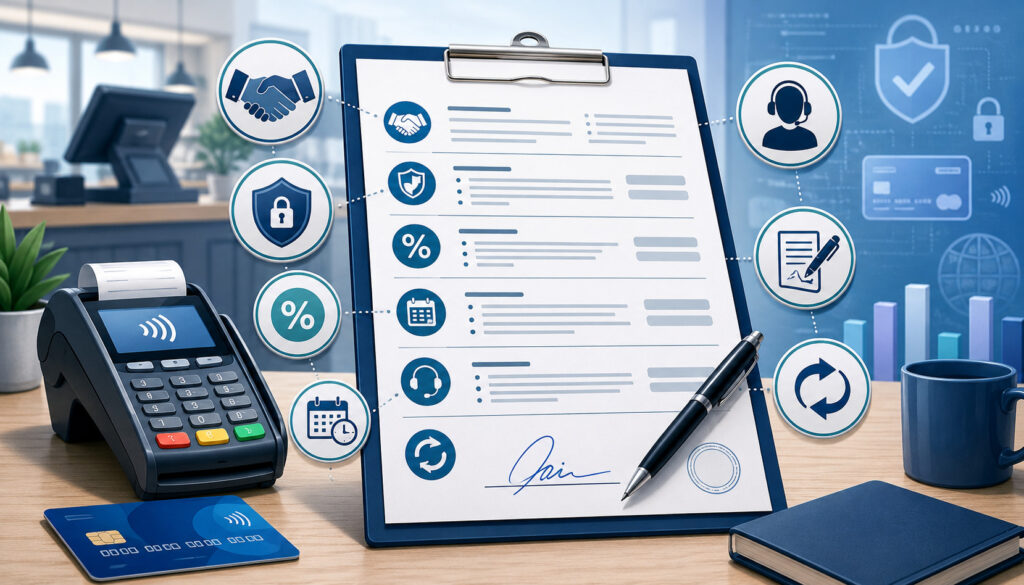
A merchant services contract is often longer than expected because it combines business terms, payment operations, compliance duties, risk controls, and legal protections. Some agreements are organized clearly, while others spread important details across multiple documents. A business should review the full contract package, not just the signature page.
Common sections include merchant information, processing services, pricing schedules, authorization rules, settlement terms, reserve provisions, chargeback procedures, data security obligations, equipment clauses, gateway terms, term length, cancellation rights, limitation of liability, personal guarantee language, and amendment rights.
The contract may also include representations and warranties. These are statements the merchant makes about its business, such as the type of products sold, ownership information, expected volume, refund policy, delivery practices, and compliance with laws. If those statements are inaccurate, the provider may treat the issue as a contract violation.
Another important section is the provider’s right to debit the merchant’s bank account. This clause may allow withdrawals for processing fees, chargebacks, refunds, fines, penalties, reserve funding, equipment costs, or other amounts owed. Since this can directly affect cash flow, merchants should understand when debits occur and how they are reported.
The agreement may include risk review and account monitoring language. This allows the provider to evaluate processing patterns, chargebacks, fraud alerts, refunds, transaction size, delayed delivery risk, or changes in the business model. Risk review is normal in payment processing, but broad or unclear language should be discussed before signing.
Many contracts also include amendment provisions. These terms explain whether the provider can change rates, add fees, update terms, or revise policies after the agreement begins. The contract should explain how notice is given and whether the merchant has cancellation rights if material changes are made.
The following table summarizes common clauses and what to check before signing.
| Agreement Clause | What It Means | Why It Matters | What to Check Before Signing |
| Pricing schedule | Lists transaction fees, monthly fees, gateway fees, and other charges | Determines your actual processing cost | Confirm pass-through costs, processor markup, recurring fees, and event-based fees |
| Term length | States how long the agreement lasts | Affects flexibility if your needs change | Check initial term, renewal period, and cancellation window |
| Early termination fee | Fee charged for canceling before the term ends | Can make switching providers costly | Ask whether it is fixed, waived, or tied to remaining months |
| Automatic renewal clause | Renews the contract unless notice is given on time | Can extend obligations unexpectedly | Check notice deadline and renewal length |
| Rate change clause | Allows pricing updates | Can change total cost after signing | Ask how notice is provided and whether you may cancel |
| Chargeback policy | Explains dispute handling and liability | Chargebacks can create fees, losses, and funding risk | Review response deadlines, evidence requirements, and fees |
| PCI compliance clause | Requires payment security responsibilities | Non-compliance can lead to fees or penalties | Confirm required tasks, deadlines, and support resources |
| Funding terms | Explains settlement schedule and deposit timing | Affects cash flow and reconciliation | Check batch cutoff times, weekend timing, and hold rights |
| Reserve account clause | Allows funds to be held for risk | Can restrict access to revenue | Ask what triggers reserves and how funds are released |
| Equipment lease | Covers terminals, POS devices, or related hardware | Leases can outlast processing services | Confirm ownership, monthly cost, term length, and return rules |
| Gateway terms | Covers online payment gateway access and fees | Important for ecommerce and virtual terminal users | Check monthly fees, per-transaction fees, integrations, and data portability |
Fees and Pricing Terms to Review Carefully
Fees are one of the most misunderstood parts of merchant service agreements. Many merchants focus on one quoted rate, but actual cost depends on the full pricing model, transaction mix, card types, sales volume, monthly charges, and contract-based fees. A fair review should separate pass-through costs, processor markup, and account-level fees.
Pass-through costs are fees from the broader card payment system, such as interchange fees and assessment fees. Interchange generally goes to issuing banks, while assessments and network fees are associated with card networks.
Processor markup is the amount the provider charges for processing, support, reporting, risk management, gateway access, and account service.
Contract-based fees are additional charges created by the merchant services contract. These can include monthly fees, annual fees, statement fees, batch fees, PCI compliance fees, PCI non-compliance fees, gateway fees, virtual terminal fees, chargeback fees, retrieval fees, minimum fees, account update fees, and cancellation fees.
The Federal Reserve explains debit card interchange standards and related fee limits for covered issuers, which is one example of how some payment costs are shaped by regulation rather than only by provider pricing. Still, many other merchant services fees depend heavily on the provider’s contract, pricing schedule, and service model.
Interchange-plus pricing
Interchange-plus pricing separates interchange and assessment fees from the processor’s markup. A merchant may see the underlying card costs passed through, plus a disclosed markup such as a percentage and per-transaction amount.
This model can make costs easier to analyze because it shows which expenses come from card acceptance and which come from the provider. It is often useful for merchants with meaningful volume, varied card types, or a need for detailed statement review.
However, interchange-plus is only helpful when the statement is transparent and the markup is clearly defined. Merchants should still check for monthly fees, gateway fees, batch fees, PCI fees, chargeback fees, and rate change provisions. A clear pricing model does not automatically eliminate all contract-based costs.
Flat-rate pricing
Flat-rate pricing charges one simple rate or a small set of rates for transactions. For example, card-present, keyed, and online payments may each have different flat rates. This model can be easier to understand because many costs are bundled into one rate.
The tradeoff is that simplicity can reduce visibility. A merchant may not know how much is pass-through cost and how much is processor markup. For low-volume businesses, this may be acceptable. For higher-volume businesses, the bundled rate may become more expensive than a more detailed pricing structure.
Businesses using flat-rate pricing should review the merchant services terms for add-on fees, funding terms, reserve account rights, chargeback fees, account holds, and cancellation procedures. The rate may be simple, but the contract still matters.
Tiered pricing
Tiered pricing groups transactions into categories, often with labels such as qualified, mid-qualified, and non-qualified. Each tier has a different rate. The challenge is that the contract may not clearly explain which transactions fall into each tier or why.
Tiered pricing can make comparison difficult because two merchants with the same sales volume may pay different effective rates depending on rewards cards, keyed transactions, corporate cards, ecommerce sales, or batch timing. A quote may highlight the lowest tier while many transactions settle at higher tiers.
If reviewing a tiered merchant processing agreement, ask for examples using your actual transaction types. Request an estimate of the effective rate, not just the lowest advertised tier. Also ask whether downgrades can occur because of missing data, late batching, or card type.
Monthly and annual fees
Monthly and annual fees can significantly affect total cost, especially for startups, seasonal businesses, professional firms, and lower-volume merchants. Common recurring fees include account fees, statement fees, monthly minimums, PCI program fees, gateway fees, software fees, and equipment fees.
A monthly minimum deserves special attention. It usually means the provider expects to earn a minimum amount from the account. If your transaction fees do not meet that threshold, you may pay the difference. That can be frustrating during slow seasons or before a new business reaches steady volume.
For more examples of line items that can increase costs, review this guide to hidden merchant service fees.
Contract Length, Renewal, and Cancellation Terms
Contract length can shape the entire merchant relationship. Some merchant service agreements operate month to month, while others include a multi-period initial term.
Some renew automatically if the merchant does not cancel during a narrow notice window. Others include early termination fees, liquidated damages, equipment obligations, or separate software commitments.
A business should review not only how long the agreement lasts, but also how to exit it. Cancellation terms may require written notice, a specific delivery method, a minimum number of days before renewal, account closure forms, equipment return, final fee payment, and resolution of pending chargebacks.
Early termination fees
An early termination fee is a charge for ending the agreement before the contract term expires. It may be a fixed amount, a formula based on remaining months, or a broader damages provision. Some agreements waive this fee under specific circumstances, while others apply it strictly.
A fixed early termination fee may be easier to understand because the amount is known upfront. A formula can be harder to estimate, especially if it includes lost profits, average monthly fees, or remaining contract value. Merchants should ask for a written example of what the fee would be if cancellation occurred at different points.
Early termination fees are not always unreasonable, but they should be clear. If a provider requires a long commitment, the business should understand what value it receives in exchange, such as equipment, implementation, custom integration, or reduced pricing.
Automatic renewal clauses
An automatic renewal clause extends the merchant services contract unless the merchant cancels within the required notice period. For example, a contract may renew for another term unless written notice is sent before the renewal date.
The risk is that business owners often forget renewal windows. By the time they decide to switch providers, the agreement may have already renewed. That can lead to another cancellation fee or a longer waiting period.
To manage this risk, record the contract start date, initial term, renewal date, and notice deadline in your calendar. Keep a copy of the cancellation procedure with your payment records. If the provider accepts cancellation only through a specific method, follow that method carefully and keep proof.
Liquidated damages
Liquidated damages are contract terms that estimate the provider’s loss if the merchant cancels early or breaches the agreement. Instead of a simple flat cancellation fee, the amount may be calculated based on expected future revenue, remaining months, or average monthly processing fees.
These clauses deserve careful review because they can be more expensive than a standard early termination fee. The phrase may appear in the main agreement, equipment lease, software agreement, or pricing addendum.
If you see liquidated damages, ask the provider to explain the formula in writing. A business should know whether the clause applies only to processing services, or also to terminals, gateways, software, loyalty tools, or other bundled services.
Chargebacks, Disputes, and Merchant Liability

Chargebacks are a major reason merchant service agreements include detailed risk language. A chargeback occurs when a cardholder disputes a transaction through the issuing bank.
The dispute may involve fraud, non-receipt of goods or services, duplicate billing, cancellation issues, authorization problems, processing errors, or claims that the product or service was not as described.
The merchant agreement usually makes the merchant financially responsible for chargebacks, related fees, refunds, penalties, and dispute losses. Even if a transaction was approved at the time of sale, approval does not guarantee the merchant will keep the funds if a valid dispute is later filed.
Card networks maintain detailed dispute rules and reason codes, and merchants must respond within required timelines. Mastercard’s merchant chargeback materials describe dispute procedures and merchant response processes for card transactions.
These rules are one reason contracts require merchants to keep receipts, proof of delivery, authorization records, refund policies, customer communications, and evidence of service fulfillment.
Chargeback liability
Chargeback liability means the business may lose the sale amount and pay additional fees if a dispute is resolved against it. The payment processor may debit the merchant bank account or deduct the amount from future settlement. If there are not enough funds, the agreement may allow collections or reserve use.
A chargeback policy may also explain representment, which is the process of responding to a dispute with evidence. Useful evidence can include signed receipts, delivery confirmation, invoices, customer messages, refund policy disclosures, AVS results, CVV match results, device data, service logs, or proof that the customer participated in the transaction.
Merchants should review how chargeback notices are delivered. Missing a notice can mean missing the response deadline. If the contract requires use of an online portal, make sure the right team member has access and alerts are monitored.
Dispute management and fraud prevention
A strong dispute management process starts before a chargeback occurs. Clear billing descriptors, accurate product descriptions, fast customer service, visible refund policies, delivery tracking, fraud screening, and proper authorization procedures can reduce preventable disputes.
For ecommerce sellers, fraud prevention may include address verification, card security code checks, device fingerprinting, velocity controls, order review rules, and delivery confirmation. For card-present merchants, chip and contactless acceptance, proper terminal use, and staff training can reduce certain types of liability.
The merchant services contract may require the business to follow card network rules, use approved equipment, avoid prohibited transactions, and maintain accurate records. Failure to follow these terms can weaken dispute responses and increase losses.
Businesses that want a deeper operational overview can review this resource on understanding chargebacks.
PCI Compliance and Payment Security Requirements
PCI compliance is a core part of most merchant service agreements because businesses that accept card payments have responsibilities for protecting cardholder data. PCI DSS is a global payment security standard maintained by the PCI Security Standards Council, which develops resources and standards for protecting payment account data.
A merchant agreement may require the business to comply with PCI DSS, complete a self-assessment questionnaire, maintain secure systems, use approved equipment, avoid storing prohibited card data, report suspected breaches, and cooperate with investigations.
The exact obligations depend on how the business accepts payments, whether it stores or transmits card data, and which third-party tools are used.
PCI compliance obligations
PCI compliance obligations are not only technical. They involve people, processes, software, hardware, vendors, passwords, access controls, network security, incident response, and staff behavior. A small retail shop, ecommerce store, service provider, and professional firm may each have different validation requirements.
The PCI Security Standards Council’s small merchant payment security resources explain that merchants may validate compliance through self-assessment questionnaires and related processes depending on their environment.
A merchant should ask its provider which questionnaire applies, whether vulnerability scans are required, and what deadlines must be met.
The agreement may also include PCI-related fees. Some are program fees for compliance tools or support. Others are non-compliance fees charged if required steps are not completed. The key is to understand what is required, what is included, and what triggers penalties.
Payment security and data security
Payment security protects both the customer and the business. Weak security can lead to fraud, data compromise, chargebacks, fines, forensic investigation costs, reputational harm, and account termination. Contracts often give providers broad rights if a breach is suspected.
Merchants should avoid storing sensitive authentication data, limit employee access to payment systems, use strong passwords, keep terminals and software updated, and make sure third-party vendors are reputable. Ecommerce merchants should pay special attention to checkout pages, plugins, shopping carts, and gateway integrations.
A payment gateway agreement may also include security terms. If your business uses a hosted checkout page, tokenization, recurring billing, or saved payment methods, ask who stores payment data and what responsibilities remain with the merchant.
For an additional payment security overview, this article on what PCI compliance is and why it matters is a useful companion resource.
Funding, Settlement, Holds, and Reserve Account Terms
Funding terms determine when your business receives money from approved transactions. This section of the merchant service agreement is crucial because it affects payroll, inventory purchases, rent, supplier payments, tax planning, and daily cash flow. A pricing offer may look attractive, but slow or unpredictable funding can create operational stress.
Most agreements describe a settlement schedule, batch cutoff times, funding methods, bank account requirements, and exceptions. The schedule may depend on transaction type, business risk, weekend timing, holidays, bank processing, batch submission, or account status. The contract may also allow delayed funding under risk-related circumstances.
The Office of the Comptroller of the Currency’s merchant processing guidance recognizes that merchant processing involves settlement of card payment transactions for merchants through card associations. Because settlement involves risk before disputes and returns are fully known, contracts often include protections for processors and acquiring banks.
Settlement schedule
The settlement schedule explains when processed funds are deposited into the merchant’s bank account. Some businesses may receive funds quickly after batching, while others may have longer timelines depending on risk, account type, or service setup.
Merchants should ask when the batch closes, when deposits are initiated, and when funds are expected to appear in the bank account. It is also important to know whether different payment types settle differently. Card-present transactions, keyed transactions, ecommerce transactions, ACH payments, and alternative payment methods may have different timelines.
If cash flow is tight, the difference between next-cycle funding and slower settlement can be meaningful. Businesses should compare settlement timing across providers, but also review the exceptions. Fast standard funding is less valuable if the contract allows broad holds without clear explanation.
Funding holds
A funding hold occurs when the provider delays release of funds. Holds may be triggered by unusual volume spikes, suspicious transactions, excessive refunds, chargeback increases, delayed delivery, incomplete underwriting information, suspected fraud, or account review.
Funding holds can be legitimate risk controls, but the contract should explain when they may occur and how merchants can resolve them. Ask what documents may be required during a review, such as invoices, shipping records, supplier information, bank statements, customer communications, or proof of fulfillment.
A hold can be especially disruptive for ecommerce sellers, travel-related businesses, ticketed services, subscription businesses, custom-order sellers, and merchants with delayed delivery. These businesses should review funding terms carefully before signing.
Rolling reserves and reserve accounts
A reserve account is money held by the provider to cover possible losses from chargebacks, refunds, fees, fines, or account closure. A rolling reserve withholds a percentage of processed volume for a period before releasing it according to a schedule.
Reserve account terms should explain what triggers a reserve, how the amount is calculated, where funds are held, when funds are reviewed, and when funds are released. If the agreement gives the provider broad discretion, ask for written clarification.
For example, a merchant processing high-ticket online orders may be required to keep a rolling reserve because disputes could occur after funds are deposited. A seasonal business may face a reserve if it takes advance payments long before services are delivered.
Equipment, Gateway, and Software Clauses
Merchant service agreements often include more than processing. They may bundle terminals, smart devices, card readers, point-of-sale systems, virtual terminals, gateways, reporting dashboards, invoicing tools, recurring billing, shopping cart integrations, or industry-specific software. Each item may come with its own fees and contract terms.
The biggest mistake is assuming equipment or software terms automatically end when processing ends. In many contracts, an equipment lease, software license, or payment gateway agreement may be separate from the merchant services contract. That means canceling processing may not cancel the hardware or software obligation.
Equipment lease terms
Equipment lease terms deserve careful review because leases can be expensive and long-lasting. A terminal that could be purchased for a relatively modest amount may cost far more over the life of a non-cancelable lease. The lease may also include return rules, damage fees, replacement costs, insurance requirements, or automatic renewal.
Before signing, identify whether the equipment is purchased, rented, leased, loaned, or included as part of service. Ask who owns it, whether it is locked to one processor, whether it must be returned, and what happens if it is lost or damaged.
If a provider offers equipment at no upfront cost, review the contract closely. The cost may be recovered through higher processing fees, monthly equipment charges, long-term commitments, or cancellation penalties.
Gateway and software fees
A payment gateway agreement governs online authorization, transaction routing, tokenization, recurring billing, virtual terminal access, reporting, and ecommerce integrations. Gateway fees may include monthly charges, per-transaction fees, setup fees, chargeback tools, fraud filters, token storage, or account updater services.
Software clauses can affect data access and portability. If your business relies on customer profiles, recurring billing data, saved payment tokens, product catalogs, or transaction history, ask what happens if you switch providers. Can data be exported? Are tokens portable? Will recurring billing continue during migration?
For merchants comparing gateway and account structures, this guide on payment gateway vs merchant account differences can help clarify the roles.
Red Flags to Watch for Before Signing
Not every unfavorable term is a deal breaker. Some contract terms exist because payment processing carries real risk. However, certain red flags should prompt deeper review, negotiation, or comparison with another provider.
One red flag is vague pricing. If the proposal highlights a low rate but does not provide a complete fee schedule, monthly charges, chargeback fees, PCI fees, gateway costs, and cancellation terms, the merchant cannot accurately compare offers. Ask for written pricing that matches the agreement.
Another red flag is broad rate-change authority without meaningful notice. A provider may need to pass through changes from card networks or update pricing over time, but the agreement should explain how notice is given and what rights the merchant has if changes are material.
Long-term non-cancelable equipment leases are also worth caution. Equipment should support the business, not trap it. If the lease continues after processing cancellation or costs far more than purchasing the hardware, evaluate alternatives.
Funding hold language should be reviewed closely. Broad discretion to hold funds indefinitely, without clear triggers or review procedures, can create serious cash flow risk. Ask how holds are handled, what documentation is required, and how long reviews usually last.
Personal guaranty language can also be significant. Some agreements require an owner to personally guarantee the business’s obligations. That means the owner may be responsible for fees, chargebacks, losses, or equipment amounts if the business cannot pay. This should not be overlooked.
Watch for these additional red flags:
- Missing or incomplete fee schedule
- Unclear cancellation process
- Automatic renewal with a narrow notice window
- Early termination fee that is not clearly stated
- Liquidated damages tied to projected future revenue
- PCI fees without clear compliance instructions
- Reserve account language with no release timeline
- Gateway terms that limit data portability
- “Free” equipment tied to long-term obligations
- Sales promises not reflected in the contract
Questions to Ask Before Accepting a Merchant Service Agreement
Asking the right questions before signing can prevent misunderstandings later. A reliable provider should be able to explain contract terms clearly, provide complete documents, and put important answers in writing. If answers are vague, inconsistent, or rushed, slow down the review.
Start with pricing. Ask for the full fee schedule, not only the transaction rate. Confirm which fees are pass-through costs, which are processor markup, and which are monthly or event-based contract fees. Ask whether there are annual fees, monthly minimums, PCI fees, non-compliance fees, gateway fees, statement fees, batch fees, account closure fees, or chargeback fees.
Then review cancellation. Ask about the initial term, renewal term, early termination fee, automatic renewal clause, notice window, cancellation method, equipment return, software cancellation, and any obligations that survive termination.
Funding questions are just as important. Ask about the settlement schedule, batch cutoff time, weekend timing, funding holds, reserve account triggers, rolling reserve percentages, and documentation needed during risk reviews.
Security and compliance questions should include PCI compliance, breach procedures, approved equipment, gateway responsibilities, and whether the provider offers support for required validation steps. The Federal Trade Commission’s business guidance includes resources on privacy, security, and fraud prevention that can help businesses think more broadly about risk management.
Use this checklist when reviewing a merchant services contract:
- Do I have the full agreement, including all addenda and program guides?
- Are all merchant services fees listed in writing?
- Can I identify pass-through costs, processor markup, and contract-based fees?
- Is the pricing model clearly explained?
- Are rate changes allowed, and how will I be notified?
- What is the initial term?
- Does the agreement renew automatically?
- Is there an early termination fee or liquidated damages clause?
- Are equipment lease terms separate from processing terms?
- What gateway fees or software fees apply?
- What is the standard settlement schedule?
- When can funds be held?
- Can the provider require a reserve account?
- What chargeback fees and response procedures apply?
- What PCI compliance tasks must I complete?
- Can the provider debit my bank account?
- Is there a personal guaranty?
- What happens if my business changes products, ownership, or sales volume?
- Are all verbal promises reflected in writing?
What is a merchant service agreement?
A merchant service agreement is a contract that governs how a business accepts and processes card payments and related electronic payments.
It usually covers pricing, settlement, chargebacks, PCI compliance, funding terms, account monitoring, cancellation rights, equipment, gateway access, and the provider’s responsibilities.
The agreement may also be called a merchant agreement, merchant services contract, merchant account agreement, merchant processing agreement, payment processing agreement, merchant account contract, or credit card processing agreement. Regardless of the title, it should be reviewed carefully before signing.
Are merchant service agreements legally binding?
Yes. A merchant service agreement is generally a binding contract once accepted by the business and provider. It can give the provider rights to charge fees, debit the merchant’s bank account, enforce cancellation terms, hold funds, require reserves, or recover losses tied to chargebacks and unpaid obligations.
Because legal obligations vary by contract and situation, business owners should seek qualified advice when they are unsure about the meaning or enforceability of specific terms.
What should businesses check before signing a merchant agreement?
Businesses should check the full fee schedule, pricing model, contract length, early termination fee, automatic renewal clause, rate change language, PCI compliance obligations, chargeback policy, funding terms, reserve account rights, equipment lease terms, gateway fees, and cancellation process.
They should also confirm whether any verbal promises appear in writing. If a fee is waived, a term is modified, or a pricing promise is made, it should be reflected in the signed documents.
Can merchant services fees change after signing?
Many merchant services agreements allow certain fees to change after signing. Some changes may be tied to pass-through costs from card networks or issuing banks, while others may be provider pricing updates.
The agreement should explain how notice is given and whether the merchant has any right to cancel if changes are material.
Businesses should review statements regularly and compare charges against the contract. Unexpected or unclear changes should be questioned promptly in writing.
What is an early termination fee?
An early termination fee is a charge for canceling the merchant services contract before the agreed term ends. It may be a fixed amount or calculated using a formula. In some contracts, liquidated damages may apply instead of, or in addition to, a standard cancellation fee.
Before signing, merchants should ask for a written example showing what they would owe if they canceled at different points during the term.
What is an automatic renewal clause?
An automatic renewal clause extends the agreement for another term unless the merchant cancels within the required notice period. These clauses can surprise businesses that miss the cancellation window.
To avoid accidental renewal, record the renewal date, notice deadline, and cancellation instructions as soon as the agreement is signed. Keep proof of any cancellation notice sent.
Why do merchant agreements include chargeback rules?
Merchant agreements include chargeback rules because disputes can create financial losses for processors, acquiring banks, and merchants. If a customer disputes a transaction, the merchant may need to provide evidence by a deadline or lose the transaction amount.
Chargeback rules also encourage businesses to maintain clear refund policies, accurate billing descriptors, secure payment practices, proof of delivery, and reliable customer service.
Can a merchant service agreement include reserve requirements?
Yes. A merchant service agreement can include reserve account terms or allow the provider to establish a reserve under certain risk conditions. A reserve may be used to cover chargebacks, refunds, unpaid fees, fines, or other losses.
Merchants should ask what triggers a reserve, how the amount is calculated, whether it is fixed or rolling, and when funds may be released.
Conclusion
Merchant service agreements are more than onboarding paperwork. They define how your business accepts payments, how much you pay, when you receive funds, what happens during disputes, how security obligations are handled, and how easily you can leave the relationship if your needs change.
The most important step is to review the full contract package before signing. That includes the merchant application, fee schedule, merchant services terms, payment gateway agreement, equipment lease, program guide, and any referenced policies. If a term affects pricing, funding, cancellation, reserves, chargebacks, or PCI compliance, it deserves close attention.
A strong review separates three types of cost: pass-through costs such as interchange fees and assessment fees, processor markup, and contract-based fees such as monthly fees, gateway fees, PCI fees, batch fees, chargeback fees, and early termination fees. That distinction makes provider comparisons more accurate.
Businesses should also review operational risk. Funding holds, rolling reserves, chargeback liability, fraud prevention duties, data security requirements, and compliance obligations can affect cash flow just as much as transaction fees.
These terms are especially important for ecommerce sellers, startups, seasonal businesses, high-ticket merchants, subscription businesses, and companies with delayed delivery.
Before accepting a merchant service agreement, ask direct questions, request written clarification, compare multiple offers, and make sure the signed documents match what was promised. A fair agreement should be understandable, complete, and aligned with how your business actually operates.
When payment contracts are reviewed carefully, they become tools for clarity instead of sources of surprise. That clarity helps business owners protect margins, manage risk, maintain cash flow, and make better long-term decisions about payment processing.
Leave a Reply